
Rusty blackbird
Euphagus carolinus
Description
How to identify
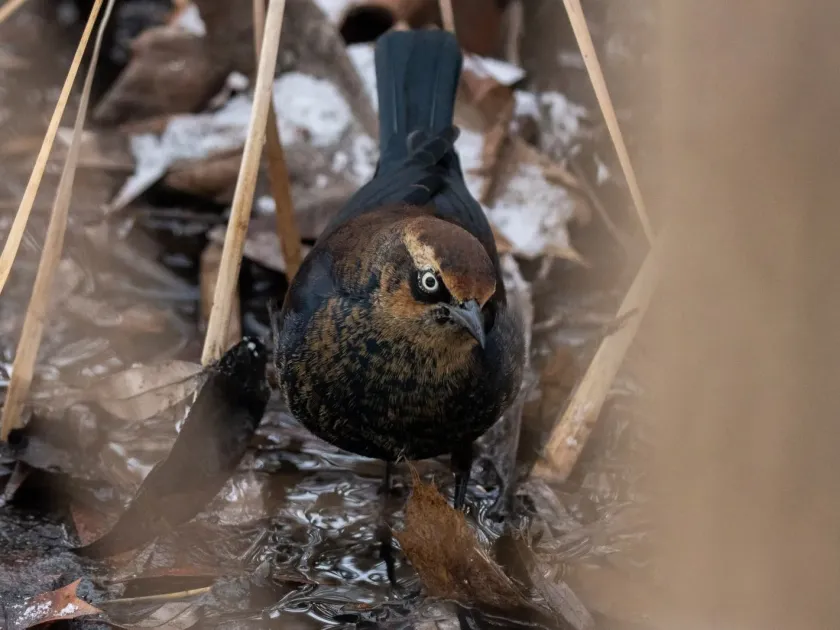
The Rusty Blackbird (Euphagus carolinus) is a medium-sized passerine bird belonging to the Icteridae family. Males in breeding plumage are characterized by glossy black feathers with distinct green or purple iridescence.
During the non-breeding season, the plumage of the males exhibits wide rusty-brown edges on the feathers, which is the primary reason for the common name of the species. Females are generally more uniform in color, featuring grayish-brown tones.
A distinctive feature of the adult bird is its piercing yellow iris, which is visible even at a distance. The bill is sharp, slender, and straight, designed for foraging on the ground and gleaning insects or seeds.
These birds are known for their strong flocking behavior. They often forage in groups, which makes them highly noticeable when they descend onto agricultural lands to feed on ripening crops.
Field identification involves noting their peculiar, harsh, and creaking vocalizations. Being highly social, their calls help the flock coordinate movements and remain alerted to potential threats.
What it damages
The primary agricultural concern with the Rusty Blackbird involves the damage caused to ripening grain crops, including wheat, barley, oats, and especially corn (maize) during the milk and dough stages.
Birds cause direct loss by consuming grains directly from the spike, cob, or panicle. This reduces both the yield quantity and the overall market quality of the harvested produce.
Significant mechanical damage is also caused by the weight of large flocks landing on crops, which leads to lodging and flattening of plants, complicating mechanized harvesting operations.
During the spring planting season, they pose a threat to emerging corn seedlings. They forage by pulling out the newly germinated seeds, resulting in thin stands and the necessity for costly replanting.
- Winter wheat and spring barley
- Corn for grain and silage
- Oats and millet
- Vegetable crops in humid areas
When it appears
The presence of the Rusty Blackbird in agricultural areas is largely dictated by their migration patterns. The most critical periods for farmers are early spring and late summer to autumn.
In spring, when natural food sources like forest insects and berries are scarce, the birds shift their attention to the protein-rich seeds available in newly sown agricultural fields.
Autumn marks a period when birds gather in massive flocks to prepare for migration. During this phase, they spend a considerable amount of time foraging in fields that are nearing harvest.
Weather conditions significantly impact their migration timing. A mild autumn may delay their departure, prolonging the duration during which crops are exposed to foraging pressure.
Continuous monitoring during these peak seasons is essential. Recognizing the arrival of a flock early allows for the timely deployment of non-lethal deterrents to save the crop.
Signs of infestation
Signs of an infestation include damaged grain heads where seeds are partially or completely missing. The affected heads often look shredded or appear unevenly picked.
On corn fields, birds tear apart the husks to reach the kernels on the cob. Feces and footprints found on the soil in the vicinity of these plants are common indicators of a recent visit by a flock.
A noticeable reduction in plant density in specific areas, coupled with visible uprooted seedlings, strongly points to bird predation during the germination phase.
The noise level generated by a large foraging flock is unmistakable. If the fields are consistently noisy during the early morning or evening hours, it is a sign of heavy bird activity.
Farmers may observe that the damage is often concentrated on the perimeter of the field, especially in sections adjacent to water sources or wooded cover, which provide safe havens for the birds.
Control measures
Visual deterrents such as holographic tapes, motion-activated scarecrows, and predatory bird decoys are highly recommended for initial crop protection.
Acoustic deterrents that utilize intermittent alarm calls or recorded predator sounds are effective in disrupting the birds' feeding patterns and encouraging them to leave the area.
Agronomic management includes optimal planting scheduling, aiming to avoid having vulnerable plant stages align with the bird's peak migration and feeding windows.
Treating seeds with specialized bird-repellent compounds can be effective during the spring planting season, making the seeds unpalatable and discouraging the birds from digging them up.
Habitat management is crucial; removing brush and tall weeds along field edges reduces the hiding spots and perching sites that birds utilize while scouting for food in the fields.
Taxonomy
- Latin name
- Euphagus carolinus
- Family
- Icteridae
- EPPO code
- EUPACA
Discussion
No discussions yet — be the first.