
Orioles
Icterus
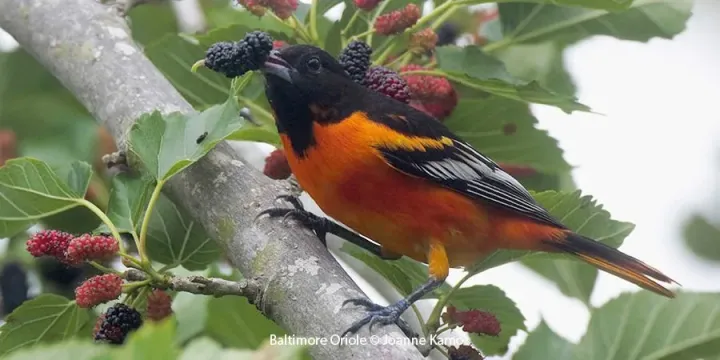
Description
How to identify
The genus Icterus, commonly known as orioles, belongs to the family Icteridae and is recognized by their vivid yellow, orange, and black plumage.
They possess sharp, conical bills which are highly effective for both insect hunting and extracting seeds or fruit pulp from agricultural crops.
These birds are primarily arboreal, often building intricately woven nests in high tree branches adjacent to orchards and fields.
Sexual dimorphism is common within the genus, with males displaying vibrant, contrasting colors while females maintain more cryptic, olive-toned patterns.
Orioles exhibit gregarious behavior after the breeding season, forming flocks that can rapidly descend upon ripening agricultural fields.
What it damages
Orioles cause significant economic losses by damaging various crops, particularly cereals, corn, and succulent fruits like berries and stone fruits.
In cornfields, they strip the husks of ripening ears, exposing the kernels to rot and secondary fungal infections, rendering the crop unmarketable.
In vineyards and orchards, they puncture the skins of fruits, which causes the fruit to spoil quickly and invites secondary insect infestation.
Grain crops are particularly vulnerable during the milk-to-dough stage, when orioles can consume a considerable portion of the harvest.
- Destruction of corn ears during the ripening phase.
- Consumption of grain in wheat and barley fields.
- Damage to fruit skin leading to decay.
When it appears
The highest level of crop damage occurs during the peak ripening season of cereals and fruits, typically concentrated in the summer months.
Post-breeding season, the emergence of juveniles from nests leads to increased pressure as larger groups forage for food.
The dawn and dusk hours are characterized by intense foraging activity, as flocks move in search of high-energy food sources.
Migration patterns of specific oriole species can increase population density in agricultural areas during critical growth stages of local crops.
Weather conditions, such as drought or early harvest seasons, can force these birds to concentrate their feeding on irrigated agricultural zones.
Signs of infestation
Distinctive signs of infestation include torn husks on corn ears and shredded edges on leaves surrounding the damaged fruit clusters.
Empty stalks and missing kernels in wheat spikes are clear indicators of avian damage compared to standard development issues.
Fecal matter accumulation on branches and the ground underneath nesting or feeding trees provides evidence of long-term bird presence.
Rapid onset of rot in fruit bunches is frequently associated with the puncture wounds left by the sharp, pointed bills of these birds.
Increased vocalization and social interaction within the canopy often precede and accompany their feeding raids on nearby produce.
Control measures
Acoustic deterrents, such as electronic bird repellers and distress call broadcasters, are highly effective at discouraging orioles from entering fields.
Physical exclusion methods like netting are recommended for high-value fruit crops to prevent any physical access to the harvest.
Reflective surfaces, bird-scare kites, and inflatable figures provide visual deterrence that can be rotated to prevent bird habituation.
Rapid harvesting and avoiding delayed field processing are crucial agricultural practices to minimize the time crops are susceptible to birds.
Managing the habitat surrounding fields, including trimming overgrown vegetation, can reduce nesting sites and lessen local population pressure.
Taxonomy
- Latin name
- Icterus
- Family
- Icteridae
- EPPO code
- ICTESP
Discussion
No discussions yet — be the first.