
Brewer's blackbird
Euphagus cyanocephalus
Description
How to identify
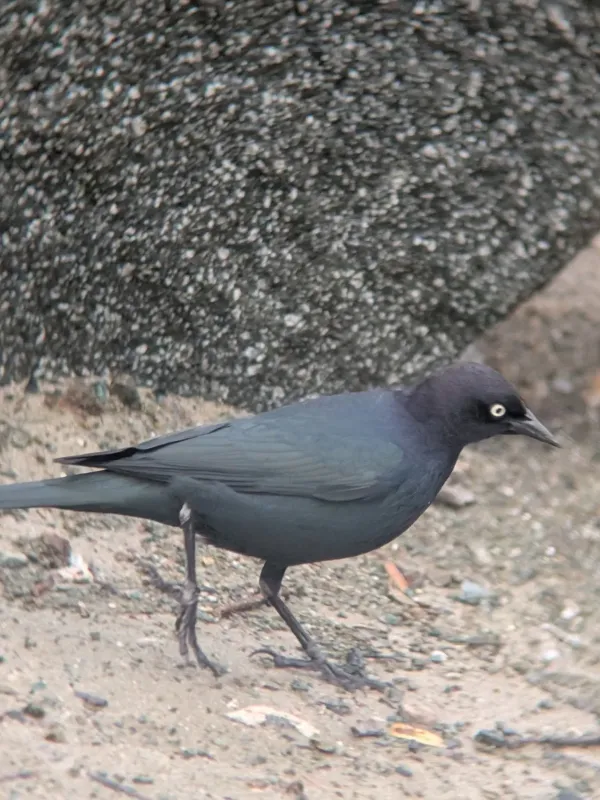
The Brewer's blackbird (Euphagus cyanocephalus) is a member of the Icteridae family within the order Passeriformes. Adult males are distinguished by their black plumage, which displays iridescent blue-green and violet reflections under direct light.
Females exhibit a more subdued, brownish-grey appearance compared to males. A distinct feature for both sexes is their sharp, bright yellow eyes, which serve as a primary identification mark when observing these birds in the field.
Measuring approximately 20-25 centimeters in length, these birds are highly social and gregarious. They are frequently found in large, mixed-species flocks, particularly outside of the breeding season when they congregate on farmland.
Native to North America, the species has demonstrated high adaptability to human-altered landscapes. This flexibility allows them to exploit agricultural resources efficiently, making them a recurring concern for crop management.
Their behavior is characterized by high agility and opportunistic foraging. They are quick to locate new food sources and can memorize field patterns, which makes long-term population management challenging for agricultural producers.
What it damages
Brewer's blackbirds cause significant economic loss by consuming seeds during the sowing stage and shortly after germination. By extracting seeds from the soil, they directly reduce the stand density of grain crops.
Cereal crops like wheat and corn are particularly vulnerable during the milk stage of grain development. The birds peel back husks or pierce the kernels, which leads to total loss of the grain and promotes secondary rot and fungal infections.
Sunflower crops also suffer from Brewer's blackbird activity. The birds target the flower heads, pecking out seeds and rendering the harvest less viable, often requiring the use of specialized protection measures.
Beyond seed consumption, the sheer size of foraging flocks leads to trampling of tender seedlings. This mechanical damage disrupts crop uniformity and provides opportunities for weed encroachment in areas where the crop cover is compromised.
The cumulative effect of these losses can be severe in regions with high population densities. Farmers may often experience significant yield gaps in specific parts of their fields where the birds concentrate their feeding efforts.
When it appears
The risk is highest during the spring planting season when seeds are easily accessible. Early-season damage is critical, as it can necessitate the replanting of large sections of the field, leading to increased production costs.
As summer progresses, the birds shift their attention to maturing grains. The period of grain filling is the most sensitive time, as the birds actively seek moisture and nutrients provided by developing seeds.
During the autumn, birds form larger flocks prior to migration. In this phase, they may feed on late-harvested crops or post-harvest residue, which can still impact overall field management and sanitation practices.
Winter activity varies by latitude. In some regions, they remain near livestock operations, where they may contaminate feed supplies and increase the risk of disease transmission among domestic animals.
Weather patterns heavily dictate the severity and timing of the bird's impact. Extended cold or wet periods may delay their movement to natural foraging grounds, keeping them in agricultural fields for longer durations.
Control measures
Visual deterrents, such as raptor decoys, holographic tape, and dynamic wind-driven scarecrows, can be effective. To maintain effectiveness, these devices must be moved or rotated frequently to prevent habituation.
Acoustic deterrent systems, including automated bird distress calls, are useful on large-scale farms. The randomized timing and frequency of these sounds are essential to ensure the birds do not grow accustomed to the disturbances.
Cultural control methods involve ensuring proper soil coverage and sowing depth. Ensuring that seeds are buried well below the surface significantly reduces the birds' ability to find and remove them.
- Applying taste-aversion treatments to seeds before planting.
- Utilizing propane-powered noise cannons during peak ripening stages.
- Maintaining clean field borders to remove cover where birds rest.
An integrated pest management (IPM) approach is vital. By combining multiple deterrence techniques and modifying field conditions, producers can create an environment that is less attractive to these birds, effectively minimizing crop damage.
Taxonomy
- Latin name
- Euphagus cyanocephalus
- Family
- Icteridae
- EPPO code
- EUPACY
Discussion
No discussions yet — be the first.