
Red-billed quelea
Quelea quelea
Description
How to identify
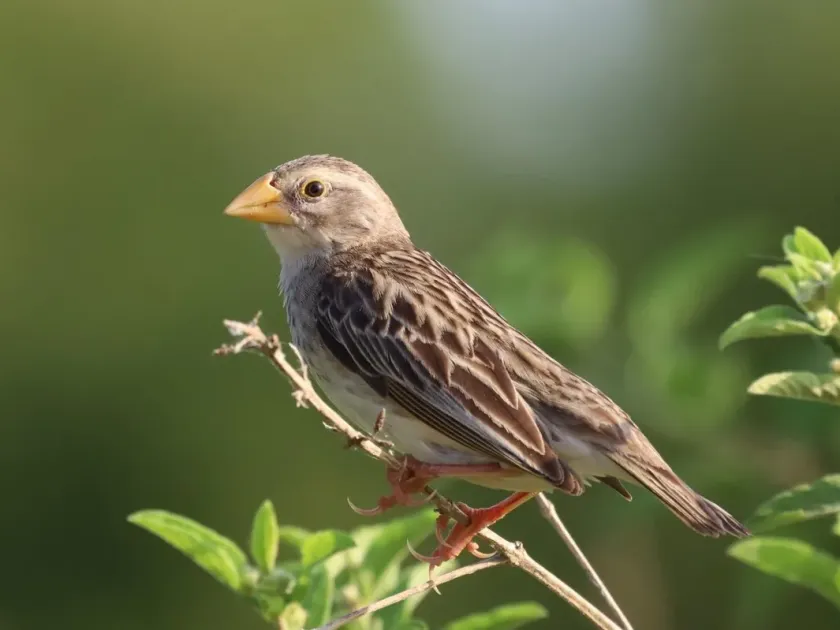
The red-billed quelea (Quelea quelea) is a small, sparrow-like bird belonging to the family Ploceidae. It is easily identified by its distinctive, bright red bill, which serves as its primary diagnostic feature.
During the breeding season, males develop a dark black facial mask and a pinkish wash on their breasts. Females and juveniles exhibit more cryptic, brownish plumage, which provides essential camouflage in the dry scrublands and savannas they inhabit.
This species is globally recognized for its massive colonial lifestyle. They move, roost, and nest in flocks of millions, making them the most abundant wild bird species on Earth by a significant margin.
Their biology is inextricably linked to rainfall patterns. They are opportunistic nomads, constantly shifting their range across sub-Saharan Africa to track the availability of seeds and water sources.
The species exhibits a rapid life history, reaching sexual maturity within a single year and possessing a short incubation period, which allows for explosive population growth when environmental conditions are optimal.
What it damages
While the red-billed quelea primarily feeds on the seeds of wild grasses, agricultural expansion has made it a severe pest. They frequently descend upon cereal crops, causing extensive economic damage.
Small-grained crops such as sorghum, millet, and wheat are the most vulnerable. A single flock of millions can devastate a harvest within hours, often leaving fields completely stripped of grains.
Beyond direct consumption, the sheer weight of these massive flocks causes significant mechanical damage to plants. Thousands of birds landing on a small area of crop lead to bent or broken stems, rendering the field unsuitable for mechanical harvesting.
In many regions of sub-Saharan Africa, the quelea is viewed as a primary threat to food security, capable of causing yield losses ranging from 30% to over 50% in affected areas.
Additionally, the accumulation of guano on crops can lead to secondary infections and fungal diseases, further reducing the market value and storage quality of the harvested grain.
When it appears
The activity and threat level of the red-billed quelea are strictly dictated by the crop phenology and the timing of the rainy seasons throughout its range.
The most critical window of vulnerability occurs during the milk and dough stages of grain development, which attract foraging flocks from vast distances to irrigated farmlands.
After the harvest season, the birds initiate large-scale migrations to search for new seed sources, moving across regional and national borders in highly unpredictable patterns.
Nesting typically coincides with the onset of the rains, when the surge in insect availability provides the necessary protein for chick rearing, a phase that precedes their mass foraging movements.
Monitoring migration routes and nesting colonies is essential for early warning systems, although the mobility of the species makes predicting their exact arrival a complex agronomical challenge.
Signs of infestation
The most prominent sign of a quelea invasion is the appearance of enormous, cloud-like flocks that create an overwhelming sound over the fields during dawn and dusk.
Upon closer inspection, fields show clear damage such as empty, pecked-out grain heads or panicles, with almost nothing left but the bare husk of the plants.
Widespread lodging of the crop, where plants are flattened against the ground, indicates the weight of large roosting groups that gathered on the stems during the night.
Significant white guano deposits on leaves, stems, and soil indicate high traffic areas, which can alter soil chemistry and leave the crop vulnerable to opportunistic pathogens.
- Complete removal of grain from sorghum or millet panicles.
- Flattened or broken crop stems throughout the field.
- Intense vocalizations and bird activity at dawn and dusk.
- White, chalky guano deposits covering the crop canopy.
Control measures
Managing the red-billed quelea requires large-scale, often inter-governmental cooperation due to the birds' ability to move across wide landscapes regardless of human boundaries.
The most common and effective large-scale control method involves aerial spraying of roosting and nesting colonies with specialized avicides, which can significantly reduce local populations.
On a local farm level, farmers employ protective measures such as the use of acoustic scarecrows, reflective ribbons, and netting, though these are often insufficient against massive migratory waves.
Agronomic strategies include adjusting planting dates to ensure that the vulnerable ripening stage of the grain does not overlap with the peak migratory activity of the local quelea populations.
Future control strategies are focusing on integrated pest management (IPM), including the use of satellite imagery to track flock movements and the development of more environmentally targeted deterrents.
Taxonomy
- Latin name
- Quelea quelea
- Family
- Ploceidae
- EPPO code
- QUELQU
Discussion
No discussions yet — be the first.