
Village weaver
Ploceus cucullatus
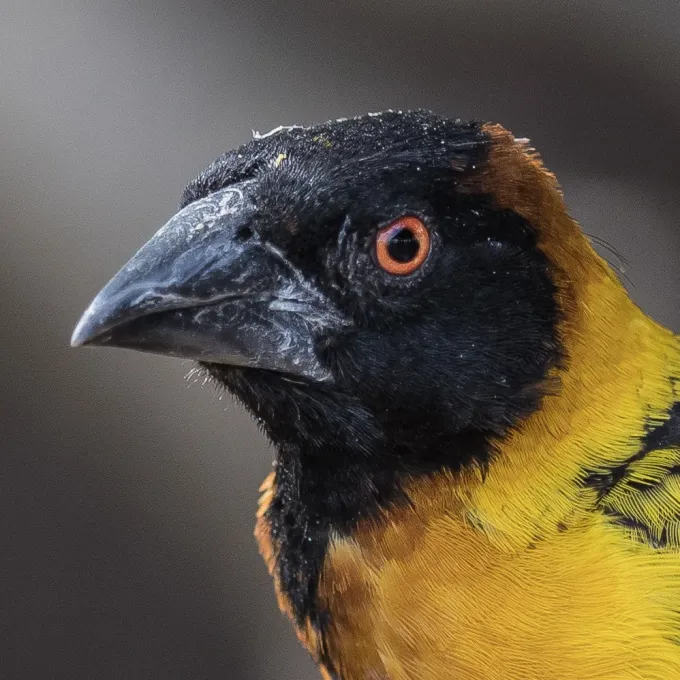
Description
How to identify
The Village Weaver (Ploceus cucullatus) is a member of the weaverbird family (Ploceidae), known for its complex social behavior and colonial nesting habits.
Breeding males are characterized by a vibrant black mask on the face, a yellow body, and a patterned back, which distinguishes them during the mating season.
Females and non-breeding males possess a more subdued olive-brown appearance, providing effective camouflage while foraging or nesting in dense foliage.
These birds construct intricate, hanging nests woven from strips of leaves and grass, often creating massive colonies in trees adjacent to agricultural fields.
They are highly gregarious and communicate with loud, distinctive calls, making large colonies very easy to locate in rural landscapes.
What it damages
The Village Weaver is a significant agricultural pest, particularly known for causing extensive damage to cereal crops such as sorghum, millet, maize, and rice.
Large flocks swarm into fields, feeding on the developing grains during the milk and dough stages, often destroying a substantial percentage of the harvest.
Beyond direct grain consumption, the birds physically damage stalks and seed heads, which can lead to increased vulnerability to secondary fungal infections.
In many regions, their presence in dense colonies near farmlands makes them one of the most destructive avian threats to local food security.
Farmers often suffer severe economic losses due to the birds' ability to rapidly strip fields of their mature grain crops before harvesting can occur.
When it appears
The severity of pest pressure from the Village Weaver is largely dictated by the growth stages of cereal crops and the local rainy seasons.
During the breeding phase, the birds congregate in large numbers, and their demand for food peaks when they are raising their young in the colonies.
As grain crops reach maturation, flocks migrate toward these accessible food sources, shifting their diet to focus on the ripening agricultural output.
The migratory patterns and local movements of these birds are heavily influenced by the availability of nesting sites and optimal foraging grounds.
High infestation levels usually coincide with the harvest period, creating a race between the farmers trying to collect crops and the birds feeding on them.
Signs of infestation
A primary indicator of a Village Weaver presence is the loud, persistent chattering of a large colony, which can be heard from a significant distance.
Signs of damage in fields include partially eaten grain heads, stripped maize cobs, and broken stems caused by the weight of the flock landing on the crops.
The presence of abandoned or active woven nests hanging from branches near the fields serves as a clear warning of potential infestation risks.
Accumulated bird droppings and physical damage to the surrounding vegetation provide further evidence of high avian activity in the area.
- Stripped cereal panicles and heads.
- Ragged damage to maize kernels.
- Flattened or broken crop stems.
- Complex woven nests in nearby canopy trees.
- Large flocks hovering over fields at dawn and dusk.
Control measures
Controlling Village Weaver populations often requires a combination of non-lethal deterrent methods to protect valuable agricultural outputs.
Acoustic deterrents, such as recorded alarm calls or predatory bird sounds, are frequently used to disrupt and displace flocks from crop fields.
Mechanical protection, including netting for small-scale plots and physical guarding, can significantly reduce the impact of bird raids on the crop.
Targeted removal of nesting sites through canopy management and tree trimming can discourage colonies from settling near active farmlands.
Prioritizing early harvesting of crops whenever feasible is a critical strategic move to mitigate the window of opportunity for these avian pests.
Taxonomy
- Latin name
- Ploceus cucullatus
- Family
- Ploceidae
- EPPO code
- HPHAAB
Discussion
No discussions yet — be the first.