
Ruppell's weaver
Ploceus galbula
Description
How to identify
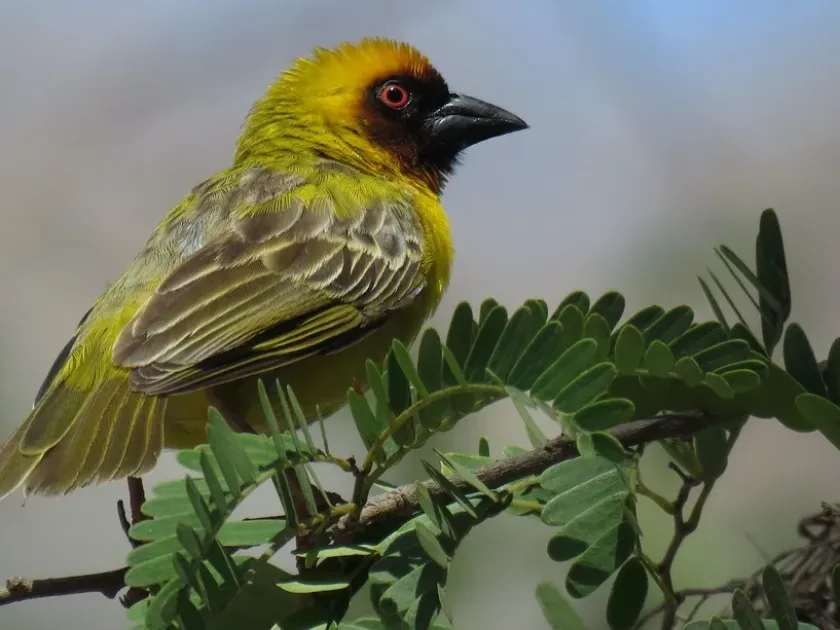
The Ruppell's weaver (Ploceus galbula) is a small passerine bird in the weaver family (Ploceidae). Adult males in breeding plumage are characterized by bright yellow heads and chests, making them distinct from other similar species in the area.
These birds possess a stout, conical bill specifically evolved for husking seeds, which makes them highly efficient at consuming grains. Females and non-breeding males exhibit duller, olive-brown plumage that provides excellent camouflage in dense grasslands.
The species is highly social and typically congregates in noisy, active colonies. Their presence is easily detected by the constant vocalizations of flocking individuals moving across agricultural landscapes in search of sustenance.
The nests are complex woven structures suspended from branches, often located in trees or shrubbery near agricultural land. The construction of these nests requires significant amounts of leaf fibers, often harvested directly from the surrounding crop fields.
Being adapted to semi-arid regions, the Ruppell's weaver exhibits high flexibility in its nesting and feeding habits. This allows the population to persist in agricultural zones where steady food supplies are available throughout the year.
What it damages
The primary economic impact of the Ruppell's weaver is the consumption of ripening grains, particularly during the milk and dough stages. Flocks of birds can descend upon a field, stripping the grain from the stalks with high efficiency.
Key agricultural crops threatened by these birds include pearl millet, sorghum, and wheat. The birds preferentially select the most nutrient-rich seeds, which directly translates into reduced yields for the farmer.
Beyond feeding, the physical weight of large flocks landing on crops causes significant damage. The birds bend and break stalks, which makes the affected grain difficult or impossible to harvest using standard mechanical equipment.
The loss of grain due to bird foraging leads to a decrease in overall crop quality. Furthermore, the shattered grains falling to the ground after bird attacks may lead to increased volunteer weed germination in subsequent seasons.
In regions where weaver population density is high, crop losses can become severe, significantly impacting the financial stability of the farm. Controlling these birds is essential for protecting the integrity of the grain supply.
When it appears
Ruppell's weaver activity is closely tied to the phenology of cereal crops. The arrival of birds in large numbers typically coincides with the maturation phase when the grain becomes accessible and soft enough for the birds to consume.
Breeding cycles of the weaver also influence their presence. During the nesting season, the increased demand for energy leads to higher foraging pressure on nearby fields as parent birds gather food for their chicks.
Migration patterns can cause the birds to appear suddenly in agricultural areas. Monitoring the specific timing of grain maturation is crucial for predicting when the weavers will pose the highest risk to the fields.
Climate conditions also play a role in the duration of the foraging period. Prolonged droughts can force weaver flocks to rely more heavily on irrigated or lush agricultural fields as native food sources become exhausted.
Agronomists should track the first sightings of weaver flocks near the farm perimeter. Early warnings allow for the deployment of deterrents before the birds settle into a established feeding pattern.
Signs of infestation
Visible signs of infestation include partially eaten heads of grain, where only the empty chaff remains on the stalks. The ragged edges of the grain clusters often distinguish bird feeding from the more systematic damage of rodents.
Large amounts of avian excrement found on the leaves and stems within a localized area indicate a favorite feeding ground. The birds often return to the same patches of the field repeatedly until the supply is exhausted.
Flat, trampled patches within a standing crop indicate areas where large numbers of birds have roosted or fed. These depressions in the crop canopy are clear indicators that the flock is causing physical destruction.
The discovery of woven nests in nearby trees or hedge rows is a definitive sign of resident weaver activity. High concentrations of nests suggest the potential for sustained and repeated attacks on the crops throughout the growth cycle.
Leftover plant fiber fragments collected from crops to build nests can be found scattered along the field edges. This material harvesting can lead to a thinning of the foliage on the periphery of the cultivated area.
Control measures
Acoustic deterrents, such as propane cannons and sound systems playing distress calls, are the most common tools for large-scale field protection. Rotating sound patterns is necessary to prevent birds from becoming habituated.
Visual deterrents, including hawk kites, reflective ribbons, and flashing lights, help protect specific, highly vulnerable areas of the field. These should be moved periodically to maintain their effectiveness as perceived threats.
Cultural methods include selecting early-maturing crop varieties to shift the harvest time before the birds arrive in peak numbers. Additionally, keeping the fields uniform and well-managed can help reduce the attractiveness of the crop.
Encouraging natural predators, such as local raptor species, by preserving nesting sites in surrounding ecosystems provides long-term biological control. A healthy ecosystem is a powerful ally in minimizing weaver population spikes.
For small-scale high-value plots, bird-proof netting is the most effective safeguard. While labor-intensive, it provides a physical barrier that completely excludes the weavers from the crop area during the critical maturation phase.
Taxonomy
- Latin name
- Ploceus galbula
- Family
- Ploceidae
- EPPO code
- HPHAGA
Discussion
No discussions yet — be the first.