
Sociable weaver
Philetairus socius
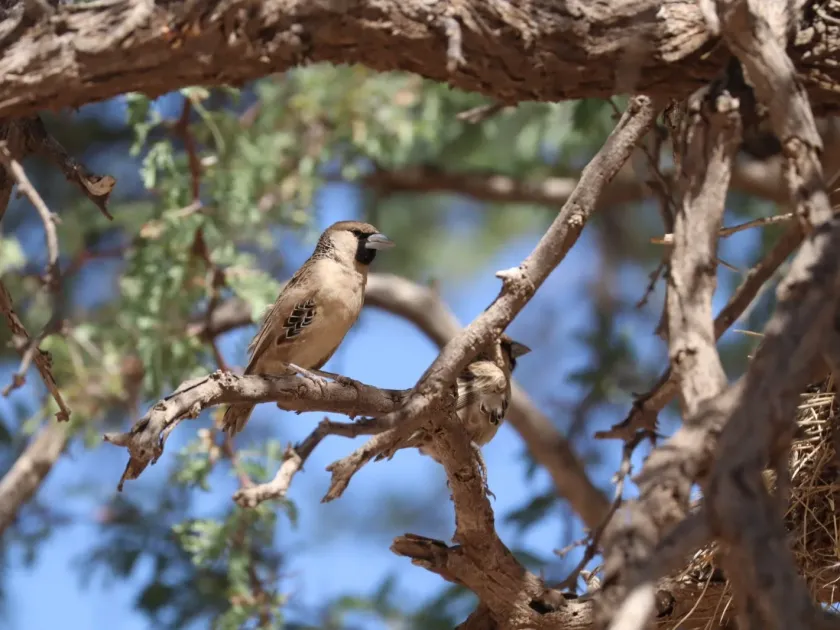
Description
How to identify
The sociable weaver (Philetairus socius) is a bird species of the Passeriformes order and the Ploceidae family. These birds are famous for their remarkable social structures and cooperative behavior.
Morphologically, they are small birds with brownish-grey plumage, perfectly adapted for life in arid regions where they rely on camouflage to avoid potential predators.
The most distinctive identification feature is their colossal nest. These structures are built in trees or on utility poles and can reach massive dimensions, often housing dozens of breeding pairs.
These colonial nests provide a stable environment, protecting the birds from temperature fluctuations, which explains their successful colonization of harsh semi-desert habitats.
The birds are highly organized, living in cohesive groups that communicate and coordinate their activities, which directly affects how they interact with agricultural environments.
What it damages
As agricultural pests, sociable weavers cause damage primarily by feeding on cultivated grains. Their impact can be devastating for localized farming communities.
They target crops such as millet, sorghum, and wheat during the ripening phase. Large flocks can consume or destroy a significant portion of the harvest in a short period.
The physical damage includes not only the consumption of seeds but also trampling. As birds land on crops in large numbers, the stems are often broken, leading to lodging and harvest loss.
Infrastructure damage is another critical issue. Their heavy nests on power lines or telecommunication masts can cause electrical failures and structural damage, impacting farm operations.
The intensity of the damage often correlates with the distance of the field to the nesting colony. Proximity to these nests significantly increases the risk of total crop failure.
Signs of infestation
The most obvious sign of presence is the massive hay-like nesting structure visible on nearby trees, poles, or man-made structures. These nests are unmistakable and very large.
Observation of fields reveals empty seed heads or damaged kernels, often accompanied by the presence of large, noisy flocks moving in a coordinated fashion between feeding grounds.
Stems of the grain crops may appear bent or broken in specific patches where the flock has gathered to forage, leaving a clear trail of agricultural destruction.
Increased activity around water sources during hot hours, combined with an audible chatter, indicates that a large colony is utilizing the immediate area for feeding.
A high density of bird droppings under surrounding vegetation or near nesting sites serves as a clear indication of a significant population settling in the vicinity.
Control measures
Controlling sociable weavers requires a strategic approach that focuses on prevention rather than extermination, given their importance to the ecosystem.
Acoustic deterrents are frequently used. By emitting distress calls or predator sounds, farmers can often discourage flocks from landing on sensitive grain fields during harvest time.
Visual deterrents, including hawk kites or reflective strips, provide temporary relief. However, because these birds are intelligent, these tools must be rotated or changed frequently to maintain effectiveness.
Agronomic planning is vital; farmers often adjust planting times to ensure that the susceptible stages of crop development do not overlap with the peak activity of the weaver colonies.
Clearing potential nesting sites, such as isolated trees near crop fields, or installing bird-resistant mesh on infrastructure are common physical methods to mitigate their impact on farm productivity.
Taxonomy
- Latin name
- Philetairus socius
- Family
- Ploceidae
- EPPO code
- PHITSO
Discussion
No discussions yet — be the first.