
Lesser masked weaver
Ploceus intermedius
Description
How to identify
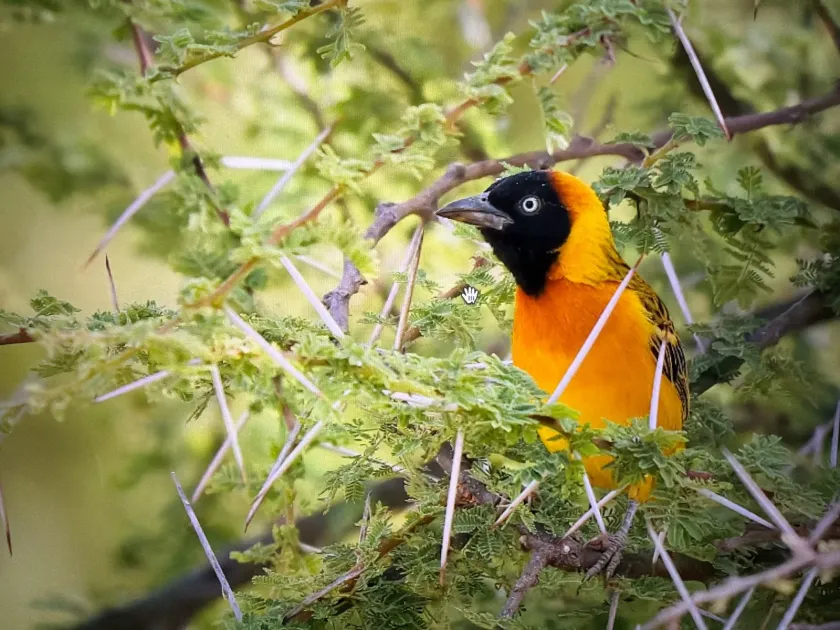
The lesser masked weaver (lat. Ploceus intermedius) is a bird species belonging to the Passeriformes order and the Ploceidae family. Males in breeding plumage are easily identified by their black facial mask, which extends from the forehead to the throat, set against bright yellow body plumage.
These birds possess a stout, conical beak that is highly specialized for crushing seeds and grains. While males are strikingly colored, females and juveniles display duller, brownish-olive tones, providing them with excellent camouflage in their native African habitats.
Lesser masked weavers are gregarious birds that nest in large, noisy colonies. Their social behavior allows them to forage in massive flocks, which creates a significant challenge for farmers working in the affected regions.
Biological adaptation to social living has enabled them to thrive in human-altered landscapes. Their ability to move rapidly between fields allows them to exploit food resources efficiently, often leading to heavy crop depletion in a very short time.
Understanding their territorial and feeding habits is essential for effective pest management. Their high activity levels during the reproductive season necessitate proactive monitoring of all vulnerable agricultural crops nearby.
What it damages
This species primarily feeds on cereal crops, such as sorghum, millet, and maize, particularly during the milky and dough stages of grain development. They consume the grains directly from the heads, causing substantial yield reductions.
Beyond direct grain consumption, the weight of a large flock landing on crops can cause severe lodging and stem breakage. This makes mechanical harvesting difficult and leads to further post-harvest losses and quality degradation.
During the sowing season, these birds are known to dig up and consume seeds from the soil surface, causing thin plant stands. This often requires replanting efforts, which increases overall farm operational costs and delays crop cycles.
In orchards, weaver birds may target young buds and shoots, especially during periods when their primary food sources are scarce. This can weaken the plants and reduce overall vegetative growth during the critical early stages.
Economic damage is most severe when large nesting colonies are located in close proximity to large commercial grain fields. Without intervention, these birds can cause significant financial losses to farmers in their native range.
When it appears
The peak activity of the lesser masked weaver occurs during the reproductive stages of host plants. The timing of their infestation usually correlates with the maturation of grain crops, as the soft, high-energy grains are most palatable to them.
In tropical climates, the breeding season often coincides with the onset of the rains. This is when the birds form large colonies and search for abundant food sources to support their rapidly growing offspring.
After the harvest, their impact on the fields diminishes. However, they continue to forage on grain stubble and weed seeds, ensuring their populations remain robust enough to return for the following planting season.
Monitoring must be intensified during the transition from the flowering stage to the grain-filling stage of maize and sorghum. This is when the crops are at their most vulnerable to avian attacks.
Weather variations can impact the crop maturation timeline, potentially misaligning the birds' migration patterns. Farmers must stay alert to local phenological shifts to prepare for potential incoming flocks.
Signs of infestation
The most evident sign of damage is the presence of hollowed-out or partially eaten grain heads. Careful inspection will show jagged edges on the glumes and shells of the seeds where the birds have pecked them.
Areas of the field that appear flattened or trampled are strong indicators of weaver activity. These sections are where flocks have rested and fed, causing significant physical structural damage to the standing crops.
The presence of pendulous, woven nests in nearby trees is a direct indicator that a colony is established. High concentrations of guano beneath these trees further confirm the density of the bird population in the area.
Auditory cues, such as the constant chattering and noise produced by a large flock, often signal their arrival before visual damage becomes obvious. Flocks often move in waves, feeding aggressively during the early morning and late afternoon.
Grain shedding is a typical result of their feeding behavior. If you notice a high concentration of kernels on the ground beneath the plant stalks, it is likely that weaver birds have been actively foraging in that area.
Control measures
The most effective strategy is the use of integrated pest management (IPM) techniques. This includes the use of acoustic devices that emit alarm calls or distress signals, which can keep flocks away from the fields.
Visual deterrents, such as reflective tapes, scarecrows, or eye-spot balloons, can provide temporary relief. However, these must be rotated frequently to prevent the birds from habituating to the presence of the deterrents.
Agricultural practice management, such as removing nesting trees or dense bushes near field borders, is crucial for long-term population control. Reducing the available nesting habitat makes the area significantly less attractive to the species.
Selecting varieties that are naturally more resistant, such as those with thicker glumes or awns, can deter feeding attempts. These physical barriers make it more difficult for the birds to reach the grain kernel.
- Deployment of bio-acoustic bird deterrents;
- Removal of nesting habitats around field edges;
- Strategic timing of planting to avoid peak bird activity;
- Use of netting for high-value small-scale crops.
Taxonomy
- Latin name
- Ploceus intermedius
- Family
- Ploceidae
- EPPO code
- PLOCIN
Discussion
No discussions yet — be the first.