
Streaked weaver
Ploceus manyar
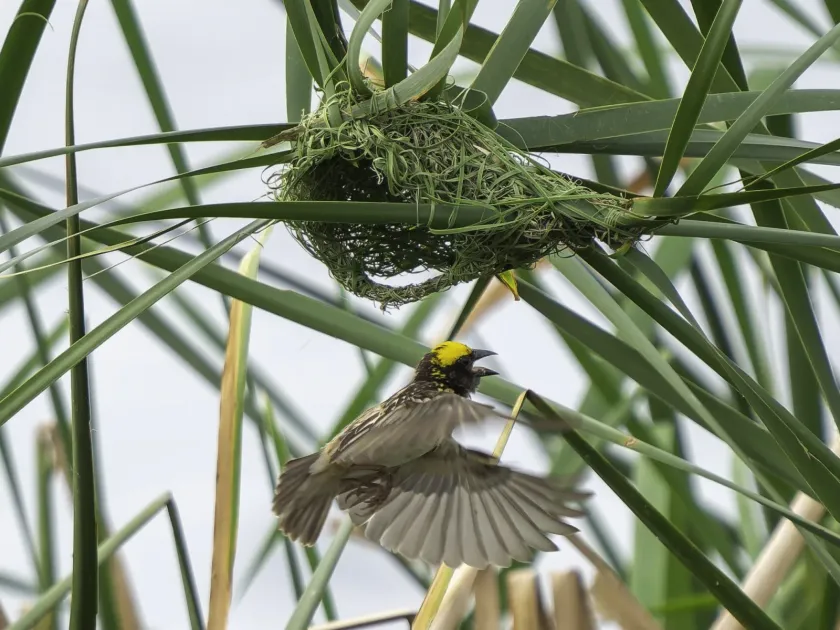
Description
How to identify
The streaked weaver (Ploceus manyar) is a small passerine bird belonging to the Ploceidae family. Known for their social nature, these birds are particularly famous for their elaborate, flask-shaped woven nests that they construct with great precision.
Males in breeding plumage are characterized by a bright yellow crown and a dark mask, making them easily identifiable. Females and non-breeding males possess a more cryptic, streaked appearance, which helps them blend into the grassland habitats they frequent.
These birds are highly intelligent and adapt their nesting habits to the environment, often choosing sites over water or within dense vegetation to protect their young from predators. They live in large colonies, exhibiting high levels of social cooperation.
The streaked weaver is a diurnal species, spending most of its daylight hours searching for seeds and grains. Their activity patterns are strictly governed by the need to secure food, making them frequent visitors to agricultural fields.
Their distribution covers various parts of South and Southeast Asia, where their interaction with human-cultivated crops has led to their classification as agricultural pests in many regions.
What it damages
The primary economic impact of the streaked weaver is the destruction of cereal crops, particularly rice, during the milky and dough stages of grain development. They consume the soft, nutritious seeds, causing significant yield losses.
Beyond rice, they are known to damage sorghum, millet, and other small-grain crops. A single colony can decimate a significant portion of a field in a matter of days due to their feeding habits and large population numbers.
Physical damage to the crop occurs not only through feeding but also through the collective weight of the flock landing on the plants, which causes lodging, broken stems, and premature flattening of the crop.
The birds also shred the leaves of cereal plants to obtain building materials for their complex nests. This defoliation reduces the photosynthetic capacity of the plants, ultimately stunting their growth and reducing overall harvest quality.
In regions with high agricultural density, the cumulative impact of these birds can significantly lower profit margins for smallholder farmers, necessitating the implementation of proactive bird management strategies.
When it appears
The threat from streaked weavers is highest during the crop's reproductive phase, specifically from the flowering stage until the grains are fully hardened. This period is when the crops are most vulnerable to avian feeding.
The breeding season of the weavers often correlates with local monsoon patterns, which also aligns with the availability of abundant food sources. As the nestlings grow, the demand for food increases, leading to more frequent raids on agricultural fields.
After the harvest, the flocks tend to move away from agricultural areas to forage in wild grasslands and marshes, waiting for the next planting season to return to human-cultivated fields.
Farmers should monitor the bird's presence carefully during the weeks leading up to the harvest, as the population density can spike unexpectedly if conditions are favorable for their colony expansion.
Early identification of nesting colonies in the surrounding areas can help predict the intensity of the incoming damage, allowing farmers to prepare protective measures well in advance.
Signs of infestation
A key indicator of a streaked weaver presence is the appearance of empty, shredded panicles on rice or sorghum plants. The grain is typically neatly removed, leaving the hulls behind on the plant.
The presence of hanging, flask-like nests in nearby bushes, palm trees, or reeds is the most definitive sign of a resident colony that will likely target the neighboring fields for food.
Observation of large, noisy flocks flying in a synchronized manner over the fields is a clear indicator that the birds have identified the area as a feeding ground.
Field lodging that occurs in patches rather than uniformly across the field often suggests the concentration of bird flocks in specific locations where they have spent significant time feeding.
Traces of nest-building activity, such as frayed leaf edges on nearby vegetation, serve as evidence of high weaver activity in the immediate vicinity of the cultivation zone.
Control measures
Visual deterrents such as reflective tapes, scarecrows, or models of predatory birds like hawks or owls are commonly used to create an environment of danger, effectively discouraging the birds from landing.
Acoustic deterrents, including the playback of predator sounds or distress calls, can be effective if the timing and frequency are varied to prevent the birds from becoming habituated to the sounds.
Physical protection through the use of netting or bird-proof screens is the most reliable method for small-scale operations or high-value breeding nurseries, ensuring total crop protection.
Agricultural management techniques involve synchronizing planting dates with neighboring farms to dilute the impact of bird raids, preventing one single field from becoming a focal point for the entire local weaver colony.
Managing the vegetation around the field, particularly clearing excessive tall grasses or reeds that provide nesting opportunities, is a long-term strategy to reduce the nesting potential of the area.
Taxonomy
- Latin name
- Ploceus manyar
- Family
- Ploceidae
- EPPO code
- PLOCMA
Discussion
No discussions yet — be the first.