
Red-billed quelea
Quelea
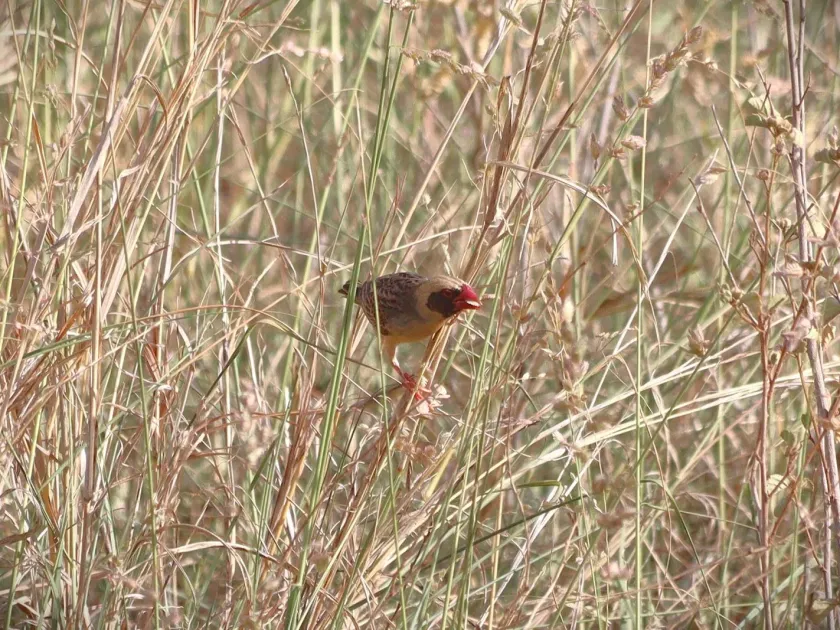
Description
How to identify
The red-billed quelea (Quelea quelea) is a small weaver bird native to sub-Saharan Africa. It is widely considered the most abundant wild bird species in the world, with a population estimated in the billions.
During the breeding season, males are easily identifiable by their black facial masks and bright red beaks, which give the species its common name. Females and non-breeding males have a more camouflaged, sparrow-like appearance.
These birds are highly gregarious and form massive colonies during the nesting season. Their social behavior is extreme, with individuals often nesting within centimeters of each other on thorny trees and bushes.
Their life cycle is remarkably short and fast-paced, allowing them to breed rapidly in response to rainfall and food availability. This high turnover contributes to their status as an incredibly resilient agricultural pest.
They are highly nomadic, constantly traveling across vast distances in search of seeding grasses. This constant movement makes predicting their arrival on farmland a significant challenge for agricultural management.
What it damages
The red-billed quelea is a primary pest of cereal crops, including wheat, sorghum, millet, and rice. They cause severe economic losses by feeding on the grain during its milky stage of development.
A single swarm, which can contain millions of birds, is capable of destroying an entire field of crops in a very short period. The sheer weight of a flock landing on a field can also cause significant physical damage to the plants.
Physical damage includes broken stalks and stems, which often prevents mechanized harvesting and lowers the overall yield and market quality of the remaining grain.
The cumulative effect of these birds on local food security is immense, particularly in regions where subsistence farming is the primary source of nutrition and income.
They target crops based on the phenological stage of the grain, moving from field to field as the crop ripens, effectively following the harvest progress across the landscape.
When it appears
Activity is dictated by the availability of food and the timing of the rainy season. Birds tend to congregate in agricultural areas as soon as cereal crops begin to reach maturity.
During the peak of the ripening season, the pressure from quelea swarms is continuous. Farmers must be hyper-vigilant during these weeks to protect their livelihoods from sudden attacks.
Daily activity cycles are predictable, with birds leaving their roosts in large numbers at dawn and returning at dusk. These movements are critical times for monitoring population levels.
Outside of the breeding season, queleas are constantly on the move, tracking rainfall patterns that bring forth natural grasses. Their presence in agricultural areas is therefore highly seasonal but intense.
Early identification of their migratory patterns within a specific region can provide a window for farmers to take preemptive measures before the main swarm arrives.
Signs of infestation
The most obvious sign of an impending attack is the sight of vast, dark clouds of birds moving across the sky. The sound produced by their wings can often be heard before the swarm itself is visible.
Signs of infestation include fields with stripped panicles where the grain has been completely consumed. The edges of the field are usually damaged first, appearing as if the crop has been harvested or trampled.
Heavy deposits of bird droppings on the soil and leaves are a clear indicator that a large flock has been roosting or feeding in the area, potentially introducing pathogens.
The constant chirping and chattering of a feeding flock create a distinct acoustic environment that is hard to ignore once it begins.
Presence of large, dense colonies of nests in nearby vegetation is a primary indicator that a large population is established in the vicinity and will target local crops.
Control measures
Controlling the red-billed quelea is notoriously difficult due to their massive numbers and nomadic lifestyle. Effective management requires large-scale, coordinated efforts.
- Aerial application of avicides targeting mass roosting sites.
- Deployment of acoustic scare devices and pyrotechnics during peak feeding times.
- Using bird-resistant crop varieties that have awns or harder husks.
- Early harvesting to reduce the amount of time the crop is vulnerable.
- Collaborative regional monitoring systems to track bird movements.
Targeting roosting sites is the most effective management strategy, as it allows for the control of millions of birds simultaneously rather than attempting to protect individual fields.
Environmental concerns necessitate the use of highly specialized chemicals applied by professionals to ensure that non-target species and local ecosystems are minimally impacted.
Modern approaches, including the use of satellite imagery and drone surveillance, are increasingly being adopted to track swarm migration and predict crop risk with greater accuracy.
Taxonomy
- Latin name
- Quelea
- Family
- Ploceidae
- EPPO code
- QUELSP
Discussion
No discussions yet — be the first.