
Smooth Rove Beetle
Quedius laevigatus
Description
How to identify
The smooth rove beetle (Quedius laevigatus) belongs to the Staphylinidae family within the order Coleoptera. It is a predatory beetle, although both larvae and adults are frequently found in specific microhabitats within decaying wood.
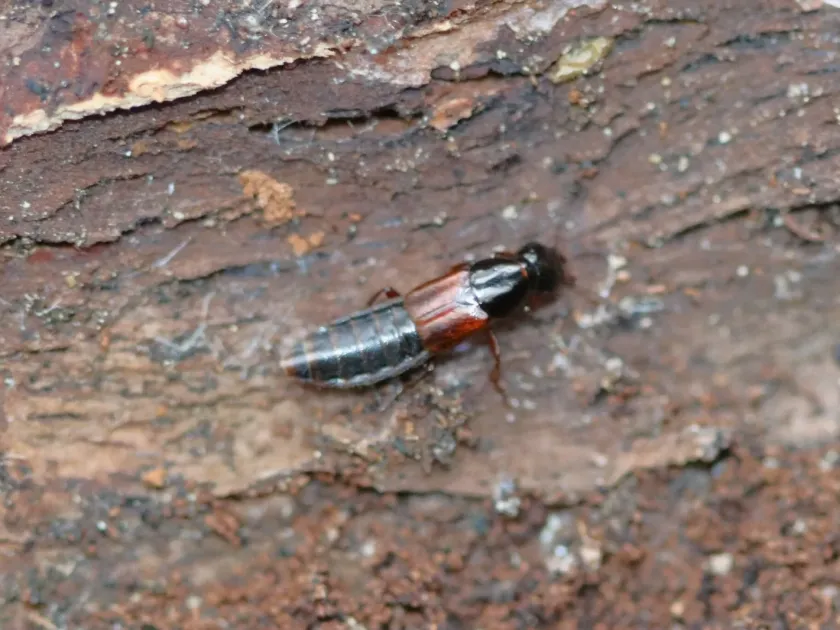
Adults possess an elongated body characteristic of the Staphylininae subfamily. Their exoskeleton is smooth and shiny, with a color range spanning from dark brown to almost black.
The body length of the beetle typically ranges from 6 to 9 millimeters. It features a large head with well-developed mandibles, adapted for capturing prey within the narrow galleries beneath tree bark.
The elytra of this species are noticeably shortened, a hallmark of rove beetles. The abdomen remains partially exposed, segmented, and highly mobile, which facilitates quick movement through leaf litter and bark crevices.
Distinguishing this species from its relatives usually requires examining the antennae structure and the micro-sculpture of the elytra, often necessitating a 10x magnifying glass in field conditions.
What it damages
The primary habitat of the smooth rove beetle includes coniferous and mixed forests, where it dwells under the bark of dying or dead trees. It prefers pine, spruce, and occasionally larch wood.
Although the species is primarily entomophagous, in an agronomic context, it is categorized as a secondary pest or an associated species found within the galleries of bark beetles and wood-boring insects.
Direct damage to healthy plants is rare; however, its presence serves as an indicator of poor forest health and the active development of xylophagous populations that destroy the cambium.
The larvae, equipped with powerful mouthparts, can occasionally damage healthy tree tissues if the population density of associated wood-boring pests is excessively high in a particular site.
In forest nurseries and stands subjected to environmental stress, mass outbreaks of Quedius laevigatus can complicate restoration efforts due to their competitive interaction with beneficial entomophages.
When it appears
The active life cycle of the adults begins in early spring when the temperature within the forest floor rises above 8 degrees Celsius.
Population density peaks typically occur in May and June, coinciding with the mass emergence and mating period, followed by oviposition into bark fissures.
Larvae develop throughout the summer period, feeding actively in subcortical spaces until the onset of the first significant autumn frosts.
Hibernation occurs primarily in the adult stage, with the beetles burrowing deep into the soil or sheltering under thick layers of moss and bark at the base of tree trunks.
In regions with mild winters or prolonged autumns, the development cycle can shift, occasionally leading to the emergence of additional generations in southern territories.
Signs of infestation
The primary sign of their presence is the discovery of beetles when peeling loose bark from weakened coniferous trees, often adjacent to bark beetle galleries.
The presence of specific frass within bark beetle tunnels, which differs from the standard waste of primary wood pests, may indicate the presence of predatory staphylinids.
Gradual dieback of the tree crown, accompanied by bark detachment, is a secondary indicator of the stem being infested by a complex of subcortical insects, including this species.
In areas where beetles congregate, a distinct smell of decay is often observed, which is associated with the proliferation of fungal spores carried by the beetles on their body surfaces.
- Darkening of bark segments.
- Presence of 1-2 mm entry holes.
- Aggregations of beetles in wood crevices.
Control measures
The main protection measure is timely sanitary logging of infested trees, which effectively removes the food source and overwintering sites for the beetles.
Strict adherence to forestry regulations is essential to avoid the accumulation of logging debris where the smooth rove beetle can successfully proliferate.
The use of pheromone traps designed for primary pests helps monitor the overall situation within the stand and suppresses the populations of associated secondary species.
Biological control strategies include maintaining populations of natural enemies, such as entomopathogenic fungi and nematodes, which naturally regulate rove beetle populations.
Chemical insecticide treatments in forest settings are generally ineffective and discouraged, as they eliminate the beneficial entomofauna essential for maintaining ecosystem balance.
Taxonomy
- Latin name
- Quedius laevigatus
- Order
- Coleoptera (beetles)
- Family
- Staphylinidae
- EPPO code
- QUEDLA
Discussion
No discussions yet — be the first.