
Large grizzled skipper
Pyrgus alveus
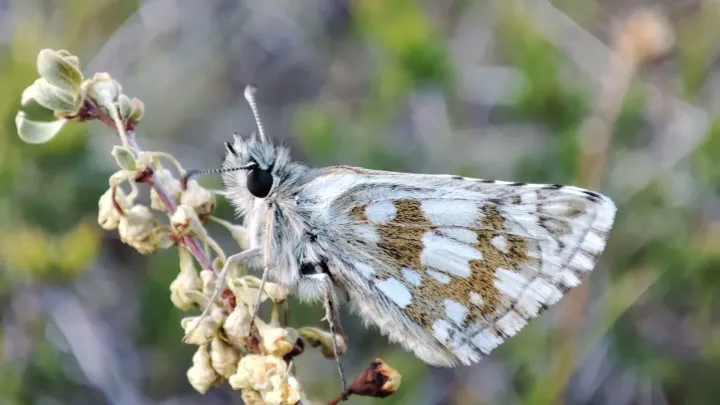
Description
How to identify
The large grizzled skipper (Latin Pyrgus alveus) belongs to the order Lepidoptera, family Hesperiidae. It is a small butterfly with a wingspan of up to 30 mm, featuring a dark, almost black coloration with a distinct white checkered pattern on the upper side of the wings.
The larvae (caterpillars) of this species have a pale, greenish-grey appearance with a dark stripe along the back and are covered in short, light hairs. The head capsule of the larvae is dark, which is an important diagnostic feature during the inspection of host plants.
The pupae of the insect develop in a light cocoon among rolled leaves and have a brownish tint. Adults are active during the daytime, preferring sunny areas, forest edges, and agricultural fields adjacent to wild vegetation.
The life cycle involves complete metamorphosis: egg, larva (caterpillar), pupa, and adult (imago). Hibernation usually occurs at the last or penultimate larval stage in shelters made of leaves.
Identification in the field is often difficult due to the external resemblance to other members of the Pyrgus genus, so entomological analysis of adults may be required for precise agronomic identification.
What it damages
The main crops susceptible to this species include members of the Rosaceae family and some herbaceous plants, including wild species of raspberry, cinquefoil, and burnet.
Damage is primarily caused by caterpillars that feed on the leaf blade, chewing holes or skeletonizing the leaf, which significantly reduces the total photosynthetic surface area of the cultivated plant.
At high population densities, damage can be critical for young seedlings, leading to stunted growth, weakened immunity, and a decrease in the overall productivity of the affected plantings.
In addition to direct leaf consumption, caterpillars often fasten the edges of leaves with silk, forming "houses" where they feed and hide from natural predators and insecticide applications.
Although this species rarely causes epiphytotic outbreaks, local population spikes near fields may require agronomical intervention to prevent loss of marketability of agricultural products.
When it appears
Adult flight occurs from late spring to mid-summer, depending on the temperature conditions of the region. Typically, the peak activity of butterflies is observed in June, coinciding with mating and egg-laying.
Caterpillars are most active during the summer, feeding intensively on the vegetative mass of plants. Their development is stretched over time, allowing damage to be observed throughout the growing season.
In southern regions, two generations may occur, significantly increasing the pest's impact as the population is replenished with new individuals in late summer when plants are already stressed.
In autumn, caterpillars stop feeding and prepare for hibernation, moving into plant litter or remaining on stems within curled leaves. In spring, with the arrival of warm weather, feeding resumes until pupation.
Agronomic monitoring should be carried out during the active growth phase of plants, starting in May, when the first caterpillars hatch and traces of their activity become visible.
Signs of infestation
The first sign of infestation is leaves that are rolled and fastened with silk at the tips of shoots. If such a leaf is unrolled, a caterpillar or insect excrement can be found inside.
A characteristic sign is the presence of "windows" or uneven edges on leaves. Unlike some other pests, the skipper does not leave the leaf veins, but consumes the entire leaf tissue, leaving only a rough structure.
Stunted development of terminal buds and deformation of young leaves often indicate the presence of larvae in hidden spots that are difficult to notice during a quick inspection of a field or garden.
The presence of butterflies actively flying between plants indicates the beginning of the egg-laying period. Monitoring adults using light traps or visual observation helps predict the emergence of the next generation.
Specific signs of activity (excrement) on the leaf surface below damaged areas also serve as a reliable indicator of active pest feeding in the sector.
Control measures
Agronomic methods include regular weeding to remove host plants that may serve as reservoirs for the pest and the removal of fallen leaves, where caterpillars may seek winter shelter.
The biological control method involves using products based on Bacillus thuringiensis, which effectively affect lepidopteran larvae without disrupting the ecological balance of the agro-ecosystem.
In cases of high infestation, broad-spectrum insecticides permitted for use on specific crops are applied, strictly adhering to pre-harvest intervals.
Spraying with contact-stomach insecticides is most effective during morning or evening hours when caterpillars leave their shelters or exhibit the highest activity on the leaf surface.
- Crop rotation compliance.
- Attracting natural enemies (birds, predatory insects).
- Monitoring with pheromone traps.
- Mechanical collection of rolled leaves on small areas.
Taxonomy
- Latin name
- Pyrgus alveus
- Order
- Lepidoptera (butterflies)
- Family
- Hesperiidae
- EPPO code
- PYRGAL
Discussion
No discussions yet — be the first.