
Skipper butterfly
Pyrgus
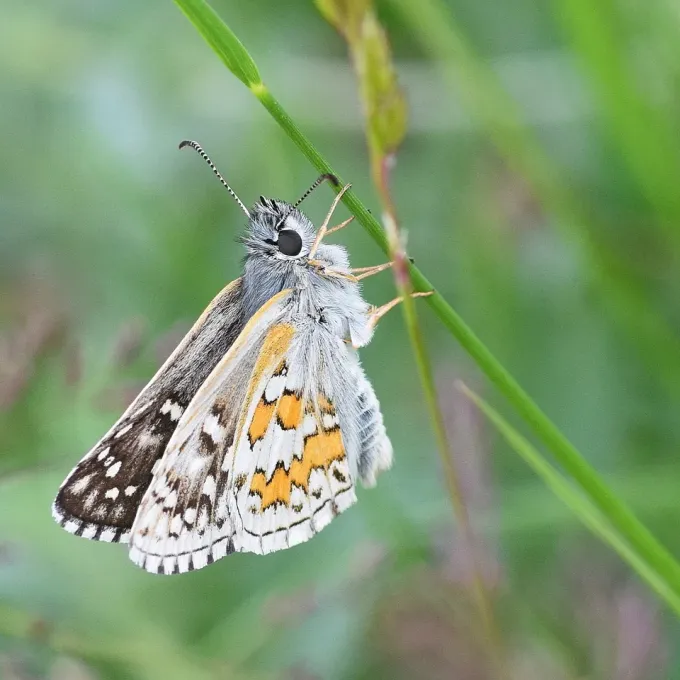
Description
How to identify
Skipper butterflies (Pyrgus) are members of the Hesperiidae family, belonging to the order Lepidoptera. They are named for their rapid, skipping flight pattern and their distinct physical appearance: a head that is as wide as the thorax, giving them a broad-headed look.
Adults are small, typically with a wingspan of 25–30 mm. Their wing patterns are usually a combination of dark brown, black, and white checkered markings, which serve as excellent camouflage against leaves and soil.
The larvae, or caterpillars, have cylindrical bodies that taper towards the rear. They often possess a dark head capsule and are colored in subtle shades of green or brown, allowing them to blend into their host plants seamlessly.
The life cycle undergoes complete metamorphosis: egg, larva, pupa, and adult. Most species in this genus have one or two generations per year, depending on the climatic conditions of their habitat.
Pupation typically occurs on the host plant, often protected within a silk-lined nest created from leaves. Many species overwinter as partially grown larvae within these specialized shelters.
What it damages
The primary damage is caused by the larval stage, which feeds on the foliage of various herbaceous plants and shrubs. Rosaceous plants, including strawberries and raspberries, are among the most common hosts.
Larvae feed by skeletonizing the leaf surface or consuming large sections of the leaf blade. When populations are high, this defoliation can significantly reduce the plant's ability to perform photosynthesis, directly impacting growth and fruit production.
Caterpillars often build protective shelters by rolling or folding leaves and securing them with silk threads. This behavior protects them from predators and environmental stressors, while also damaging the integrity of the leaves.
Severe infestations can lead to stunted plant development and reduced yield quality. In nursery settings or young plantations, this can be particularly detrimental to the survival of new vegetative growth.
If left unchecked, the accumulation of larval damage can lead to premature leaf drop and increased susceptibility to other plant pathogens or stress factors.
When it appears
Adult activity begins in late spring, typically in May or June, as temperatures consistently reach favorable levels for flight and mating. This is the period when oviposition occurs on the leaves of host plants.
Larval development takes place throughout the summer months. Depending on the species and geographical region, a second generation may appear towards the end of summer, extending the period of potential damage.
Optimal development for most Pyrgus species occurs in temperatures ranging from 20 to 25 degrees Celsius. Extreme weather events, such as heavy rain or cold spells, can act as natural checks on population levels.
As autumn approaches and temperatures drop, larvae prepare for diapause. They retreat into their leaf shelters or seek refuge in plant debris to survive the winter months.
Effective monitoring should be concentrated during the late spring to early summer window, which is the most critical time for detecting early larval stages before damage becomes widespread.
Signs of infestation
The most visible indicator of a skipper infestation is the presence of folded or rolled leaves. Observing these structural changes on host plants is the primary way to detect the pest's presence.
Frass (larval droppings) visible on leaves or accumulating in leaf shelters is a strong sign of active feeding. This provides a clear clue for growers to examine the surrounding area for larvae.
Early stage damage presents as translucent patches or small holes in the leaves where the larvae have scraped away the surface tissues. As they mature, these holes grow in size and frequency.
A general lack of vigor in plants, combined with stunted shoot development, can suggest a heavy infestation. Inspecting the undersides of leaves during the spring often reveals small eggs laid singly.
When infestation is severe, the affected shrubs appear tattered and may show significant defoliation, which is easily noticeable during routine agricultural inspections.
Control measures
Agricultural management begins with robust sanitation practices, such as removing weeds that serve as alternative host plants and clearing away plant debris where larvae hibernate.
For small-scale gardeners, manual removal and destruction of the rolled-up leaves containing larvae is a simple and effective control measure that prevents further spread.
Biological control, particularly the use of products based on Bacillus thuringiensis, is highly effective against Lepidopteran larvae while remaining safe for beneficial insects and the environment.
Chemical control is reserved for instances where the economic injury level is reached. Targeted applications of contact insecticides should be timed with the peak of larval activity for maximum effectiveness.
- Regular monitoring of host crops starting in May.
- Using pheromone traps, if available, to track adult flight.
- Encouraging natural predators such as parasitic wasps and predatory birds.
- Maintaining proper plant spacing to improve spray coverage and reduce microclimate favorability for pests.
Taxonomy
- Latin name
- Pyrgus
- Order
- Lepidoptera (butterflies)
- Family
- Hesperiidae
- EPPO code
- PYRGSP
Discussion
No discussions yet — be the first.