
Willow prominent
Pygaera inclusa
Description
How to identify
The Willow prominent (Pygaera inclusa) is a moth species belonging to the Notodontidae family. The adult moth has a wingspan of approximately 35–40 mm and displays a cryptic, brownish-grey coloration that mimics bark, helping it remain hidden during the day.
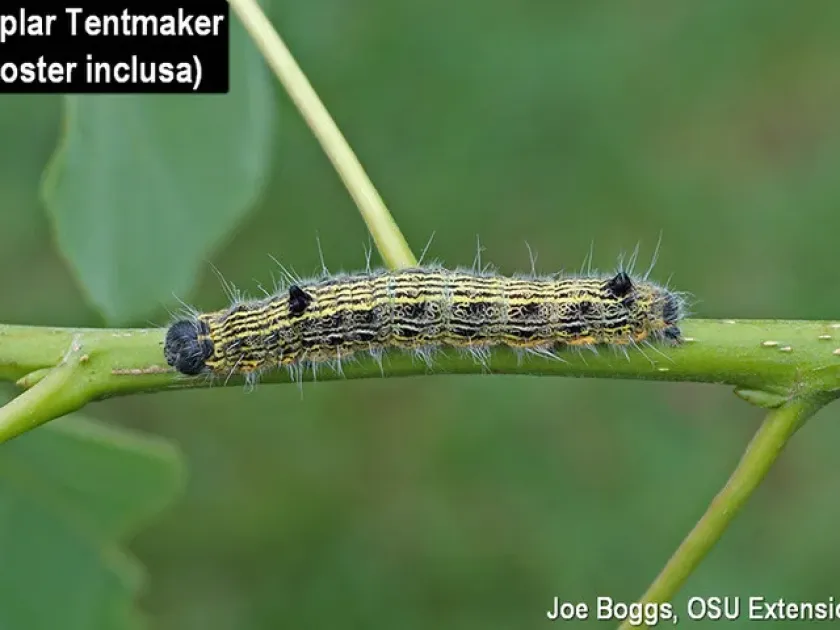
The larvae are easily recognized by their distinct dorsal bump on the second thoracic segment. Their body coloration is usually yellowish-green with dark patches and longitudinal stripes along the back.
The life cycle includes two to three generations per year, depending on the climatic zone. The insect undergoes complete metamorphosis, passing through the egg, larva, pupa, and adult stages.
Adult moths are nocturnal and are strongly attracted to artificial lights, which is often how the presence of the population is first noted in an area.
Female moths lay eggs in small clusters on the undersides of leaves, ensuring that the newly hatched larvae have an immediate food source.
What it damages
This pest primarily attacks members of the Salicaceae family, specifically willows (Salix spp.) and poplars (Populus spp.). It can cause significant damage in riparian forests, parks, and plantations.
Young larvae initially feed gregariously, skeletonizing the leaves, which causes the foliage to lose its integrity and turn brown as the tissue dies.
As the larvae reach maturity, they become solitary and consume the entire leaf blade, leaving only the primary veins, which leads to rapid defoliation.
Heavy infestations can lead to total stripping of the tree crown, causing severe physiological stress, reduced annual growth, and increased susceptibility to secondary pests.
Repeated defoliation over several consecutive years can cause the death of branches or even the entire tree, especially in drought-stressed environments.
Signs of infestation
Early infestation signs include the appearance of skeletonized leaves on the lower canopy, as young larvae feed together in small groups.
The presence of silken threads that bind leaves together provides shelter for the developing larvae and is a key visual indicator of an active infestation.
Fine granular frass (excrement) found on the ground or on foliage beneath the canopy is a definitive sign of high larval activity above.
Damaged leaves often curl or wither prematurely, creating a patchy appearance in the tree crown, which is clearly visible during the mid-summer months.
In late summer, careful examination of the leaf litter or crevices in the tree bark may reveal the protective cocoons where the pupae are resting.
Control measures
Cultural control involves removing and destroying leaf litter in the autumn, as this significantly reduces the number of overwintering pupae near the host trees.
Biological control methods are highly recommended, specifically the use of microbial insecticides containing Bacillus thuringiensis, which effectively target larval stages.
In cases of severe outbreaks, chemical control using targeted insecticides should be applied as soon as the first young larvae are detected on the foliage.
Promoting natural biodiversity, such as encouraging birds and predatory insects like parasitic wasps, can help keep the Willow prominent population below damaging thresholds.
- Monitoring flight periods using light traps.
- Manual removal of larval nests during the early stages of infestation.
- Targeted spraying programs for commercial willow nurseries.
Taxonomy
- Latin name
- Pygaera inclusa
- Order
- Lepidoptera (butterflies)
- Family
- Notodontidae
- EPPO code
- PYGAIN
Discussion
No discussions yet — be the first.