
Bruce's prominent
Pygaera brucei
Description
How to identify
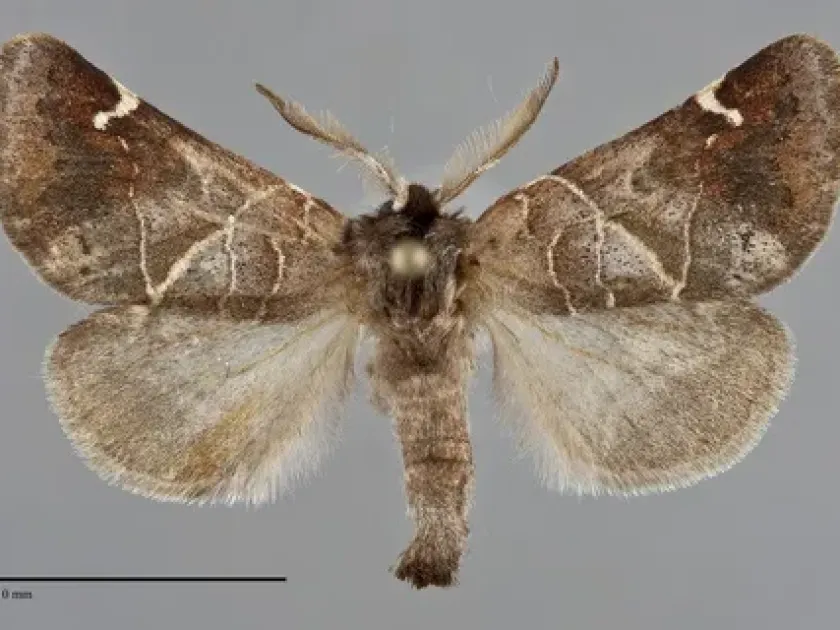
Bruce's prominent (Pygaera brucei) is a moth species belonging to the family Notodontidae. Like other members of this family, the adult moths are recognized by the characteristic tuft of scales on the inner margin of the forewings.
The larvae, or caterpillars, are the primary life stage causing damage to vegetation. They possess a distinct appearance with patterns that may act as a warning or camouflage depending on their developmental stage.
Pupation typically occurs within a cocoon made of silk and debris, often located in the leaf litter or just below the soil surface, providing protection against winter temperatures.
The adult moth is nocturnal and exhibits a strong attraction to light sources, a trait frequently used by researchers to monitor population levels in the field.
The taxonomic classification of this species involves detailed examination of wing patterns and morphological structures, as it can sometimes be confused with closely related prominent moths.
What it damages
This pest primarily attacks host plants within the Salicaceae family, focusing heavily on willow (Salix) and poplar (Populus) species throughout its range.
Damage is characterized by the consumption of leaf tissue, which can progress from minor holes to complete defoliation of branches or entire trees in severe infestations.
In forest nurseries and plantations, the feeding activity of these caterpillars can stunt the growth of young trees, leading to economic losses and reduced stand quality.
When trees lose a significant portion of their leaves, they become stressed, which limits their ability to produce energy through photosynthesis and weakens their defense systems.
Recurring defoliation caused by large populations of this pest can lead to branch dieback and, in extreme cases, the mortality of weakened or drought-stressed trees.
When it appears
The life cycle is dictated by local climatic conditions, with adult emergence occurring in spring as temperatures rise, signaling the start of the breeding season.
There is usually at least one generation per year, though in warmer climates, multiple overlapping generations may occur, extending the period of caterpillar activity.
Larval development is most intense during the mid-summer months when the foliage is nutrient-rich and conducive to rapid growth of the caterpillars.
By late summer or autumn, larvae prepare to pupate, marking the end of the feeding season before they overwinter in the soil or under layers of organic matter.
Synchrony between the moth's life cycle and the host plant's growth is vital for the survival of the species, as they rely on fresh leaves for larval development.
Signs of infestation
One of the most obvious signs of a Bruce's prominent infestation is the presence of irregular holes in the leaves, often starting from the edges or the center of the lamina.
The accumulation of caterpillar frass, or droppings, on the ground beneath the tree canopy is a clear indicator that feeding is actively occurring above.
Evidence of silken webbing on leaves or branches, which the larvae use for protection or as a resting spot during the day, confirms their presence in the canopy.
Premature leaf drop or yellowing of the foliage without seasonal changes is another diagnostic sign that the tree is under heavy herbivory pressure from the caterpillars.
Increased presence of predatory insects, such as wasps or beetles, around the tree foliage can sometimes signal a high density of larvae, as they are drawn to the food source.
Control measures
Biological control using formulations of Bacillus thuringiensis is highly recommended, as it targets the larvae specifically while minimizing harm to beneficial insects.
In landscape management, physically removing infested leaves or branches can help reduce localized population numbers before the pest spreads to neighboring trees.
Encouraging the presence of natural predators, including various bird species and parasitic wasps, provides a sustainable way to keep population numbers in check.
Chemical intervention should be considered a last resort and should be conducted using selective insecticides that do not disrupt the wider ecosystem of the forest or garden.
- Regular monitoring of host plants for early detection of egg masses.
- Soil cultivation around the base of the tree in autumn to disturb pupae.
- Using light traps to monitor adult flight activity and time protective measures.
Taxonomy
- Latin name
- Pygaera brucei
- Order
- Lepidoptera (butterflies)
- Family
- Notodontidae
- EPPO code
- PYGABR
Discussion
No discussions yet — be the first.