
Sigmoid prominent
Pygaera albosigma
Description
How to identify
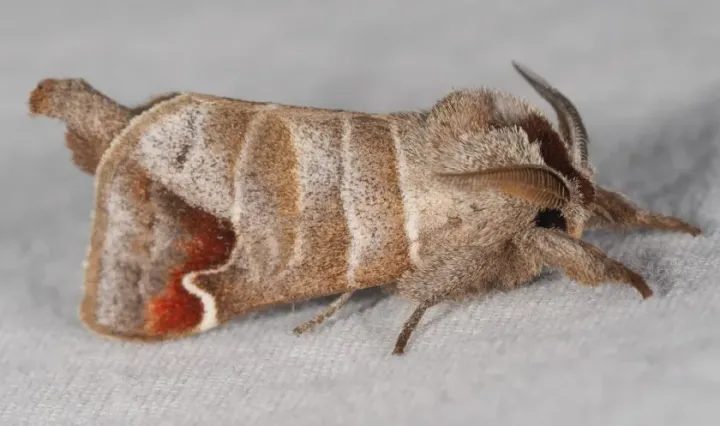
The sigmoid prominent (Pygaera albosigma) is a moth belonging to the family Notodontidae, order Lepidoptera. It is named for the distinctive S-shaped (sigmoid) white mark located on the forewings of the adult moth, which is the key identification feature for this species.
Adult moths have a wingspan typically ranging from 35 to 45 mm. Their coloration is generally buff, gray, or brown, providing excellent camouflage against the bark of host trees during the day. The body is covered in dense hairs, giving it a soft, robust appearance.
The larvae, or caterpillars, reach lengths of up to 40 mm when mature. They are smooth-skinned and often possess a distinct hump or elevation on the eleventh segment, which is a common characteristic within the Notodontid family.
Pupation occurs within a tough, silken cocoon often spun between folded leaves or hidden within bark crevices. The species typically overwinters in the pupal stage, awaiting the return of favorable temperatures in the spring to complete its lifecycle.
Depending on the climate and latitude, this moth can produce one or two generations per year. This adaptability allows it to maintain populations across various environmental conditions within its native range.
What it damages
The sigmoid prominent is a specialized feeder primarily targeting plants within the Salicaceae family, specifically poplars (Populus species) and occasionally willows (Salix species). It is a significant defoliator in both natural forests and urban landscapes.
Larvae consume foliage, initially creating "skeletonized" patches on the leaves. As they grow older and reach later instars, they consume the entire leaf blade, leaving only the primary veins or petioles. This results in heavy defoliation if populations are high.
Young trees and saplings in nurseries are particularly vulnerable to attack. Repeated defoliation weakens the plant, reducing its vigor, photosynthetic efficiency, and overall growth rate, making it susceptible to secondary stressors like drought or disease.
In ornamental urban settings, the aesthetic impact of the damage is often a primary concern for arborists and park managers. The thinning of the canopy and the accumulation of larval waste (frass) under the trees can cause significant issues in public areas.
While mature, healthy trees can usually tolerate moderate levels of feeding, large-scale outbreaks of the sigmoid prominent can cause branch dieback and significantly reduce the lifespan and beauty of affected trees.
When it appears
Adult moths begin their flight period in late spring or early summer, depending on the region. As nocturnal insects, they are most active during the night, when they mate and lay eggs on the undersides of host plant leaves.
Eggs hatch after an incubation period of approximately two weeks. The appearance of the first generation of caterpillars aligns with the period of peak leaf development for host trees, ensuring an abundant food supply for rapid growth.
Feeding activity continues throughout the summer months. Caterpillars pass through several instars, causing the most significant damage during mid-to-late summer before they descend to pupate in preparation for winter.
Pupation typically begins in late summer or early autumn. This is the period when the larvae create their protective cocoons in leaf litter or bark, entering a state of dormancy until the following spring.
Monitoring for this pest is most effective during the active feeding season, from early June through August. Trapping adults with light traps or inspecting leaves for clusters of eggs are standard diagnostic procedures.
Signs of infestation
The most noticeable sign of a sigmoid prominent infestation is the presence of partially consumed leaves that appear as fine webs of veins. Over time, as larvae increase in size, this damage progresses to complete leaf loss.
Large quantities of larval droppings (frass) appearing as dark pellets on sidewalks or lawns beneath the canopy are a clear indication that a colony of caterpillars is feeding overhead.
During the late summer, inspectors may find silken cocoons attached to twigs or hidden in the bark. Additionally, cast larval skins (exuviae) left behind after molting can often be found on the leaves or branches, confirming the presence of active larvae.
A thinning canopy or "see-through" appearance of the tree foliage is a significant indicator of advanced feeding. Affected trees may exhibit signs of stress, including premature leaf yellowing and dropping during dry weather conditions.
Visual observation of the caterpillars is possible during the day, although they are well-camouflaged. Shaking branches over a white sheet or tray is a reliable method to dislodge the larvae for positive identification.
Control measures
Integrated Pest Management (IPM) is the most effective approach for controlling the sigmoid prominent, balancing environmental safety with the need to protect tree health and aesthetics.
- Manual removal of infested leaves or twigs when populations are detected early on small trees.
- Sanitation efforts, including the raking and destruction of fallen leaves in autumn to eliminate overwintering pupae.
- Application of biological insecticides, such as Bacillus thuringiensis (Bt), which targets caterpillars specifically without harming beneficial insects.
- Conservation of natural predators, such as insectivorous birds and predatory bugs, which can suppress moth populations naturally.
- Targeted use of systemic insecticides for severe outbreaks where tree survival or high ornamental value is at risk.
Chemical applications should be restricted to the period of larval activity and applied during the evening to reduce the risk to pollinators and other non-target beneficial species.
Maintaining tree health through proper fertilization and irrigation helps trees withstand feeding pressure. Healthy, vigorous plants are more capable of recovering from partial defoliation than those suffering from physiological stress.
Long-term planning, such as diversifying tree species in urban plantings, is recommended to prevent large-scale outbreaks of specialized pests like the sigmoid prominent.
Taxonomy
- Latin name
- Pygaera albosigma
- Order
- Lepidoptera (butterflies)
- Family
- Notodontidae
- EPPO code
- PYGAAL
Discussion
No discussions yet — be the first.