
Great spittlebug
Ptyelus grossus
Description
How to identify
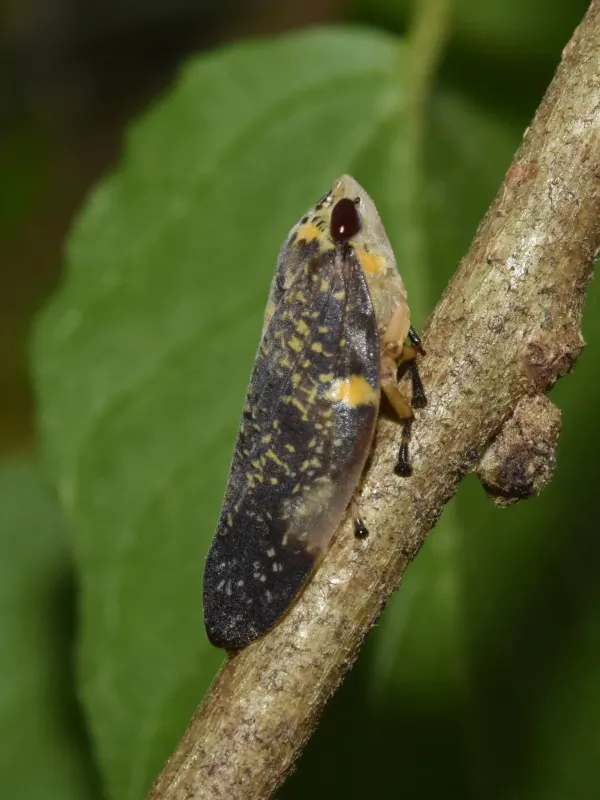
The great spittlebug (Ptyelus grossus) is a prominent insect belonging to the family Aphrophoridae within the order Hemiptera.
Adults are relatively large, often measuring between 10 and 12 mm in length, and typically exhibit a brownish or earthy coloration that provides excellent camouflage.
The most distinctive feature of the immature stage is the production of a frothy, spittle-like mass that surrounds the nymph, protecting it from desiccation and predators.
Adults possess strong hind legs adapted for jumping, allowing them to escape quickly when disturbed by human activity or natural threats.
They possess a specialized piercing-sucking mouthpart, known as a rostrum, which is essential for feeding on the vascular fluids of their host plants.
What it damages
The great spittlebug acts as a generalist feeder, causing damage to a wide variety of ornamental shrubs, fruit trees, and various herbaceous plants.
The nymphs and adults primarily target soft tissues, such as tender new shoots, buds, and young leaves, where nutrient concentration is highest.
By constantly extracting phloem sap, the pest causes severe physiological stress to the host, resulting in stunted growth and weakened plant vitality.
Infested plants frequently show significant deformation of stems and leaves, often leading to twisted growth patterns that permanently affect the plant's aesthetic and health.
- Fruit production is significantly reduced due to the damage inflicted on flowers and developing fruit peduncles.
- Nursery stock is particularly vulnerable, often suffering from malformed shoots that reduce commercial value.
When it appears
The life cycle of the great spittlebug is strictly synchronized with the plant growing season, spanning from early spring to late autumn.
The species overwinters primarily in the egg stage, with eggs tucked securely into bark crevices or near the base of vegetative buds.
Nymphs emerge in early spring, coinciding with bud burst, and immediately begin constructing their characteristic protective foam chambers.
The transition to the adult stage typically occurs in mid-summer, after which the insects become highly mobile and distribute themselves throughout the host range.
As temperatures begin to drop in late autumn, the adult population prepares to lay eggs, ensuring the cycle continues into the following year.
Signs of infestation
The presence of white, bubbly foam at leaf axils, on stems, or around flower clusters is the primary indicator of a spittlebug infestation.
Host plants often display yellowing leaves (chlorosis), wilting, and distorted growth, which are classic signs of sap-feeding damage.
In cases of severe infestation, the areas around feeding sites can become necrotic, creating entry points for secondary fungal or bacterial pathogens.
Early-season stunting and the absence of vigorous new growth on susceptible shrubs are clear indicators that nymphs have been feeding on the plant.
Regular monitoring of the underside of leaves and branch junctions during late spring is essential to detect early stages of the population buildup.
Control measures
Cultural management starts with rigorous weed control, as many wild grasses and herbs serve as vital reservoirs for early-stage nymphs.
For home gardens, a simple but effective manual approach is to wash away the foam nests with a high-pressure water spray, exposing nymphs to natural predators.
If population levels exceed economic thresholds, the application of systemic insecticides can provide effective control by targeting the insects through the plant's vascular system.
Applying contact insecticides in the early morning or evening when insects are most active can help reduce population density during peak infestation periods.
Promoting a healthy garden ecosystem by providing habitats for natural enemies, such as lady beetles and spiders, acts as a long-term deterrent against outbreaks.
Taxonomy
- Latin name
- Ptyelus grossus
- Order
- Hemiptera (bugs, aphids, leafhoppers)
- Family
- Cercopidae
- EPPO code
- PTYEGR
Discussion
No discussions yet — be the first.