
Plumed Prominent
Ptilophora
Description
How to identify
The Plumed Prominent (Ptilophora plumigera) is a moth belonging to the family Notodontidae. It is a nocturnal species known for its highly specialized biology.
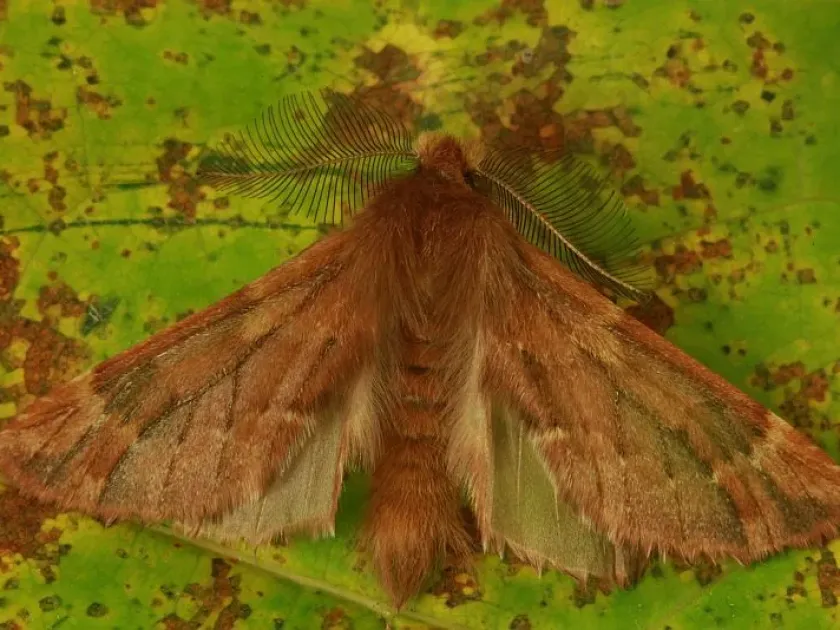
The adult moth features brownish or ochre-colored forewings with distinct dark veins, providing excellent camouflage against bark. Its wingspan typically ranges from 40 to 50 mm.
Males are easily identified by their large, feather-like (plumose) antennae, which are designed to detect female pheromones across long distances during the late autumn mating season.
The larvae are cylindrical, green caterpillars with faint longitudinal stripes. Their coloration allows them to blend in perfectly with the leaves of their host plants.
After reaching maturity, the larvae descend to the ground, where they pupate within a silk cocoon hidden in the soil or under leaf litter.
What it damages
The primary host plant of the Plumed Prominent is the maple (Acer spp.), specifically Field Maple and Norway Maple, which the larvae consume during their development.
While maples are the preferred food source, the caterpillars may also occasionally feed on lime (Tilia) and hazel, particularly in areas where maple populations are dense.
The damage is caused by the larvae feeding on the leaf margins, which can lead to significant defoliation of the tree canopy if the infestation is severe.
Excessive consumption of foliage reduces the photosynthetic capacity of the tree, causing stress, growth retardation, and a decrease in overall tree vigor.
Severe and repeated defoliation events can make trees more susceptible to secondary pests, wood-boring insects, and various fungal diseases.
When it appears
The Plumed Prominent is univoltine, meaning it has one generation per year, with a highly unusual emergence time in the late autumn.
Adult moths are typically active in October and November. They lay eggs singly or in small clusters on the twigs of host trees, where the eggs remain through the winter.
Eggs hatch in early spring, precisely timing the emergence of larvae with the opening of maple buds, ensuring a constant supply of fresh, tender foliage.
The larval stage lasts until late spring or early June. During this time, they feed intensively before retreating to the soil to pupate.
The insect remains in the pupal stage throughout the summer months, undergoing metamorphosis underground until it emerges as an adult in the fall.
Signs of infestation
The first sign of an infestation is the appearance of ragged, chewed leaf edges on maple trees, usually observed in mid-to-late spring.
Careful inspection of the undersides of the leaves may reveal the green, well-camouflaged caterpillars attached to the foliage.
Frass (caterpillar droppings) found on the leaves or on the ground beneath the canopy indicates the presence and active feeding of larvae in the upper branches.
Thinning of the foliage or localized defoliation is a clear indicator of a significant Plumed Prominent population within the tree.
Observing adult moths fluttering near artificial lights in October or November is a strong indicator of the species' presence in the local environment.
Control measures
Preventative control can be achieved through soil management; lightly tilling the soil under host trees in late summer or autumn can destroy pupae located in the ground.
For active infestations, applying biological insecticides containing Bacillus thuringiensis during the early larval stage is highly effective and eco-friendly.
In cases of heavy infestation, systemic insecticides may be used, though this should be limited to avoid harming non-target beneficial insects and pollinators.
Encouraging natural predators, such as insectivorous birds and parasitic wasps, helps maintain the caterpillar population at a natural equilibrium.
Monitoring the flight activity of adult moths using light traps in autumn helps assess population density and the potential risk for the following spring season.
Taxonomy
- Latin name
- Ptilophora
- Order
- Lepidoptera (butterflies)
- Family
- Notodontidae
- EPPO code
- PTILSP
Discussion
No discussions yet — be the first.