
Pale Prominent
Pterostoma palpina
Description
How to identify
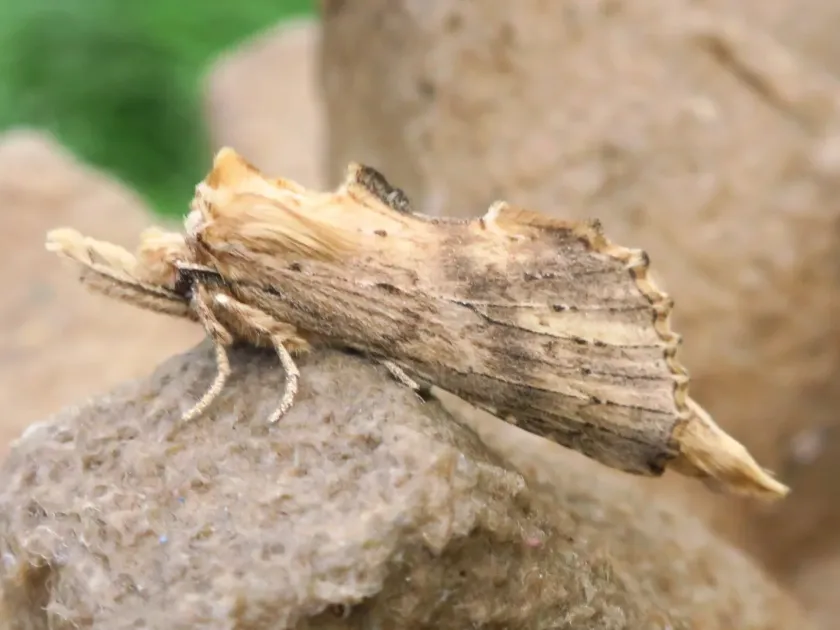
The Pale Prominent (Latin: Pterostoma palpina) is a moth of the family Notodontidae. It has a wingspan of 40 to 50 mm and features a cryptic grey-brown color pattern that helps it blend into bark and wood.
The common name is derived from the long, forward-pointing palps on its head. When at rest, these palps form a sharp, beak-like projection, which is the most recognizable morphological feature of the species.
The larva (caterpillar) grows up to 45 mm in length. It is generally bright green with yellow longitudinal stripes, providing excellent camouflage among the foliage of its host plants.
The rear end of the caterpillar bears two characteristic conical tails. When disturbed, it often lifts both the head and the tail, adopting a defensive posture common to many species in this family.
Pupation occurs in a tough, silken cocoon located either in the soil or within the leaf litter beneath the host tree, where it remains until the next season.
What it damages
The caterpillar is the primary destructive stage, acting as an active defoliator. It feeds on the leaves of deciduous trees, initially skeletonizing them and later consuming the entire leaf blade.
Host plants primarily include various species within the Salicaceae and Betulaceae families, most notably willows (Salix) and poplars (Populus), with birch (Betula) also being a common target.
Severe infestations can lead to significant defoliation of the canopy. This reduces the tree's photosynthetic capacity, causing stunted growth and increased susceptibility to secondary environmental stressors.
In nurseries and young plantations, the Pale Prominent can cause substantial economic losses by stunting the development of saplings, making them less viable for further cultivation.
While mature trees are generally resilient, repeated defoliation over several consecutive years can weaken the health of the tree, potentially predisposing it to diseases.
When it appears
The species typically undergoes two generations per year. The first generation of adults emerges in late spring, usually around May and June, depending on local climate conditions.
The second generation of moths is active during mid-summer, specifically in July and August. Adults are nocturnal, showing a strong attraction to artificial light sources at night.
Females deposit eggs on the undersides of host plant leaves. The incubation period typically lasts about two weeks before the larvae emerge to begin their feeding cycle.
The first generation of larvae feeds throughout early summer, followed by pupation. The second generation larvae develop through late summer and autumn before entering the pupal stage.
Overwintering occurs exclusively in the pupal stage. This biological strategy allows the species to survive harsh winter temperatures within the protection of the soil or leaf debris.
Signs of infestation
The most visible sign of an infestation is the presence of eaten foliage. Damage typically manifests as irregular, jagged edges or completely skeletonized leaves with only the main veins remaining.
Frass (caterpillar droppings) accumulating on the leaves or the ground beneath the tree canopy is a clear indicator of active feeding by a high number of larvae.
Due to their effective camouflage, finding the caterpillars themselves requires careful inspection of the foliage, particularly near the leaf midribs where they often rest during the day.
Adult moths can be monitored using light traps at night, which provides a useful metric for assessing the population density within a specific area or orchard.
In cases of heavy infestation, the tree canopy may appear sparse, and a noticeable thinning of foliage becomes apparent from a distance as the season progresses.
Control measures
Biological control using Bacillus thuringiensis or other microbial insecticides is the most recommended approach for managing caterpillar populations in garden and forest settings.
If chemical intervention is necessary due to high infestation rates, systemic or contact insecticides should be applied during the early larval stages when caterpillars are most vulnerable.
Good sanitation practices, such as removing and destroying fallen leaves in autumn, can significantly reduce the number of pupae overwintering in the soil.
Promoting a healthy ecosystem by encouraging bird populations and predatory insects (natural enemies) is a sustainable long-term strategy for keeping moth populations in check.
Regular monitoring of young plantations throughout the spring and summer allows for early detection, ensuring that control measures are implemented before extensive damage occurs.
Taxonomy
- Latin name
- Pterostoma palpina
- Order
- Lepidoptera (butterflies)
- Family
- Notodontidae
- EPPO code
- PTRSPA
Discussion
No discussions yet — be the first.