
White plume moth
Pterophorus pentadactylus
Description
How to identify
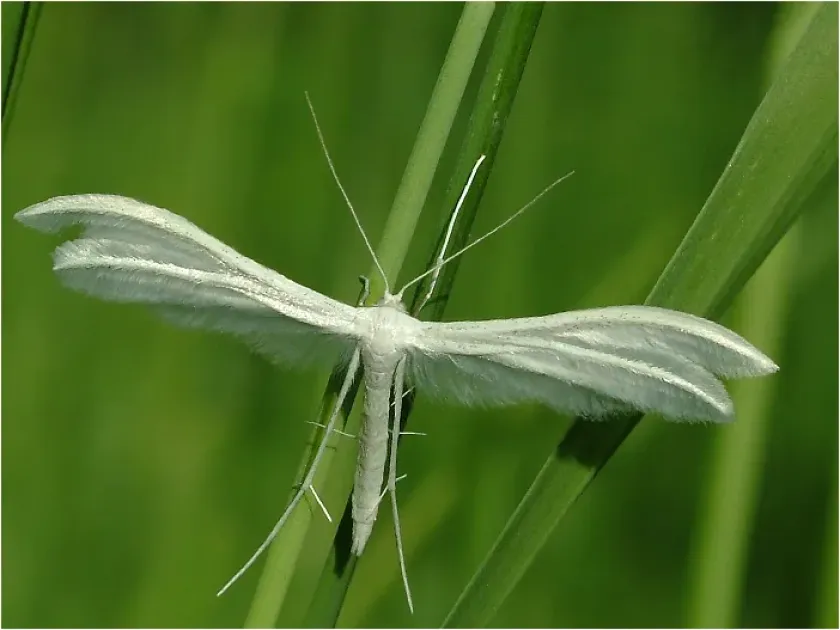
The White plume moth (Pterophorus pentadactylus) is a member of the Pterophoridae family within the Lepidoptera order. It is easily recognized by its distinctive, deeply cleft wings that resemble a hand or fan when folded.
The wingspan of an adult moth ranges between 24 and 35 mm. Its entire body and wings are pure white, sometimes with a pearly luster, making it highly conspicuous during its nocturnal flight.
The larvae, or caterpillars, are pale green and densely covered in fine, white hairs, which provide both camouflage and protection against some predators.
Pupation typically occurs on the host plant, where the pupa is attached to the stem or the underside of a leaf, showing green or yellowish coloration.
As a species, it follows a standard holometabolous life cycle, typically spending the winter as a larva in vegetation debris or sheltered spots.
What it damages
The primary host plant for the White plume moth is Field Bindweed (Convolvulus arvensis), a common and often invasive weed species.
While the moth primarily feeds on weeds, in high-density populations, it can occasionally damage other plants within the Convolvulaceae family if they are present in the immediate vicinity.
Larvae feed on the foliage and flower buds, chewing irregular holes or completely skeletonizing the leaves, which can stunt plant growth.
Severe infestations can lead to significant defoliation, reducing the plant's ability to perform photosynthesis and weakening its overall health.
Though rarely classified as a major agricultural pest, it can be problematic in private gardens or nurseries where bindweed is difficult to eradicate completely.
When it appears
The adult moth flight season extends from June through August, coinciding with the peak vegetative growth of its host plants.
The species is primarily nocturnal, remaining hidden among foliage during the day and becoming active only after dusk.
Eggs are laid singly or in small clusters on the underside of bindweed leaves, with larvae hatching within approximately one to two weeks.
Caterpillar feeding is most intensive in mid-summer, as the larvae consume significant amounts of plant tissue prior to pupation.
Depending on the latitude, the species may produce one or two generations per year, requiring ongoing monitoring throughout the growing season.
Signs of infestation
The most reliable sign of an infestation is the presence of irregular "shredded" holes in bindweed leaves, indicating recent feeding activity.
Caterpillars can be found by inspecting the undersides of leaves, especially on plants showing signs of tissue loss.
Accumulation of larval excrement (frass) on the leaves or stems of the host plant provides evidence of a nearby, actively feeding colony.
In cases of heavy infestation, plants may exhibit wilted, yellowed leaves that fail to mature properly due to the loss of photosynthetic area.
Nighttime visual observation with a light source can reveal the presence of adult moths flying in the vicinity of bindweed patches.
Control measures
The most effective long-term strategy is the consistent removal of the primary host, Field Bindweed, through manual weeding or targeted herbicide application.
Autumn tillage helps disrupt the life cycle of the moth by burying overwintering larvae and exposing pupae to environmental stress.
Biological control using Bacillus thuringiensis (Bt) sprays can be highly effective in controlling young larvae while minimizing impact on non-target species.
In ornamental settings, if infestation levels are high, contact-based insecticides may be used, provided that environmental regulations are followed.
Encouraging biodiversity in the garden, including populations of natural insect predators and birds, can help maintain the moth population at sub-economic levels.
Taxonomy
- Latin name
- Pterophorus pentadactylus
- Order
- Lepidoptera (butterflies)
- Family
- Pterophoridae
- EPPO code
- PTRHPE
Discussion
No discussions yet — be the first.