
Amblyptilia
Amblyptilia
Description
How to identify
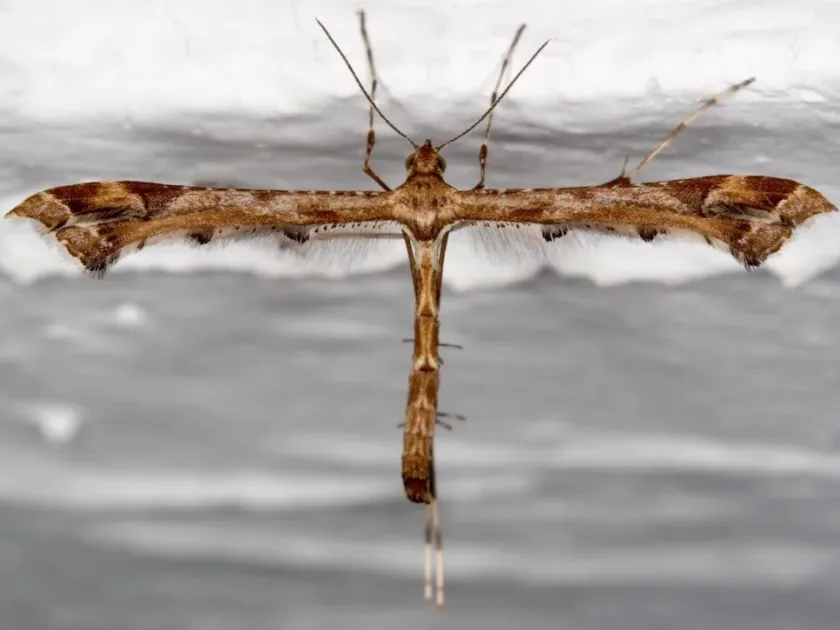
Amblyptilia is a genus of moths belonging to the family Pterophoridae, commonly known as plume moths. Adult moths are characterized by their unique wing structure, which is split into lobes that give them a T-shaped appearance when at rest.
The body of the adult is slender and often colored in shades of brown, gray, or tan, providing excellent camouflage against the stems and foliage of the host plants they inhabit.
The larvae, or caterpillars, have a slightly hairy body, typically displaying vibrant green or yellowish-green colors with darker lateral stripes that help them blend into the vegetation.
Pupae are usually of the open type, attached to the underside of leaves or stems with a silken girdle, allowing them to remain suspended and protected during the transformation phase.
Eggs are typically laid singly or in small clusters on the underside of young leaves, making them difficult to detect during routine scouting of the crop fields.
What it damages
This pest primarily targets plants within the Lamiaceae family, most notably mint, sage, and lemon balm. It can also be found on several other herbaceous plant species under favorable conditions.
Larval feeding causes significant damage, as caterpillars consume both leaf tissue and apical buds, which stunts the overall growth and development of the infested host plant.
When infestation levels are high, the larvae aggressively feed on generative organs, destroying flower buds and preventing seed production, which drastically reduces the yield of aromatic crops.
The affected areas often become deformed, curled, or scorched. These weakened parts of the plant are highly susceptible to secondary infections by bacteria and fungi, exacerbating the damage.
The economic impact of Amblyptilia is particularly severe in greenhouse environments, where the lack of natural predators allows the moth population to multiply rapidly throughout the year.
When it appears
Adult moth activity typically spans from late spring through August, with the flight period often being extended depending on local weather patterns and regional climatic conditions.
The most destructive phase is the larval stage, which peaks during the budding and flowering of the crops, as these developmental stages are crucial for the plant's productivity.
Overwintering usually occurs at the larval stage within plant debris or in the topsoil layer, providing the pest with a buffer against harsh winter temperatures.
Larval emergence coincides with the beginning of the plant's active growing season, enabling the caterpillars to immediately begin feeding on tender new shoots and young foliage.
The number of annual generations depends heavily on the geographic location, ranging from a single generation in cooler northern regions to multiple successive generations in warmer climates.
Signs of infestation
Small irregular holes in the foliage, caused by early-instar larval feeding, are often the first visible signs that an infestation is present in the field.
Curled and distorted shoot tips, often held together by light, wispy silk threads produced by the larvae, are a classic diagnostic sign of Amblyptilia presence.
The presence of fine, dark granular frass (excrement) scattered on leaf surfaces or inside flower heads is a clear indicator that caterpillars are actively feeding nearby.
Premature drop of buds and flowers without any signs of environmental stress is a common consequence of larvae feeding on the pedicels of the plants.
Adult moths are primarily nocturnal or crepuscular, but can occasionally be spotted resting motionless on the underside of leaves if disturbed during the early morning hours.
Control measures
Effective management begins with strict field sanitation, including the removal and destruction of crop residues after harvest to eliminate overwintering sites for the larvae.
Regular cultivation and weeding are essential to destroy alternative host plants in the surrounding area that may support the Amblyptilia population throughout the season.
Biological control using microbial insecticides like Bacillus thuringiensis is highly effective against young larvae while remaining safe for beneficial insects and the environment.
Chemical control should be reserved for cases where pest populations exceed the economic injury level, utilizing selective insecticides that minimize harm to natural predatory populations.
- Monitor fields using pheromone traps to time interventions accurately.
- Promote the presence of natural enemies such as parasitic wasps (Trichogramma).
- Rotate crops to disrupt the life cycle of the moth.
Taxonomy
- Latin name
- Amblyptilia
- Order
- Lepidoptera (butterflies)
- Family
- Pterophoridae
- EPPO code
- AMBASP
Discussion
No discussions yet — be the first.