
Pselliopus assassin bug
Pselliopus
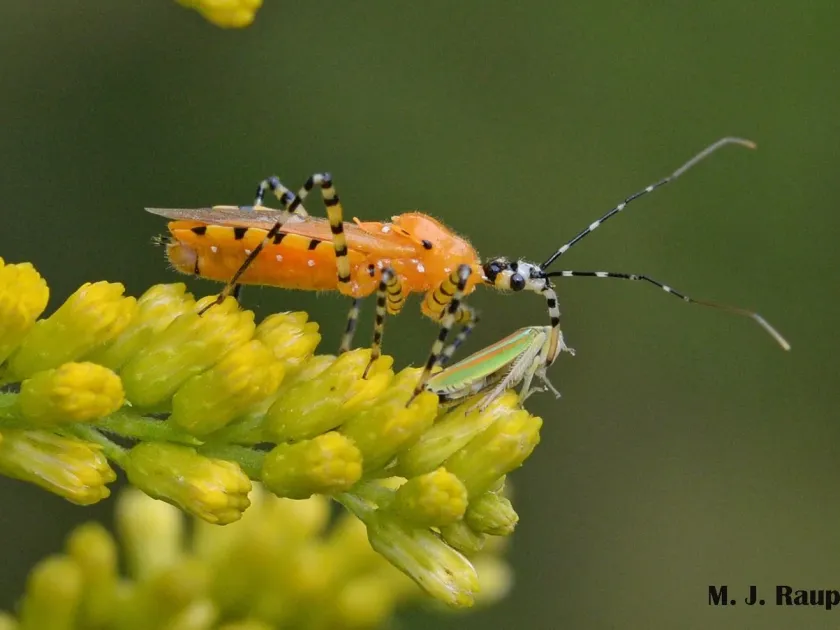
Description
How to identify
The assassin bug of the genus Pselliopus belongs to the family Reduviidae, which is part of the order Hemiptera. These insects are characterized by an elongated body, a distinctive proboscis, and often vibrant coloration that serves as a warning to potential predators.
Adults possess developed legs that allow them to move quickly across leaves and stems in search of prey. Morphological features include specific spines on the pronotum and clearly visible antennae, which play a crucial role in detecting prey.
To identify the species, agronomists use visual inspection methods during the early morning hours. Often, these bugs prefer to hide in the root zone or on the underside of leaves, making them difficult to detect during the early stages of infestation.
It is important to distinguish Pselliopus from other beneficial predatory bugs, as some members of this family can provide benefits by eliminating harmful pests. Misidentification can lead to unnecessary insecticide application and disruption of the agroecosystem.
Pselliopus nymphs go through several developmental stages, during which they resemble adults but differ by the absence of wings and smaller size. The development of nymphs directly depends on the availability of a prey base consisting of small invertebrates.
What it damages
Although most representatives of this genus are entomophagous, some Pselliopus species may exhibit phytophagy or cause indirect damage by damaging young plant tissues while searching for prey fluids or puncturing plant cell walls.
The primary crops at risk from these bugs include vegetables and ornamental plants. Damage to vegetative organs leads to a disruption of plant metabolism, which slows down growth and development.
When mass populations appear in fields, deformation of young shoots and drying of apical buds are observed. This is because, during feeding, the bug can inject specific enzymes that cause necrosis of tissues around the puncture site.
The greatest danger is posed to seedlings and young saplings in greenhouses. Even a small number of bugs in a greenhouse can cause a sharp decrease in product quality and significant yield loss.
In some cases, Pselliopus act as vectors for phytopathogens by damaging the plant epidermis, which creates entry points for fungal and bacterial infections. Thus, the damage is often a combined effect.
When it appears
The seasonal activity of assassin bugs begins in late spring when average daily temperatures reach the threshold for activating diapausing individuals. This is when they emerge from overwintering sites.
During the summer, population peaks are observed, which correlates with the active growth phases of agricultural crops. High temperatures accelerate the nymph development cycle, shortening the time between molts.
In the autumn, adults begin searching for hibernation shelters, choosing plant debris, tree bark crevices, or dry weed stalks. During this period, the pests become less mobile and feed less intensively.
The number of generations per year can vary depending on the climatic zone where the crop is grown. In warmer regions, development occurs faster, allowing the pest to form several complete generations per season.
To forecast outbreaks, it is necessary to consider the hydrothermal coefficients of the specific year. Sudden weather shifts can either stimulate or suppress the development of local Pselliopus populations.
Signs of infestation
The first sign of infestation is small pinpoint punctures on leaves that eventually turn into light necrotic spots. If you carefully examine the underside of the leaf, you may find shed larval skins.
The presence of bugs is often accompanied by the appearance of excrement on leaf surfaces in the form of dark spots. Agronomists also note the presence of characteristic empty husks of other insects that the predatory bugs have fed upon.
Deformation or curling of leaves in the early growth stages is a warning signal indicating damage to the plant's vascular system. Such signs are often mistaken for mite infestations, requiring a detailed inspection.
- Presence of adults or nymphs on the underside of leaves.
- Appearance of chlorotic spots that gradually turn yellow and die.
- Slowing of overall plant growth compared to control groups.
- Presence of a specific unpleasant odor during large aggregations of insects.
Using yellow or blue sticky traps helps to quickly detect the migration of adults to the site. Early detection allows for local protection measures without treating the entire field.
Control measures
The defense system against assassin bugs is based on an integrated approach combining agrotechnical, biological, and chemical methods of population control. Prevention is the most effective containment method.
Agrotechnical measures include deep autumn plowing and the removal of plant debris where bugs prefer to overwinter. Crop rotation and weed control reduce the site's attractiveness for pest reproduction.
Biological control is based on supporting populations of the bugs' natural enemies, such as egg parasitoids or insectivorous birds. In some cases, the application of biological insecticides based on fungal cultures is acceptable.
Chemical treatment with systemic or contact-stomach insecticides is carried out only when the economic threshold of harmfulness is exceeded. It is important to rotate products to prevent the development of pest resistance.
When working in greenhouses, the use of entomological nets on ventilation windows is recommended. Monitoring microclimate and regular greenhouse inspections allow for minimizing pesticide use and preserving an environmentally friendly harvest.
Taxonomy
- Latin name
- Pselliopus
- Order
- Hemiptera (bugs, aphids, leafhoppers)
- Family
- Reduviidae
- EPPO code
- PSLOSP
Discussion
No discussions yet — be the first.