
Scutellaria moth
Prochoreutis myllerana
Description
How to identify
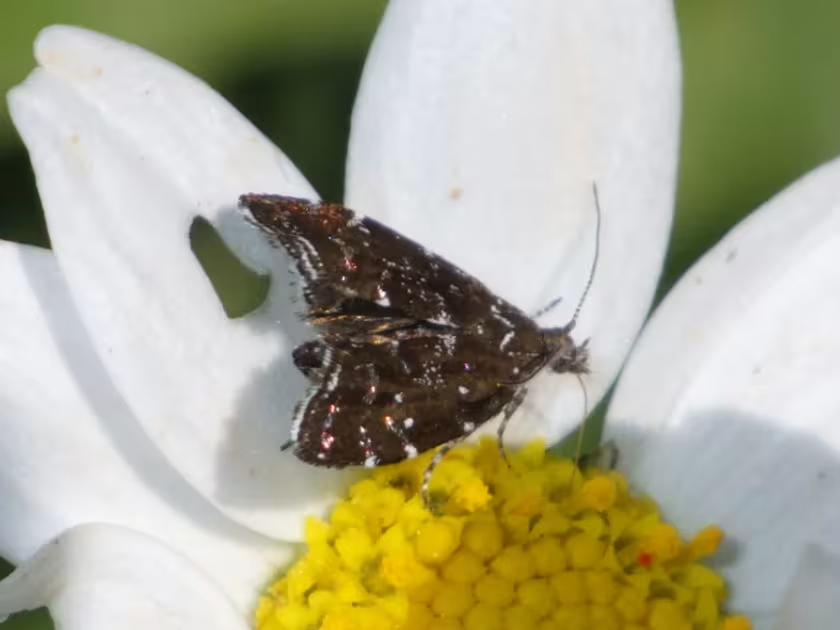
The Scutellaria moth (Prochoreutis myllerana) is a small moth belonging to the family Choreutidae (metalmark moths). Unlike many other moths, it is primarily diurnal, meaning it is active during the day.
Adult moths have a wingspan of approximately 10–12 mm. Their forewings feature a distinct mottled pattern of dark brown with metallic or white markings, providing effective camouflage.
The larvae, or caterpillars, possess pale green or yellowish bodies with dark heads. They are quite active and will quickly drop from the leaf if disturbed by a potential predator.
Pupation occurs within a silken cocoon, which is usually spun inside a leaf that the larva has folded or rolled together for protection.
This species is found throughout Europe and temperate parts of Asia, primarily inhabiting areas where its host plants from the Lamiaceae family thrive.
What it damages
The primary host plants for the larvae are members of the genus Scutellaria, as well as some species of mints and other related plants in the Lamiaceae family.
The damage is caused exclusively by the larvae. They feed on the leaf parenchyma between the veins, creating characteristic "windows" or skeletonized patches on the foliage.
Severe infestations can lead to a significant loss of leaf surface area, which hinders photosynthesis and reduces the overall vigor of the host plant.
The aesthetic value of ornamental plants is heavily compromised, and for medicinal crops, the damage can lead to lower quality and quantity of the raw harvest.
If not managed properly, heavy infestations can result in the complete defoliation of the plant, significantly weakening its chances of survival for the following season.
When it appears
The lifecycle of the Scutellaria moth typically consists of one or two generations per year, depending on the climatic conditions of the region.
The flight period for the adults usually begins in late spring, continuing into early summer when temperatures are sufficiently high to support mating.
Larval activity peaks during the summer months, specifically June and July, which corresponds to the most intensive growth stage of the host plants.
The final generation of caterpillars enters the pupal stage in late summer, overwintering in the soil or within protected debris near the host plants.
Warm and moderately humid weather is considered the most conducive environment for the development and survival of both the larval and pupal stages.
Signs of infestation
The most noticeable sign of an infestation is the presence of delicate silken webbing on the leaf tips, used by the larvae to fold the leaves.
Yellowing, thinning, or "lace-like" leaves are common indicators that the larvae have been feeding on the internal tissues of the foliage.
Accumulation of tiny dark frass (droppings) on the leaves or at the base of the plant is a clear indication that caterpillars are present and feeding.
Leaf curling and deformation of young shoots are symptomatic of the larvae's protective feeding behavior, making the plant look stressed and withered.
Monitoring the plant for adult moths, which are often seen fluttering around flowers in sunlight, can help determine when to begin preventive treatments.
Control measures
Good agricultural practices, such as the consistent removal of weeds belonging to the Lamiaceae family, help eliminate alternative food sources for the moth.
Tilling the soil in autumn can effectively destroy the pupae overwintering in the ground, significantly reducing the population density for the next growing season.
For small-scale gardeners, manual collection and destruction of the rolled-up leaves containing larvae is a highly effective and non-toxic method of control.
In larger plantations, the use of biological insecticides containing Bacillus thuringiensis is recommended to target the larvae while sparing beneficial insects.
Chemical control should be implemented early in the season, using systemic insecticides before the caterpillars successfully roll the leaves, as the leaf shelter provides significant protection against sprays.
Taxonomy
- Latin name
- Prochoreutis myllerana
- Order
- Lepidoptera (butterflies)
- Family
- Choreutidae
- EPPO code
- QCHOAR
Discussion
No discussions yet — be the first.