
Red swamp crayfish
Procambarus clarkii
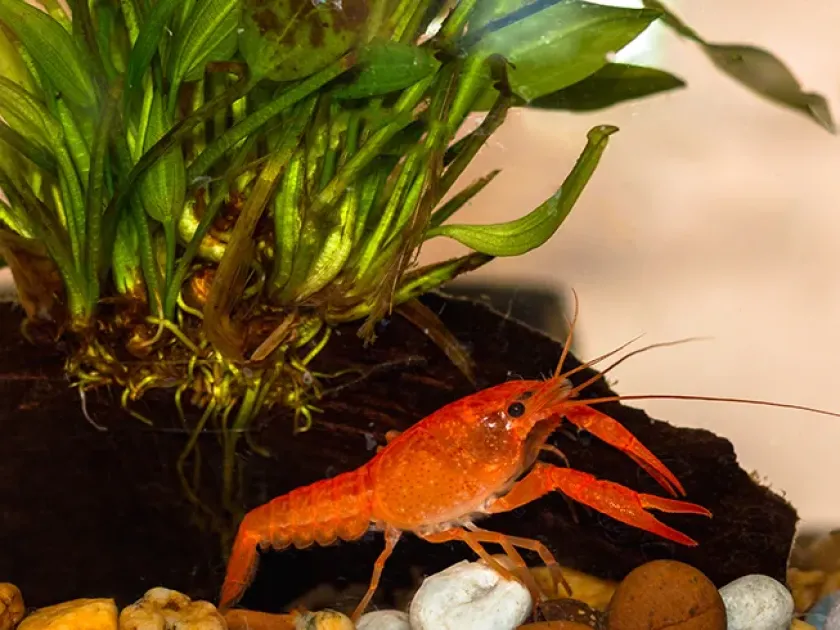
Description
How to identify
The red swamp crayfish Procambarus clarkii is a crustacean of the order Decapoda, family Cambaridae. It is characterized by a dark red or brownish color and prominent tubercles on its large claws.
Adults typically reach 10–12 cm in length. This species is highly adaptable and can survive in fluctuating water levels, making it a formidable invasive pest in many parts of the world.
They are known for their high reproductive rate, with females capable of laying hundreds of eggs in a single cycle, leading to rapid population expansion in suitable habitats.
The species prefers habitats with slow-moving water and soft substrates, which allow them to dig complex burrow systems for protection and breeding.
They are active throughout a wide temperature range, though feeding behavior intensifies in warmer water, typically between 15°C and 25°C.
What it damages
The primary agricultural impact of this species is on rice farming. Crayfish feed on young rice seedlings and roots, causing significant gaps in stands and reducing yield.
Beyond feeding, their burrowing activity is extremely destructive to irrigation infrastructure. They dig into levee banks and canals, leading to water leakage and structural damage.
Burrowing activities increase water turbidity, which suppresses the growth of other aquatic plants and alters the nutrient dynamics of the wetland ecosystem.
While primarily herbivorous, they are opportunistic feeders and can consume young shoots of various crops, extending their potential impact beyond just rice fields.
High population densities can cause severe economic losses, with damage to rice production potentially reaching 50% in heavily infested areas.
When it appears
Crayfish activity is highly dependent on temperature, peaking during the spring and summer months when rice is in its active growth phase.
Springtime warming triggers emergence from overwintering burrows, leading to early season feeding that is particularly damaging to young rice shoots.
Summer is the period of peak reproductive and burrowing activity, which poses the greatest threat to the integrity of levees and water retention systems.
Autumn brings a gradual reduction in surface activity as the water cools and the crayfish prepare for lower temperature dormancy.
In tropical and subtropical climates, the activity period is significantly longer, presenting a near-year-round challenge for agricultural management.
Signs of infestation
The most visible sign of infestation is the presence of numerous mud chimneys or holes along the banks of irrigation ditches and rice field levees.
Cut rice stalks floating on the surface of the paddy indicate active feeding by a crayfish population residing within the field.
Increased water turbidity caused by mechanical agitation of the substrate is a clear indicator that a large number of crayfish are present.
Finding discarded exoskeletons (molts) near the water's edge confirms a healthy, growing population that is regularly shedding.
Nighttime sightings using artificial light are a highly reliable method for assessing population size, as the species is nocturnal.
Control measures
Water management is a key control strategy; draining fields at specific growth stages can effectively reduce crayfish populations by eliminating their habitat.
The use of mechanical traps, such as baited wire traps or fyke nets, is a common practice to physically remove individuals from the ecosystem.
Chemical control with molluscicides is possible but restricted due to potential environmental toxicity and impacts on non-target species like fish.
Biological control through the management of natural predators, such as predatory fish and waterfowl, can help maintain lower population densities naturally.
Engineering interventions, such as lining levees with protective mesh or geo-fabrics, can prevent burrowing and protect vital irrigation infrastructure from damage.
Taxonomy
- Latin name
- Procambarus clarkii
- Family
- Cambaridae
- EPPO code
- PROMCL
Discussion
No discussions yet — be the first.