
Rusty crayfish
Faxonius neglectus
Description
How to identify
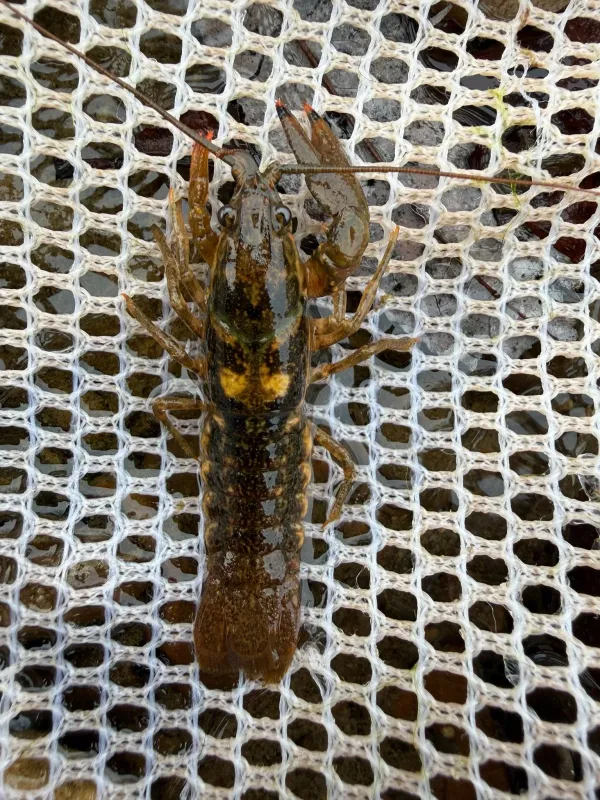
The rusty crayfish (Faxonius neglectus) is a crustacean in the family Cambaridae. Originally from North America, it has become a highly invasive pest in various global water systems.
It is identifiable by distinctive rust-colored spots on the sides of its carapace. Its claws are robust, relatively large, and often exhibit a dark band at the tip.
Adult specimens typically measure between 8 to 12 centimeters in length. The coloration can vary from olive-green to brown, depending on the environmental conditions of the habitat.
This species is known for its aggressive nature compared to native crayfish. It outcompetes local fauna for food and space, quickly dominating aquatic environments.
The rusty crayfish is a known carrier of Aphanomyces astaci, the pathogen causing crayfish plague, which poses an existential threat to native crustacean populations.
What it damages
The primary agricultural impact of the rusty crayfish is the degradation of irrigation infrastructure. Their burrowing activity causes erosion and collapses in irrigation canals.
They consume vast amounts of aquatic macrophytes. The removal of this vegetation disrupts the filtration capacity of water systems, leading to increased siltation and clogging.
In aquaculture and pond farming, the rusty crayfish preys on fish eggs and fry, leading to severe economic losses in fish production and stock replenishment.
By overgrazing on snails and aquatic insects, they disrupt the natural food web, which can result in blooms of algae or outbreaks of other pests due to the loss of natural predators.
Their activity degrades water quality by stirring up sediments, which makes the water less suitable for irrigation and can lead to equipment malfunctions in pumping stations.
When it appears
Activity begins in early spring as water temperatures rise above 8 degrees Celsius. The crayfish emerge from deeper substrates where they spent the colder months.
Summer is the peak season for both feeding and reproduction. During this period, their metabolism is at its highest, and their demand for resources is most intense.
In the autumn, they engage in heavy feeding to accumulate lipid stores for the winter. This period often sees an increase in burrowing activity to prepare for winter hibernation.
Winter activity is significantly reduced; however, the tunnels created during the active season remain and continue to compromise the structural integrity of canal banks.
Growth and molting occur throughout the warm season. During molting, they are vulnerable to predation but remain ecologically active as they recover and continue foraging.
Signs of infestation
One of the most obvious signs is the rapid depletion of aquatic vegetation in ponds or irrigation channels that were previously well-vegetated.
The presence of large, circular tunnel entrances along the embankments of canals and water reservoirs is a definitive indicator of an established rusty crayfish population.
Increased turbidity in water systems, even in the absence of rainfall, suggests that the crayfish are actively disturbing bottom sediments through their foraging habits.
The disappearance of native crayfish species from a water body is often a direct result of the rusty crayfish's expansion into that territory.
- Presence of rust-colored patches on the carapace.
- Excessive erosion of canal banks.
- Loss of fish fry and eggs in hatcheries.
- Signs of claw markings on nearby vegetation.
Control measures
Mechanical trapping remains the most effective immediate control method. Using specifically designed traps can significantly reduce population density in contained systems.
Biological control involves maintaining a healthy population of native predators, such as bass, perch, and pike, which help suppress the juvenile crayfish population.
Physical barrier reinforcement is necessary to prevent structural damage. Lining canal banks with riprap or geotextiles prevents the crayfish from digging their burrows.
Strict quarantine measures are essential, including public education to prevent the release of bait crayfish into local waterways, which is a major pathway for their spread.
Integrated Pest Management (IPM) programs should monitor populations to determine the threshold at which damage warrants large-scale removal or chemical intervention.
Taxonomy
- Latin name
- Faxonius neglectus
- Family
- Cambaridae
- EPPO code
- ORCONE
Discussion
No discussions yet — be the first.