
Spiny-cheek crayfish
Faxonius limosus
Description
How to identify
The spiny-cheek crayfish, taxonomically known as Faxonius limosus, belongs to the family Cambaridae. Originating from North America, it has become one of the most successful invasive decapod crustaceans in Europe.
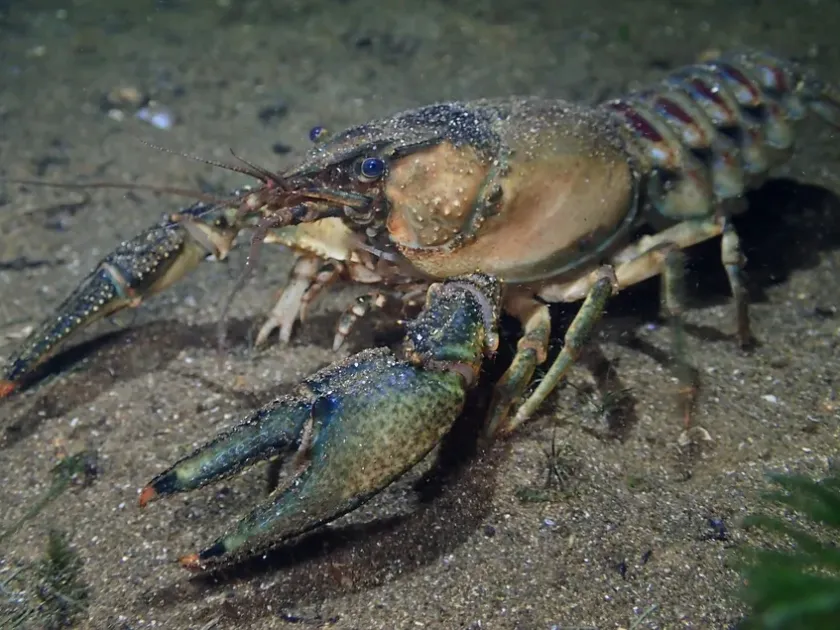
It is identifiable by distinct dark transverse stripes on the abdominal segments and reddish-orange tips on its claws. The carapace color ranges from light brown to olive-green, providing effective camouflage in murky water.
Adult individuals typically grow to a length of 10 to 12 centimeters. They are highly adaptable, capable of surviving in poor water quality conditions that would be lethal to most native European crayfish species.
The reproduction strategy involves late autumn mating with high fecundity rates. This high reproductive output allows the species to quickly outcompete native rivals and occupy all available niches in a water body.
Crucially, Faxonius limosus is a known vector for the crayfish plague (Aphanomyces astaci). While the spiny-cheek crayfish is resistant, it serves as a carrier that spreads the lethal fungus to susceptible local populations.
What it damages
In agricultural settings, these crayfish cause significant damage by burrowing into banks, canals, and levees. This burrowing activity weakens infrastructure and leads to costly erosion and water loss through leaks.
In rice paddies and aquatic plant nurseries, the crayfish cut off plant stalks, directly reducing yield. They consume both submerged vegetation and tender sprouts, causing severe depletion of aquatic crops.
Their impact on aquaculture is multifaceted; they prey upon fish eggs, larvae, and juvenile fish. Furthermore, they aggressively compete for limited food resources like benthic invertebrates and zooplankton.
The physical disturbance of the bottom sediment by their digging increases water turbidity. This prevents proper light penetration, negatively affecting the growth of aquatic plants and the overall productivity of the pond ecosystem.
The displacement of native biodiversity is the most significant ecological consequence. Their presence leads to the loss of local crayfish populations and creates a simplified, less resilient aquatic environment.
When it appears
Activity increases during the spring months as water temperatures rise above 8–10 degrees Celsius. Crayfish emerge from their overwintering burrows to forage and establish their territories.
Summer is the peak season for growth and activity. During this period, the crayfish undergo molting, which requires them to feed heavily on protein-rich prey, including fish fry and aquatic larvae.
As water temperatures drop below 6 degrees Celsius in the autumn, the species begins to migrate towards deeper waters or into deeper sections of their burrows for winter protection.
Mating occurs during the autumn, which is often when they are most susceptible to capture via baited traps. Understanding these seasonal shifts is vital for designing effective population suppression programs.
While they are less active in deep winter, they do not enter true hibernation. Any continued activity in irrigation canals during warmer winter spells can still contribute to structural damage of banks.
Signs of infestation
A sudden decline or total disappearance of native crayfish species is the most reliable early warning sign of a Faxonius limosus infestation in a water body.
Visible signs include the presence of numerous small burrows (5–8 cm in diameter) along the banks of canals or ponds. These holes are often clustered and contribute to visible soil instability.
The discovery of shed exoskeletons (molts) washed up on the shoreline is a definitive indicator of an established, growing population. These shells exhibit the signature striped abdominal pattern.
Plants within the vicinity of the water that appear neatly clipped or severed at the base indicate the presence of foraging crayfish. Floating fragments of vegetation are common indicators of their feeding behavior.
Deploying baited traps is the most effective diagnostic method. If trapped individuals match the physical description of the spiny-cheek crayfish, immediate action should be taken to assess the population density.
Control measures
Continuous trapping programs remain the primary method for population suppression. Using high-efficiency traps with protein-based bait can significantly reduce the number of breeding adults.
Preventing the spread of this species is critical. All equipment, boats, and boots used in infested waters must be thoroughly cleaned and disinfected before being transported to other areas.
In pond aquaculture, total drawdown and pond drying, combined with lime treatment of the substrate, is the only effective way to eradicate established populations hidden in the mud and burrows.
Encouraging or stocking native predatory fish such as perch, pike, or catfish can help naturally keep the crayfish population in check by preying on the juvenile crayfish.
Structural protection is essential for irrigation systems. Lining canal banks with stone rip-rap or installing geogrids can physically prevent crayfish from burrowing, thereby protecting the integrity of the infrastructure.
Taxonomy
- Latin name
- Faxonius limosus
- Family
- Cambaridae
- EPPO code
- ORCOLI
Discussion
No discussions yet — be the first.