
White river crayfish
Procambarus acutus
Description
How to identify
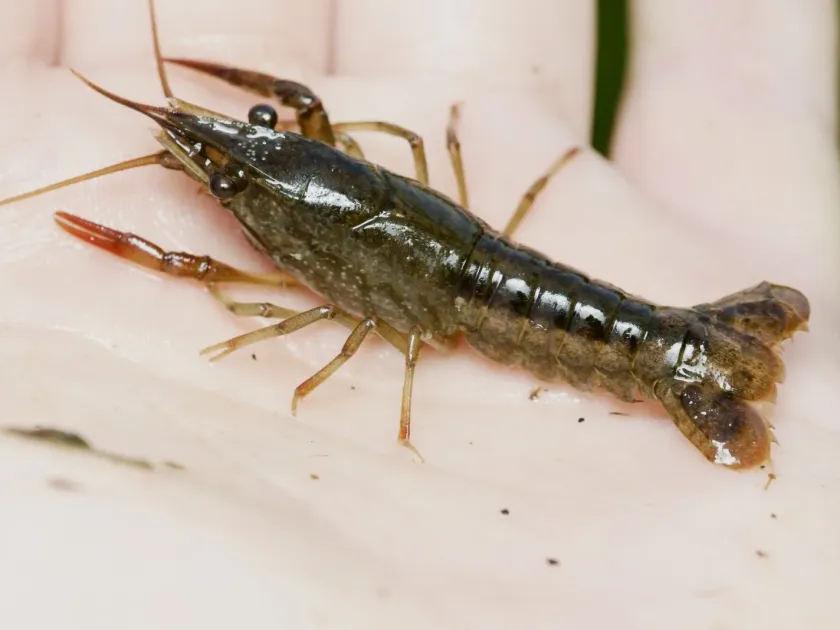
The white river crayfish (Procambarus acutus) belongs to the order Decapoda and the family Cambaridae. It is a highly invasive species known for its reddish-brown to light-brown body coloration.
The species possesses sharp spines on its carapace and powerful claws adapted for burrowing and clipping vegetation, which makes it a significant threat to young aquatic crops.
Adult individuals typically reach a length of 10 to 12 centimeters, although growth rates depend heavily on environmental conditions and available food sources within the habitat.
Their biological cycle includes an egg-laying stage where females carry eggs on their pleopods. The incubation time is temperature-dependent, allowing for rapid population expansion in warm climates.
These crayfish are extremely resilient, capable of surviving in low-oxygen water and enduring long dry periods by retreating into deep, self-constructed underground burrows.
What it damages
Rice crops are the primary target of this pest. The crayfish clip off young rice seedlings at the base, which leads to total crop loss during the early stages of plant development.
Besides rice, the species causes damage to other wetland and aquatic crops, including lotus and various reeds, by consuming roots and tender stems in aquaculture systems.
The burrowing behavior of the crayfish damages irrigation infrastructure, including levees and canals, leading to significant water loss and disruption of required hydraulic regimes.
As an invasive species, it competes with native fauna and can act as a vector for various aquatic diseases that negatively affect the health of the entire agricultural ecosystem.
The economic damage is severe; in high-density populations, these crayfish can destroy the majority of a rice field in a very short period if left unmanaged.
When it appears
Crayfish activity begins in early spring as water temperatures rise above 12-15 degrees Celsius, prompting them to emerge from their wintering burrows to forage.
The peak period of damage coincides with the planting season and the emergence of young rice sprouts, during which the crayfish are most active in searching for succulent plant material.
Throughout the summer, high metabolism and active breeding ensure that the population maintains a consistent level of pressure on the crop until the water cools in the autumn.
In autumn, as temperatures drop, activity levels begin to decrease, although the crayfish continue to refine their burrows in preparation for the winter dormancy period.
The winter months are spent in deep burrows, protecting the individuals from freezing and ensuring their survival to initiate the next infestation cycle in the following season.
Signs of infestation
One of the earliest signs of infestation is the presence of floating or sunken rice shoots that have been cleanly cut near the base by the crayfish's claws.
The presence of numerous small holes, 3 to 5 centimeters in diameter, along the banks, levees, and irrigation ditches is a telltale sign of a burrowing population.
Noticeable turbidity (cloudiness) in the water, which occurs during calm weather, is often caused by the crayfish moving along the bottom and disturbing the substrate.
Finding discarded exoskeletons after molting along the shoreline or floating in the irrigation water confirms the active growth and development of the population.
Direct observation of the crayfish near the surface, especially during dusk or dawn, serves as a clear indicator of a significant infestation level within the field.
Control measures
Managing the white river crayfish requires an integrated approach that combines mechanical intervention with strategic agricultural practices to minimize damage.
Deep plowing of the fields during the dry season is essential to destroy underground burrow systems and expose the crayfish to natural environmental stresses.
- Installing fine-mesh screens on water intake pipes to prevent colonization.
- Using specialized traps and netting for industrial population reduction.
- Rapid draining of fields to force crayfish out of hiding and into the open.
- Encouraging natural predators such as herons and specific fish species.
- Applying specific molluscicides or pesticides authorized for aquatic use.
Maintaining clean shorelines by removing excessive aquatic weeds reduces the available cover for crayfish and limits their ability to establish stable colonies.
Routine monitoring of irrigation infrastructure is crucial to detect early burrowing activity, allowing for localized control measures before the population spreads across the entire crop.
Taxonomy
- Latin name
- Procambarus acutus
- Family
- Cambaridae
- EPPO code
- PROMAC
Discussion
No discussions yet — be the first.