
Poophilus costalis
Poophilus costalis
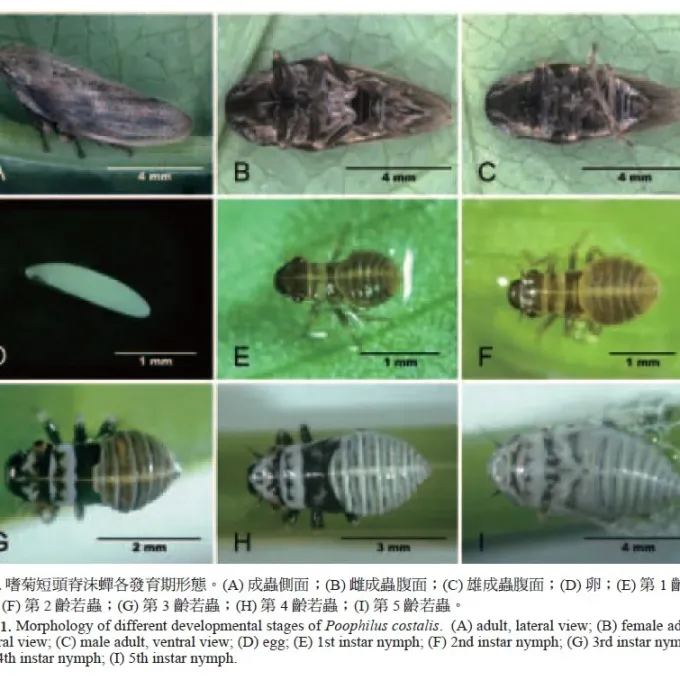
Description
How to identify
Poophilus costalis is a member of the Aphrophoridae family within the order Hemiptera. These insects are commonly known as spittlebugs due to the unique behavior of their nymphs.
The adult form is characterized by a sturdy, wedge-shaped body, typically measuring around 10 mm in length. A defining feature is the pale or white marginal stripe on the forewings, which distinguishes this species.
Nymphs are easily identified by the white, bubbly foam they produce. This "spittle" is secreted from their anal glands and helps prevent desiccation while providing cover from predators.
As true bugs, they possess a piercing-sucking mouthpart (proboscis), which they use to feed on the xylem and phloem fluids of various host plants throughout their lifecycle.
The species prefers habitats with sufficient vegetation, often residing in meadows, pastures, and cereal fields where the environmental conditions facilitate their developmental stages.
What it damages
Poophilus costalis is a polyphagous pest, meaning it feeds on a wide range of plants, including cereals, legumes, and several forage crops, causing economic damage.
The feeding activity of both nymphs and adults removes vital fluids from the plant, which leads to metabolic stress, reduced photosynthetic capacity, and stunted development.
In addition to sap loss, the saliva injected by the insect during feeding can cause local tissue damage, often resulting in yellowing, leaf curling, and necrosis at the site of the puncture.
A significant risk associated with this pest is its potential to act as a vector for various plant diseases, including phytoplasmas that can cause severe physiological disorders in crops.
When infestation levels are high, the impact on grain yield is substantial, manifesting as shriveled kernels and reduced overall biomass of the plant population.
When it appears
The lifecycle begins in the spring when eggs, which overwintered on plant debris or in soil crevices, hatch into nymphs as temperatures rise to favorable levels.
The nymphal stage is most active from late spring to early summer, matching the period of rapid plant growth. This is when the characteristic foam nests are most abundant on the stems.
Adults typically emerge by mid-summer. They are highly mobile and are capable of migrating between fields, spreading the infestation to healthy crops or neighboring areas.
Depending on the climatic zone, the insect may complete one or more generations per year, with activity peaking during warm, humid conditions that support nymphal development.
As the season draws to a close, adults lay eggs in protected spots near the base of host plants or within stem sheaths, where the eggs remain in diapause through the winter.
Signs of infestation
The most reliable sign of an infestation is the presence of frothy spittle masses on the stems, leaf axils, or flower heads of the host plants during the spring months.
Visually, plants may exhibit signs of nutrient deficiency, such as chlorosis or stunted internodes, due to the persistent feeding of the pest population.
Leaves may show signs of wilting or distortion even when soil moisture is adequate, indicating a disruption in the vascular transport caused by insect feeding.
In the field, adults are easily startled and will perform short, agile jumps when vegetation is disturbed, making them difficult to capture without a sweep net.
Severe infestations often result in patchy growth and uneven field maturation, which are common hallmarks of damage caused by sucking insects like Poophilus costalis.
Control measures
Effective management begins with sanitation: removing weeds and crop residues after harvest significantly reduces the number of suitable sites for overwintering eggs.
Tillage practices, such as deep plowing or harrowing, are highly effective in destroying overwintering populations and disrupting the lifecycle before the new season begins.
Chemical control should be employed only when monitoring reveals that populations have exceeded economic thresholds, using systemic or contact insecticides.
Timing of insecticide application is critical; targeting the nymphal stage is more efficient, as their mobility is limited and they are more susceptible to chemical agents.
Integrated Pest Management (IPM) strategies, including the preservation of natural predators like spiders and parasitic wasps, can help keep population densities below damaging levels.
Taxonomy
- Latin name
- Poophilus costalis
- Order
- Hemiptera (bugs, aphids, leafhoppers)
- Family
- Cercopidae
- EPPO code
- POOPCO
Discussion
No discussions yet — be the first.