
Aspen buprestid
Poecilonota
Description
How to identify
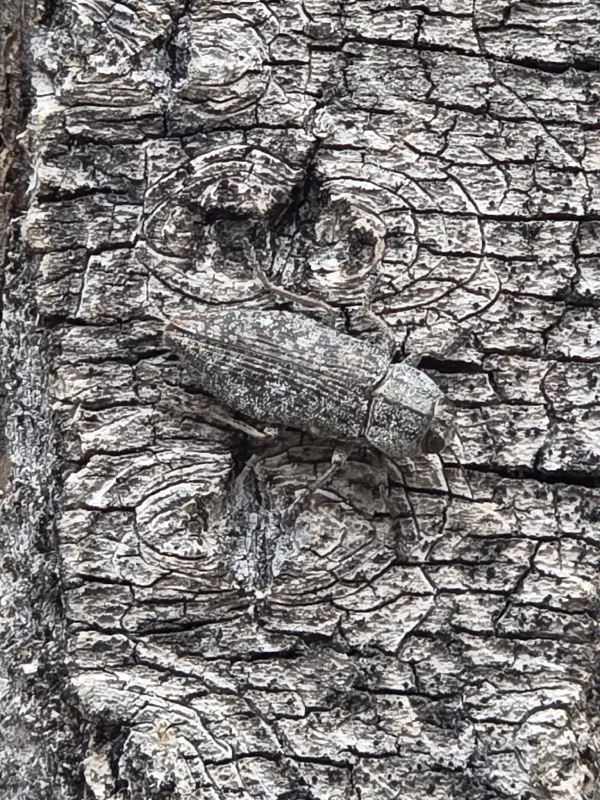
The aspen buprestid (Poecilonota variolosa) is a member of the Buprestidae family, known as metallic wood-boring beetles. The adult beetle typically reaches a length of 15 to 25 millimeters.
The body is characterized by a metallic bronze or greenish-copper color. The elytra (wing covers) feature numerous tiny pits and depressions, creating a textured surface that reflects light effectively.
The larvae are legless and have a distinctly flattened, broadened thorax. This morphological adaptation allows them to move efficiently through the cambium layers of their host trees.
The life cycle is long, often spanning two to three years. Adults are active during the day, commonly found on sun-exposed trunks of host trees during the summer months.
Females lay eggs in bark crevices, where the larvae begin their development after hatching, gradually boring deeper into the inner bark and sapwood.
What it damages
This pest primarily targets trees within the Populus genus, with a strong preference for aspen and poplar species. It rarely attacks healthy, vigorous trees.
Infestation usually occurs on trees that have been weakened by environmental stressors such as prolonged drought, frost damage, or mechanical injuries to the bark.
The larval stage causes the most significant damage by feeding on the cambium and xylem. This activity severs the flow of nutrients and water, eventually leading to branch dieback.
Repeated attacks by successive generations can lead to the death of the entire tree. Such weakened trees act as breeding grounds, increasing the overall risk to the surrounding stand.
The economic impact is reflected in timber degradation and the loss of aesthetic value in ornamental urban landscaping and park environments.
Signs of infestation
The most reliable sign of an infestation is the presence of small, oval-shaped exit holes on the tree trunk, left behind by emerging adult beetles.
Crown thinning, yellowing foliage, and premature leaf drop are common visible indicators that the tree's vascular system has been compromised by larval feeding.
Peeling away the bark reveals extensive, meandering galleries filled with frass (wood dust and excrement), which are characteristic of buprestid larval activity.
Stunted growth, bark cracking, and localized necrosis on the trunk surface are often observed in heavily infested or long-term colonized trees.
In mid-summer, adult beetles may be spotted resting on the trunk, mating, or feeding on leaves, often congregating in areas with high sunlight exposure.
Control measures
The primary management strategy involves strict sanitation measures, specifically the removal and destruction of infested wood before the next adult emergence period.
Maintaining tree vigor through proper irrigation and soil nutrient management is crucial, as healthy trees are better equipped to produce resin and callus tissue to deter larvae.
Encouraging natural predators, especially woodpeckers, is an effective biological control method, as they are capable of extracting larvae directly from the tree trunk.
Chemical control is generally difficult due to the cryptic life cycle of the pest; however, contact insecticides may be applied to trunks to deter egg-laying in high-value areas.
- Regular site monitoring during the growing season.
- Prompt disposal of downed logs and dead standing timber.
- Preventing mechanical bark damage during maintenance operations.
Taxonomy
- Latin name
- Poecilonota
- Order
- Coleoptera (beetles)
- Family
- Buprestidae
- EPPO code
- POELSP
Discussion
No discussions yet — be the first.