
Holub's golden weaver
Ploceus xanthops
Description
How to identify
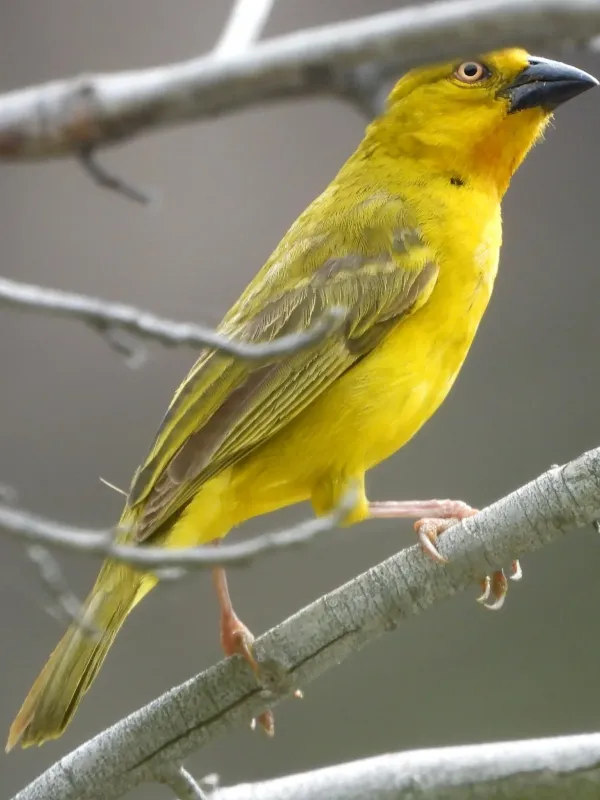
Holub's golden weaver (Ploceus xanthops) is a bird species belonging to the Ploceidae family, order Passeriformes. These birds are known for their striking golden-yellow plumage, making them conspicuous in their natural habitat.
Adults typically measure around 18–20 cm in length. During the breeding season, the male displays a vivid yellow head and underparts, while the upper parts are olive-green with dark markings, providing camouflage in the foliage.
They are primarily found in sub-Saharan Africa, inhabiting damp savannas, riverine forests, and the edges of cultivated agricultural landscapes where they find abundant nesting sites.
The biology of the species involves building complex, intricately woven hanging nests. These nests are often suspended from the tips of branches, sometimes over water to protect eggs from predators.
As social birds, they often gather in small groups or colonies, which increases their potential impact on local agriculture when they forage in nearby fields during the ripening season.
What it damages
The primary agricultural damage caused by these weavers occurs in cereal crops such as maize, sorghum, and millet. The birds feed on developing grains during the milk and soft-dough stages.
By consuming grains directly from the ears and cobs, they cause significant yield losses. Their feeding habits also lead to structural damage to the plants, reducing the overall commercial quality of the harvested produce.
Beyond grains, they may also damage rice and sunflower crops if these are grown near their nesting colonies or preferred resting zones during the migration or seasonal dispersal.
Direct consumption is coupled with mechanical damage to stems and leaves. This physical stress often creates entry points for fungal spores and pathogens, leading to secondary plant diseases.
The economic impact can be severe in regions where farming is intensive. A large flock of these weavers can devastate a harvestable portion of a field within a very short timeframe.
Control measures
Effective management strategies include the use of acoustic repellents, such as recorded distress calls of raptors or loud sonic devices designed to deter birds from entering the field perimeter.
Visual deterrents, including reflective tapes, scarecrows, and laser-based bird repelling systems, are widely utilized to protect high-value plots from weaver bird interference.
Agricultural practices should emphasize the modification of the landscape, specifically the clearing of dense scrub or trees adjacent to fields, which often serve as primary nesting or roosting habitats.
Physical exclusion remains the most reliable method for small-scale operations. Installing fine-mesh bird netting over crops acts as an impassable barrier that prevents birds from reaching the fruit or grain.
Integrated pest management (IPM) programs, which monitor bird population levels and combine multiple deterrence techniques, are essential for sustained crop security against avian pests like the golden weaver.
Taxonomy
- Latin name
- Ploceus xanthops
- Family
- Ploceidae
- EPPO code
- HPHAXA
Discussion
No discussions yet — be the first.