
Northern masked weaver
Ploceus taeniopterus
Description
How to identify
The Northern masked weaver (Ploceus taeniopterus) is a species of bird in the Ploceidae family. Known for its complex nesting habits, it lives in large, noisy colonies across various African habitats.
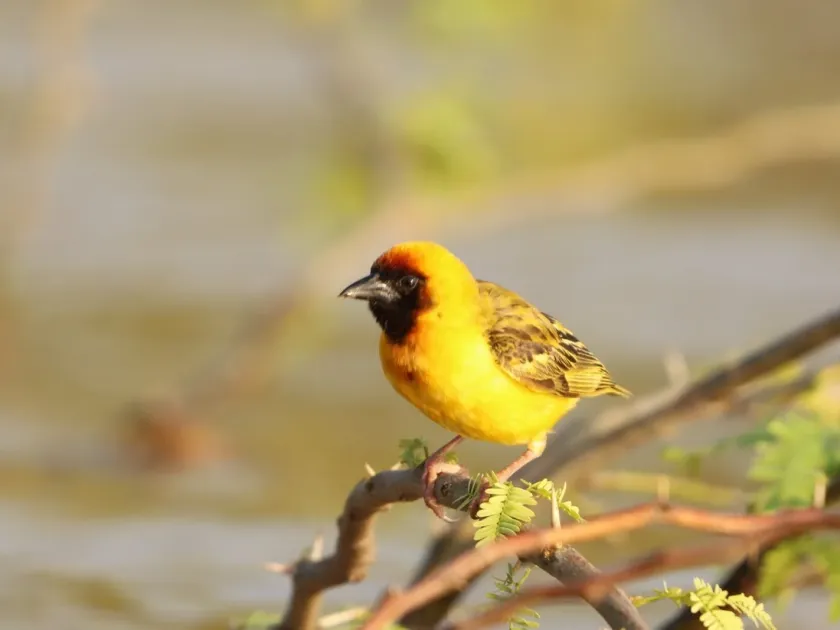
Males are easily identified during the breeding season by their brilliant yellow plumage and a distinct black mask covering the eyes and throat. Females and non-breeding males possess more muted, olive-brown tones.
These birds are highly social and exhibit strong colonial behavior. Their high density in certain areas makes them significant agricultural pests, as they consume large quantities of grain seeds.
The species is well-adapted to environments near water and wetlands, where they construct elaborate hanging nests. These locations often place them in close proximity to irrigated cereal crops.
Their breeding cycle is closely tied to the availability of food sources, which often leads to an explosion in population during the ripening stages of local grain crops.
What it damages
The Northern masked weaver is notorious for damaging cereal crops such as sorghum, pearl millet, wheat, and rice. They primarily target the grains during the milk and dough stages of development.
A flock of these weavers can strip a field of its grain in a very short amount of time. They not only eat the seeds but also damage the stalks and ears, leading to significant yield losses.
Physical damage to the plants occurs when massive flocks land on the crops, causing stems to bend or break. This type of damage can lead to lodging and make the crop difficult to harvest mechanically.
Fields situated near nesting colonies or water sources are at the highest risk of attack. The economic impact can be devastating, sometimes reducing potential yields by over 40% in affected areas.
Beyond seed consumption, their presence can introduce secondary issues like increased humidity in the canopy due to foliage trampling, which favors the growth of certain molds.
When it appears
The activity of the weaver is synchronized with the phenology of the grain crops. They appear in the fields precisely when the grain becomes nutrient-rich and soft enough for their beaks.
The breeding season often coincides with the crop harvest window, which provides a high-energy food source for the chicks. This creates a challenging situation for agricultural management.
The birds are most active during the early morning and late afternoon. These times are critical for monitoring and implementing scaring measures to prevent large-scale consumption of the grains.
During dry seasons, these birds are known to travel significant distances to find water and food, frequently targeting irrigation zones where grain remains available.
As the grain hardens and reaches full maturity, the attraction for weavers decreases, and they eventually move on to other food sources or nesting areas.
Signs of infestation
A clear sign of Northern masked weaver infestation is the appearance of shredded or empty ears of corn or stalks of millet. The grain has been systematically removed from the rachis.
Large, noisy flocks flying in a synchronized manner over the fields are an obvious indication of their presence. The sound of a large colony is easily recognizable from a distance.
The presence of hanging, woven nests in nearby trees or shrubs is a warning sign that the field is likely to be targeted by the colony once the grain begins to mature.
Small piles of seed hulls and chaff on the ground beneath the plants suggest that the flock has been feeding in that specific section of the field.
Localized areas of flattened or broken stems within a field are indicative of where the flock has been congregating and feeding most intensively.
Control measures
Managing the Northern masked weaver requires an integrated approach focusing on deterrence and habitat modification to protect the crops from large-scale damage.
Acoustic deterrents, such as propane cannons or recordings of predator calls, are commonly used to scare flocks away from the fields during the critical ripening stages.
- Installing visual scarecrows and reflective materials.
- Harvesting crops as early as possible to minimize exposure time.
- Managing nearby nesting sites to reduce the resident population.
- Using protective netting for small-scale plots or high-value trials.
Reducing the availability of water and shelter near the crops is a long-term strategy to discourage colonies from establishing themselves in the immediate vicinity of farmland.
Cooperation between neighboring farmers is essential. Since the weavers are mobile, uncoordinated efforts on single fields may simply shift the pest pressure to adjacent properties.
Taxonomy
- Latin name
- Ploceus taeniopterus
- Family
- Ploceidae
- EPPO code
- HPHATA
Discussion
No discussions yet — be the first.