
Baya weaver
Ploceus philippinus
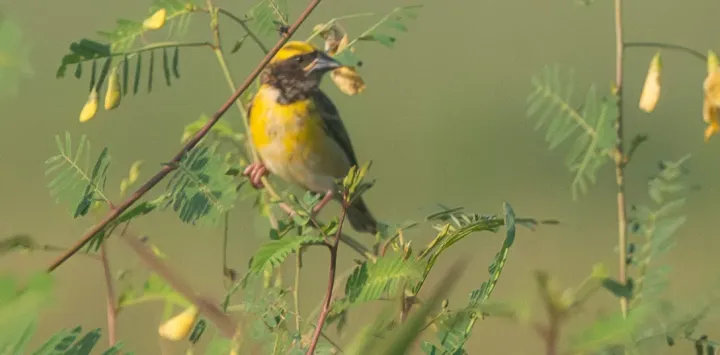
Description
How to identify
The Baya weaver (Ploceus philippinus) is a small bird of the weaverbird family, known for its strong, conical beak and highly social behavior.
During the breeding season, the male develops bright yellow plumage on the crown and breast, making it easily distinguishable from other small birds.
Females and non-breeding males possess a dull, streaked brown appearance, which serves as camouflage in the dense grasslands and palm trees they inhabit.
They are famous for constructing elaborate, retort-shaped hanging nests, which are woven from long strips of paddy leaves or similar grasses.
These birds nest in large, noisy colonies, often in trees located near or amidst agricultural fields, which puts their food source right next to their habitat.
What it damages
The Baya weaver is considered a significant pest in rice-growing regions because it feeds primarily on the seeds of cereal grasses.
When the rice crop reaches the milk or dough stage of grain development, the birds swarm the fields and consume a substantial amount of the grains.
In addition to rice, they frequently target sorghum, millet, maize, and wheat crops, causing localized but intense economic losses.
Mass feeding behavior often involves large flocks descending on a single field, stripping the grain from the stalks in a very short timeframe.
The weight of the flock landing on the stalks can also cause the rice plants to lodge, leading to secondary damage such as grain rotting on the damp soil.
When it appears
The period of greatest pest pressure occurs during the ripening phase of the crops, coinciding with the peak breeding season of the weaver birds.
Since these birds can breed multiple times a year, their population pressure on crops remains high throughout the extended agricultural season.
During the off-season, they congregate into massive nomadic flocks that move across large areas in search of the most accessible food resources.
Activity is most pronounced during the early morning and late afternoon hours, when flocks travel between their roosting sites and the feeding grounds.
Migratory movements and feeding habits are strongly regulated by the availability of cultivated grains, which are preferred over wild seeds.
Signs of infestation
Presence is first indicated by the continuous, high-pitched chatter of large flocks and their visible movement over the fields.
Visual inspection of the crop reveals stalks that have been stripped of grains, leaving empty husks on the panicles.
Irregular patches of flattened or lodged crops often mark the areas where the flocks have spent considerable time feeding.
The presence of hanging, bottle-shaped nests in nearby trees or vegetation is the most reliable indicator of a potential infestation.
Discarded husks on the ground beneath the plants and the accumulation of bird droppings serve as clear indicators of high avian activity.
Control measures
Effective control measures include the use of acoustic deterrents, such as sirens or recordings of hawk calls, to break the feeding rhythm of the flocks.
Visual deterrents like reflective ribbons, scarecrows, or wind-activated spinners can provide short-term protection if moved frequently.
In smaller high-value plots, covering the crop with fine-mesh netting is the only method to achieve near-total exclusion from bird damage.
A synchronised planting strategy, where all farmers in a region plant at the same time, helps spread the risk and minimizes the duration of the vulnerable crop window.
- Removal of nesting habitat in non-cultivated areas.
- Use of scaring devices during the ripening phase.
- Encouragement of natural predators, such as raptors, near the fields.
Taxonomy
- Latin name
- Ploceus philippinus
- Family
- Ploceidae
- EPPO code
- PLOCAT
Discussion
No discussions yet — be the first.