
Artichoke plume moth
Platyptilia carduidactyla
Description
How to identify
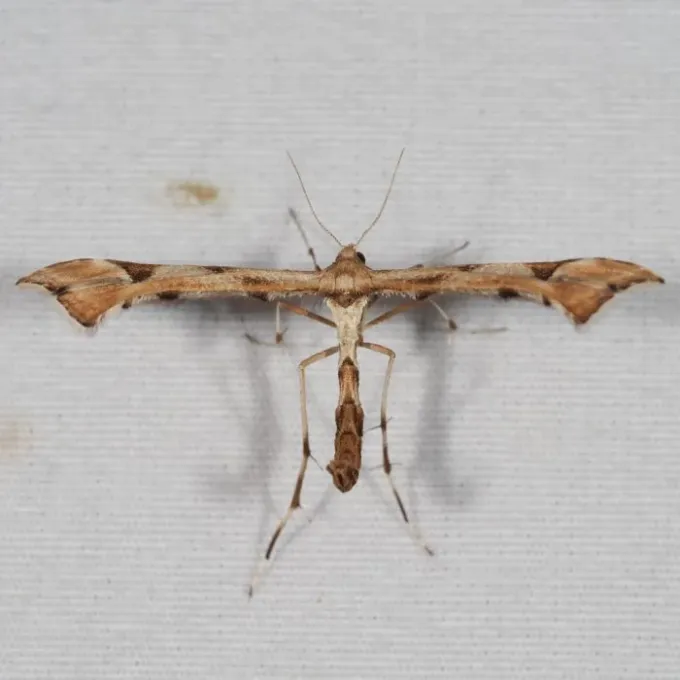
The artichoke plume moth (Platyptilia carduidactyla) belongs to the order Lepidoptera, family Pterophoridae. Adult moths are easily identified by their narrow, deeply cleft wings that resemble feathers.
When resting, the wings are folded in a way that gives the moth a distinctive T-shape profile. The typical coloration ranges from brownish-grey to ochre with subtle dark markings.
Larvae are small, reaching up to 15–20 mm in length. Their body color is generally cream or yellowish-green, often featuring a dark head and scattered bristles on the segments.
Pupation usually occurs on the host plant, with the pupae being either greenish or brownish, often well-camouflaged against the plant stems and leaves.
These moths are primarily nocturnal, which often makes visual identification of adults in the field challenging without the use of light traps or pheromone lures.
What it damages
The primary host plant for this pest is the globe artichoke, where it causes significant economic losses by damaging the harvestable buds.
The larvae are also known to feed on various wild thistle species (Cirsium and Carduus), which act as a reservoir for the pest in agricultural landscapes.
Damage is caused by larvae boring into the developing buds and stems. They consume the internal soft tissues, causing necrosis and malformation of the flower buds.
Besides direct tissue consumption, the feeding tunnels allow pathogens to enter the plant, leading to secondary rot and further degrading the quality of the harvest.
In severe infestations, the larvae can tunnel into the central shoot, which may stunt the growth of the entire plant and lead to a total loss of the bud production.
When it appears
The lifecycle of the artichoke plume moth varies based on local climatic conditions, typically featuring several overlapping generations per growing season.
Winter is usually spent as larvae within the stems or crowns of host plants, including perennial thistles, which provides them with winter protection.
Adult moth activity begins in the spring when temperatures rise, leading to mating and the start of egg-laying on the host plants.
Eggs are typically deposited on the underside of leaves or at the base of the buds, ensuring that newly hatched larvae have immediate access to food.
Population levels generally peak during the summer months, coinciding with the development of the artichoke crop, leading to intensified damage during this period.
Signs of infestation
A primary indicator of infestation is the presence of larval frass (excrement) around the base of the buds or near the entry holes on the stems.
Visible entry holes, often accompanied by dark staining or sap exudation (gummosis) on the bud surface, are clear signs of larval boring activity.
Affected flower buds often show signs of distortion, premature wilting, or failure to open properly, which is a key symptom for growers to monitor.
Opening an infested bud will reveal internal tissue damage and the presence of the larva itself, which is the most definitive sign of an active infestation.
The presence of adults around the crop during the evening or night hours can also serve as an early warning for potential upcoming larval pressure.
Control measures
Management of the artichoke plume moth requires an integrated pest management (IPM) approach to minimize chemical reliance and maximize efficacy.
- Sanitation practices: Thoroughly removing and destroying crop residues and infested plant debris after harvest to reduce overwintering populations.
- Weed management: Eliminating wild thistle reservoirs in the vicinity of artichoke fields to reduce initial infestation sources.
- Monitoring: Utilizing pheromone traps to detect adult activity and timing insecticide applications correctly for maximum larval control.
- Biological control: Encouraging natural predators and using Bacillus thuringiensis sprays during the egg-hatch stage.
- Chemical control: Applying selective insecticides based on economic thresholds to target young larvae before they burrow deep into the buds.
Taxonomy
- Latin name
- Platyptilia carduidactyla
- Order
- Lepidoptera (butterflies)
- Family
- Pterophoridae
- EPPO code
- PLALCA
Discussion
No discussions yet — be the first.