
Japanese green woodpecker
Picus awokera
Description
How to identify
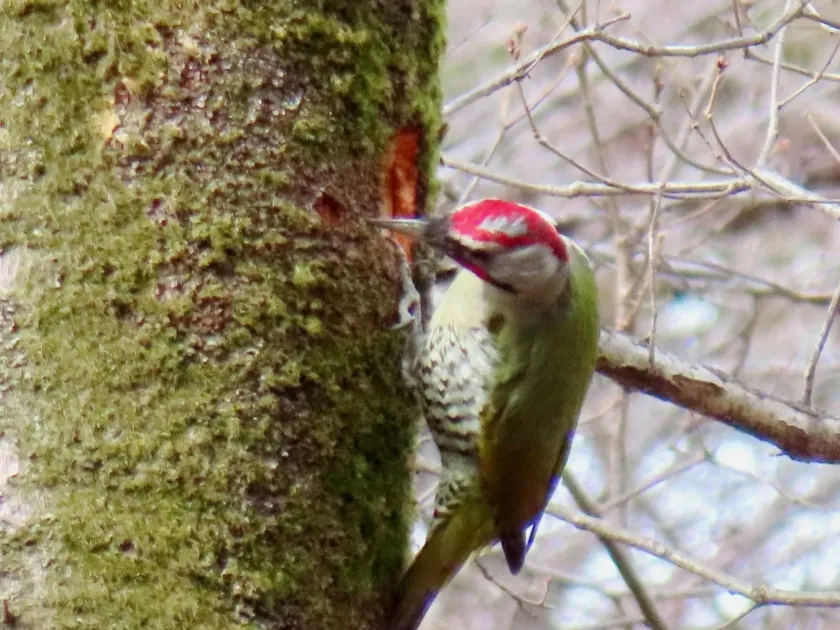
The Japanese green woodpecker (Picus awokera) is a species of bird in the Picidae family, endemic to Japan. It is characterized by its vibrant olive-green plumage, which provides excellent camouflage in forest environments.
Males possess a distinctive red mustache mark and a bright red crown, while females show less prominent coloration. Adults reach a length of approximately 30 cm, making them a significant avian presence in their habitat.
The bird is equipped with a robust, chisel-like beak designed for powerful pecking into wooden surfaces. While primarily forest-dwelling, it frequently enters orchards and suburban gardens.
Unlike some other woodpeckers, the Japanese green woodpecker is often seen foraging on the ground for ants; however, it readily switches to arboreal foraging when targeting wood-boring larvae.
Its call is a loud, rattling series of notes, which is often the earliest indicator of its arrival in a specific area of the garden or orchard.
What it damages
This woodpecker targets various orchard trees, including apple, pear, and stone fruits. It causes damage by drilling deep holes into the trunks and primary branches to reach wood-boring insects.
The pecking activity compromises the tree's vascular system, particularly the cambium layer, which is essential for nutrient and water transport.
These deep excavations serve as entry points for pathogens, including fungi and bacteria, which lead to wood decay and secondary infections like necrosis.
Young saplings are at high risk, as a single series of deep pecks around the trunk circumference can girdle the tree and cause it to wither rapidly.
The economic impact manifests in reduced fruit yields, degraded timber quality, and the high cost of maintenance required to heal or remove severely infested trees.
When it appears
The peak period of woodpecker activity occurs in the spring when birds are nesting and require a high-protein diet, such as insect larvae, to feed their fledglings.
During the summer months, the activity of wood-boring beetles increases, which in turn attracts the woodpeckers, leading them to intensify their damage to orchard trees.
Autumn activity can persist as the birds continue to forage, although it may decrease as insects move deeper into the heartwood to overwinter.
Winter remains a potential threat period, as the birds search for dormant larvae and pupae within the rough bark or damaged sections of the trunk.
Overall, the damage cycle is closely linked to the seasonal phenology of the trees and the presence of accessible prey within the bark structure.
Signs of infestation
Visible piles of wood chips and bark debris at the base of the trunk are the most obvious indicators that a woodpecker has been working on the tree.
Small, neat, and deep holes in the trunk, often arranged in vertical or horizontal rows, are diagnostic signs of woodpecker feeding behavior.
Excessive sap flow or gumming from the damaged areas is a common sign, indicating that the bird has breached the bark and disturbed the tree's internal circulation.
Unexpected branch dieback or yellowing of leaves in localized areas often correlates with a cluster of deep pecking holes found on the corresponding branch.
Persistent drumming sounds heard early in the morning confirm the woodpecker's active presence and immediate threat to the tree's structural integrity.
Control measures
Utilizing visual deterrents such as reflective tapes, spinning mirrors, or realistic predator silhouettes can effectively discourage woodpeckers from approaching the orchard.
Ultrasonic bird repellers, which emit frequencies that disrupt the birds' environment or mimic alarm calls, offer a non-invasive way to manage their presence.
Physical protection, such as wrapping the trunks of valuable young trees with hardware cloth or specialized protective netting, provides an effective barrier.
Proactive treatment of tree wounds with horticultural sealants or fungicides is vital to prevent decay and secondary disease development after a pecking incident.
- Manage wood-boring insect populations through integrated pest management to reduce the food source that attracts woodpeckers.
- Remove deadwood and severely infested branches that serve as primary foraging sites.
- Maintain tree health through proper fertilization and pruning to ensure the tree can withstand minor bark injuries.
Taxonomy
- Latin name
- Picus awokera
- Family
- Picidae
- EPPO code
- PICUAW
Discussion
No discussions yet — be the first.