
Japanese pygmy woodpecker
Dendrocopos kizuki
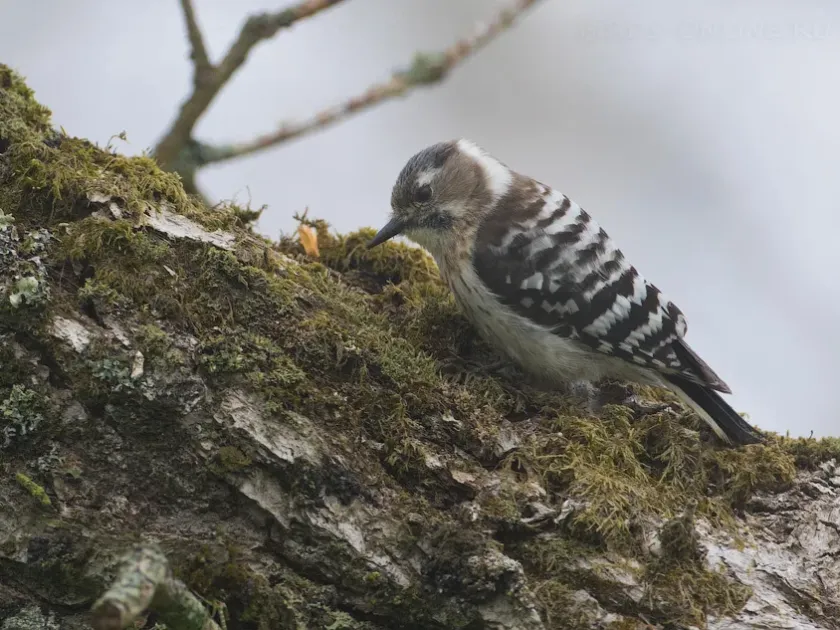
Description
How to identify
The Japanese pygmy woodpecker (Dendrocopos kizuki) belongs to the Picidae family within the Piciformes order. It is one of the smallest woodpecker species, reaching approximately 15 cm in length.
Its plumage is predominantly brownish-grey with distinctive horizontal white bars on the wings and tail, which serves as camouflage against tree bark.
The underparts are lighter, featuring subtle dark streaks. Its small, sharp beak is highly evolved for excavating small holes to extract larvae from deep within the bark.
These birds are known for their high activity levels and agile movement, often climbing vertically or horizontally along tree branches in search of food.
Despite their small size, they exhibit significant territorial behavior and can be persistent when hunting for prey on a suitable host tree.
What it damages
This woodpecker primarily causes damage to orchards, targeting species such as apples, pears, and plums. It is considered an occasional pest in commercial and private horticulture.
The damage occurs when the bird perforates the bark to reach wood-boring insects. These holes often penetrate deep into the cambium layer, disrupting the tree's natural sap flow.
By creating multiple small holes, the woodpecker significantly reduces the structural integrity of the bark and increases the tree's susceptibility to physical stress.
The exposed inner wood becomes a primary site for fungal infections, bacterial rot, and further infestations by secondary insect pests, leading to branch decline.
Young shoots and buds can also be damaged during the spring season, causing localized loss of foliage and potentially impacting the fruit production cycle.
When it appears
Activity is most pronounced during the early spring when birds are actively foraging to meet nutritional requirements before the breeding season begins.
The autumn season also presents a high risk as the birds prepare for winter, increasing their frequency of visits to orchards to exploit overwintering insect populations.
During the winter months, when natural food sources are scarce, these woodpeckers frequently visit orchards, systematically exploring trees for wood-dwelling larvae.
The intensity of tree damage usually corresponds with the lifecycle of the insects living under the bark, which the woodpecker preys upon throughout the year.
Seasonal fluctuations in temperature and food availability dictate the frequency and duration of the woodpecker's presence on specific orchard sites.
Signs of infestation
The most visible sign of infestation is the presence of neat, closely spaced rows of small, round holes on the surface of the tree bark or branches.
Fresh wood debris, sawdust, or small bark chips found at the base of a tree are clear indicators of recent feeding activity by the Japanese pygmy woodpecker.
The physical appearance of the bark often changes, showing visible pits or scars that may ooze sap depending on the tree species and the season of the damage.
A decline in tree vigor, characterized by leaf yellowing or stunted branch growth in affected areas, suggests long-term feeding pressure from the woodpecker.
Repeated attacks on the same tree often lead to patches of dead or peeling bark, which may further jeopardize the health of the affected plant.
Control measures
Effective management includes the use of acoustic or ultrasonic deterrents, which can disrupt the woodpecker's activity and discourage them from entering the orchard.
Visual deterrents, such as reflective tape, streamers, or fake raptor silhouettes, are often employed to discourage the birds by creating a hostile environment.
Wrapping the trunks of vulnerable young trees with protective netting or burlap during high-activity seasons provides a physical barrier against woodpecker pecking.
Integrated Pest Management (IPM) to control wood-boring insect populations is essential, as these insects are the primary attractant for the Japanese pygmy woodpecker.
- Pruning and removing infested branches to reduce attractants.
- Applying protective horticultural pastes to seal existing feeding wounds.
- Regular monitoring of tree bark health throughout the growing season.
Taxonomy
- Latin name
- Dendrocopos kizuki
- Family
- Picidae
- EPPO code
- DENPKI
Discussion
No discussions yet — be the first.