
Hairy Woodpecker
Picoides villosus
Description
How to identify
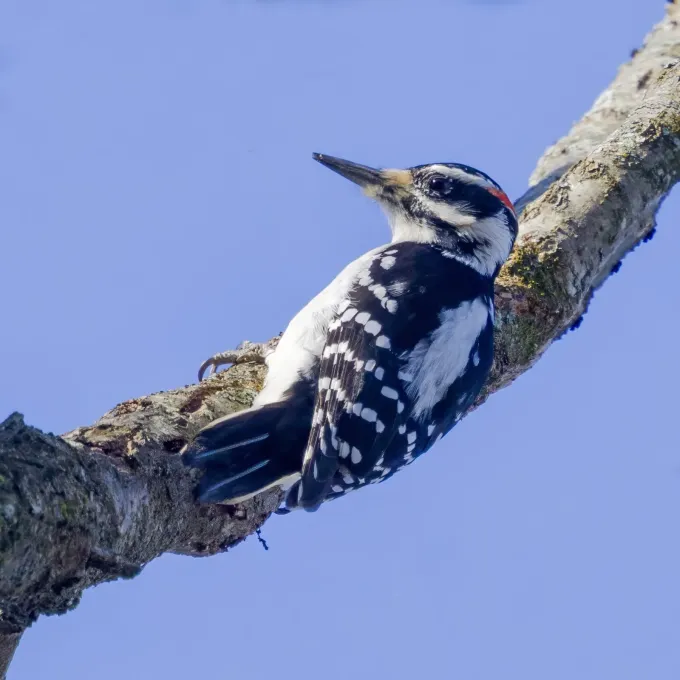
The Hairy Woodpecker (Picoides villosus) belongs to the Picidae family. It is a medium-sized bird with a bold black-and-white plumage pattern and a notably large, chisel-like beak designed for drilling.
The species is distinguished by its white back and distinct outer tail feathers. Males possess a small red patch on the back of the head, which is absent in females and juveniles.
These birds are primarily residential, inhabiting forests and orchards. They are well-adapted for vertical movement on tree trunks, utilizing sharp, curved claws to maintain a firm grip on the bark.
Their biological cycle revolves around searching for wood-boring insects. They play a complex role in the ecosystem, but their habit of excavating nests in trees can cause significant damage to fruit wood.
During the nesting season, their search for larvae is intensified, leading them to investigate trees more thoroughly than at other times of the year.
What it damages
The Hairy Woodpecker causes damage to various fruit trees, including apples, cherries, and pears. The primary issue arises from the bird drilling into the wood to locate larvae under the bark.
Such activity often involves removing large sections of bark and underlying cambium. This action interferes with the tree's vascular system, disrupting the transport of nutrients and water.
Repeated drilling creates structural weaknesses, making the trunk susceptible to breakage during windstorms. These wounds also serve as entry points for pathogens, fungi, and bacterial infections.
Young trees are particularly vulnerable, as even limited drilling can result in partial or full girdling, which threatens the survival of the entire plant.
In addition to direct structural damage, the loss of sap and the stress caused by the drilling can lead to reduced fruit yield and overall tree decline.
Signs of infestation
The most evident sign of woodpecker presence is the appearance of rows of holes in the tree bark. These holes are usually concentrated in specific areas where larvae are suspected to exist.
Piles of wood chips or "sawdust" at the base of the trunk are clear indicators of recent activity. These chips vary in size depending on the force used by the bird.
Exposed wood with deep grooves where the beak has penetrated is a common observation. On stone fruit trees, this is often accompanied by significant gumming or sap flow.
The presence of abandoned nesting holes or exploratory excavations is a strong signal that the tree is being targeted for foraging or habitat.
Wilted or dead foliage on specific branches indicates that the vascular flow has been damaged by the bird's excavation efforts.
Control measures
The most effective strategy for managing the Hairy Woodpecker in an orchard is to control the underlying pest population. Managing wood-boring insects prevents birds from seeking food in the trees.
Visual deterrents, such as reflective tapes, spinning mirrors, or predator decoys, can be used to discourage the birds from landing in the orchard area.
Maintaining tree health through proper pruning and the removal of dead wood reduces the nesting and feeding opportunities for the woodpeckers.
Wounds caused by birds should be promptly sealed with specialized tree paint or grafting wax to protect the inner tissues from fungal infection and promote healing.
- Install protective mesh around vulnerable young tree trunks.
- Utilize ultrasonic bird repellers for constant deterrence.
- Implement strict sanitation practices to remove infested wood.
Taxonomy
- Latin name
- Picoides villosus
- Family
- Picidae
- EPPO code
- DENPVI
Discussion
No discussions yet — be the first.