
Downy woodpecker
Picoides pubescens
Description
How to identify
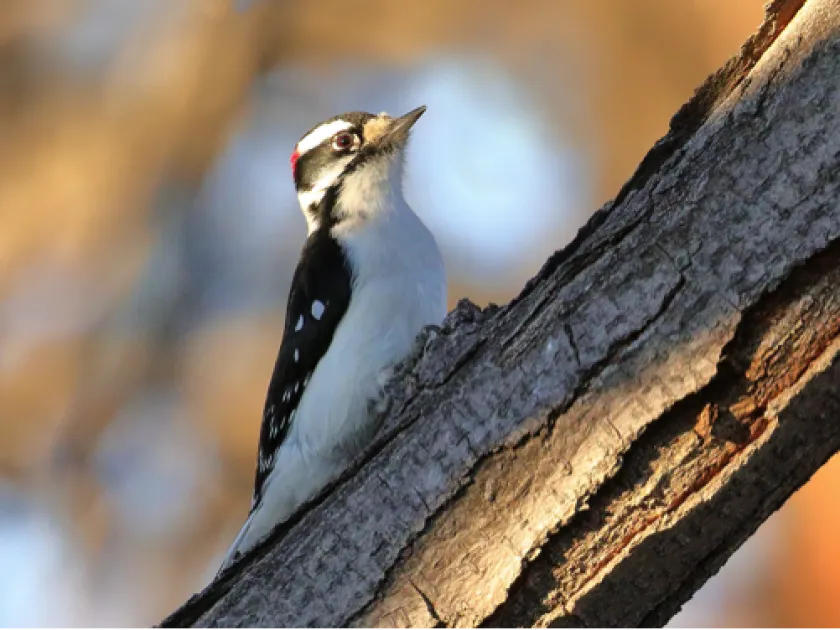
The downy woodpecker (Picoides pubescens) is a member of the Picidae family, widely recognized as the smallest woodpecker species in North America.
It possesses a distinct black-and-white plumage pattern, with adult males featuring a small red patch on the back of their heads, serving as a primary identification mark.
While often considered beneficial for eating wood-boring insects, these birds can become pests in orchards and gardens due to their aggressive pecking habits on living trees.
Their biology is centered around high-energy foraging, which often leads them to drill into the bark of ornamental and fruit trees during periods of food scarcity.
Their small stature allows them to reach delicate branches where larger woodpeckers cannot maneuver, leading to widespread but often subtle damage across a tree canopy.
What it damages
Downy woodpeckers commonly attack fruit-bearing trees such as apple, pear, and cherry, as well as various ornamental deciduous species in the garden.
The primary damage involves the removal of outer bark layers, which can sever the cambium layer that is essential for nutrient transport and tree growth.
These wounds act as entry points for various fungal and bacterial pathogens, leading to cankers, wood decay, and a significant decline in tree health.
In many cases, the physical impact of the pecking reduces the structural integrity of thin branches, making them more susceptible to breakage during wind or snow events.
Repeated foraging on the same tree year after year can weaken even mature specimens, ultimately leading to branch dieback or total tree loss.
Signs of infestation
The most telltale sign of a downy woodpecker is the presence of neatly spaced, small, circular or oval holes arranged in horizontal rows across the bark.
Fresh wood chips and bark debris scattered at the base of the tree are clear indicators that a woodpecker has been active in the area recently.
In the spring, one might observe sap bleeding from the holes created by the bird, which can attract bees, wasps, and other unwanted garden pests.
Leaves on damaged branches may show early signs of wilting or chlorosis because the bird's pecking has compromised the tree's vascular system.
- Neat rows of small holes in the bark.
- Fresh wood shavings at the base of the tree.
- Sap flowing from small circular punctures.
- Premature dieback of small twigs.
Control measures
To discourage downy woodpeckers, the use of visual deterrents like reflective tape, holographic strips, or CDs hung from branches can be effective.
Wrapping the trunks of young or vulnerable trees with hardware cloth or plastic tree guards provides an impenetrable physical barrier against bird activity.
Ultrasonic bird repellers equipped with motion sensors can be placed near valuable trees to scare away woodpeckers without harming them.
Maintaining a healthy orchard through proper pest management reduces the population of insects inside the bark, thereby eliminating the woodpecker's primary food source.
If woodpeckers are causing severe damage, consider installing netting over the canopy of sensitive fruit trees during the peak foraging seasons of winter and early spring.
Taxonomy
- Latin name
- Picoides pubescens
- Family
- Picidae
- EPPO code
- DENPPU
Discussion
No discussions yet — be the first.