
White-headed Woodpecker
Picoides albolarvatus
Description
How to identify
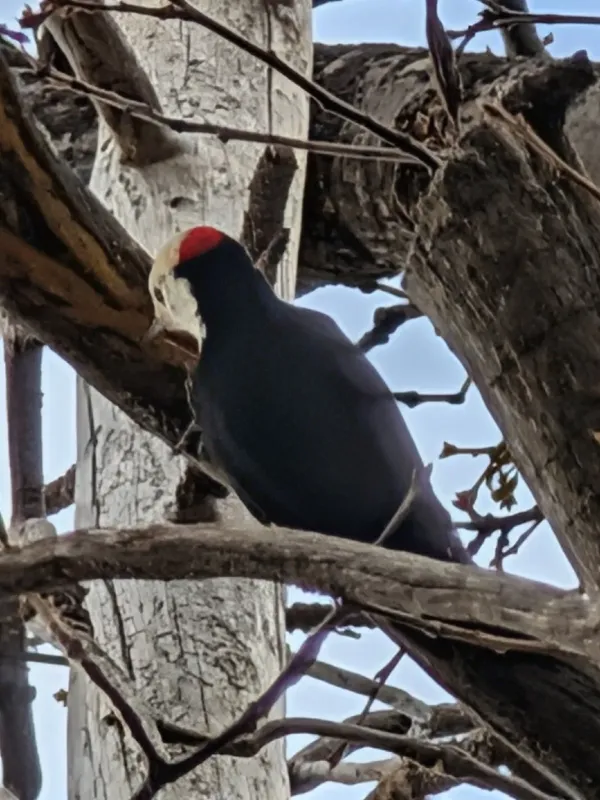
The White-headed Woodpecker (Picoides albolarvatus) is a unique member of the woodpecker family, easily recognized by its entirely white head and throat, contrasted against a solid black body. Males possess a small red patch on the nape.
These birds are predominantly found in the coniferous forests of western North America. They have evolved a specialized bill structure that allows them to forage efficiently by peeling bark from pine trees to reach wood-boring larvae.
Their biological behavior is centered around dense pine stands. Unlike many other species that drill deep into wood, the White-headed Woodpecker focuses on the surface of the bark, which defines their interaction with forest health.
The life cycle involves nesting in cavities of old-growth trees. During the breeding season, the pair is highly active, often visiting young saplings to forage, which can result in noticeable damage to the trees in commercial plantations.
Although they are often considered beneficial for controlling insect outbreaks, their foraging methods can pose a risk to young coniferous trees under specific environmental conditions.
What it damages
The White-headed Woodpecker primarily targets coniferous trees, especially various pine species. The damage occurs when the bird strips large sections of bark to feed on insects, leaving the living cambium exposed to environmental stress.
This exposure creates entry points for fungal pathogens and secondary wood-boring insects, which can lead to localized necrosis or weakening of the tree structure. In severe cases, the bark stripping can girdle the tree.
In commercial forestry, the economic impact is linked to the loss of growth and timber quality. Repeated foraging on young trees can stunt their development and make them more susceptible to drought and disease.
The woodpecker's intensive scaling behavior often leaves significant parts of the tree trunk bare. This mechanical damage disrupts the tree’s natural protective barrier, leading to premature drying of the bark layer.
While the intent is to eliminate harmful insects, the collateral damage to the tree's health is often the primary concern for forest managers who value tree longevity and growth rate.
Signs of infestation
The most distinctive sign of a White-headed Woodpecker is the presence of large, vertical or irregular patches of missing or peeled bark on the main trunk of coniferous trees.
A thick layer of wood chips and bark flakes at the base of the tree is a strong indicator of recent foraging activity. The debris is usually fresh, indicating the bird's presence within the last few days.
Small, shallow gouges in the bark, where the woodpecker has tested for the presence of larvae, are also common. These marks are often clustered in areas where insect activity is high under the bark.
The sound of vigorous pecking or hammering on the bark can be heard in mature and young pine forests during foraging hours. This is a common behavioral signal for forest observers.
Visible resin flow (sap) from the exposed cambium layer indicates that the bird has reached the inner tissue of the tree, which serves as a clear diagnostic sign of significant mechanical damage.
Control measures
Forest management strategies for the White-headed Woodpecker focus on preventative care rather than active eradication, as the species is an essential component of the ecosystem.
The most effective strategy is the maintenance of healthy forest stands through proper thinning and sanitation. Removing dead or severely infested trees reduces the prey population, thereby decreasing the attractiveness of the area to woodpeckers.
For high-value saplings in nurseries or young plantations, mechanical protection such as mesh netting can prevent the bird from accessing the bark, effectively mitigating damage without harming the bird.
Promoting a balanced forest environment helps manage the overall population of wood-boring insects, which reduces the dependency of woodpeckers on scaling healthy commercial trees.
- Regular forest health monitoring and inventory.
- Sanitation logging to remove infested or dead timber.
- Installation of protective barriers on high-value saplings.
Taxonomy
- Latin name
- Picoides albolarvatus
- Family
- Picidae
- EPPO code
- DENPAL
Discussion
No discussions yet — be the first.