

Pest · Coleoptera (beetles) · affects Winter wheat, Winter barley, Fodder beet
Especially harmful
Cereal leaf beetle
Oulema melanopus
Description
How to identify
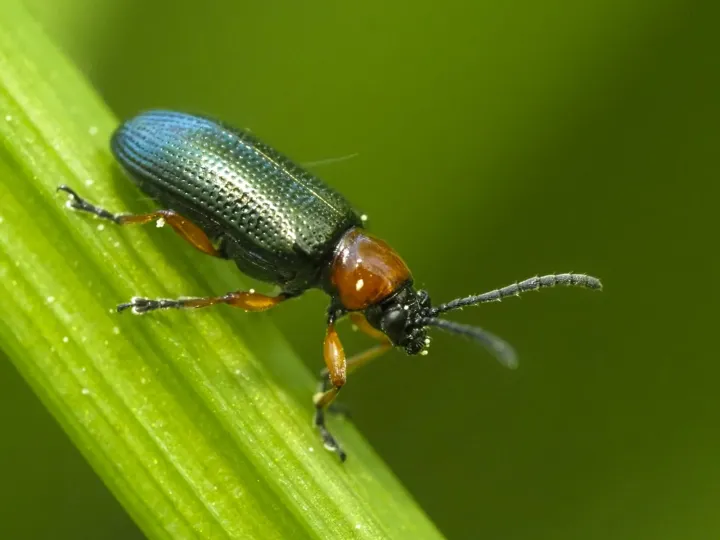
The Cereal leaf beetle (Oulema melanopus) is a member of the leaf beetle family (Chrysomelidae). Adult beetles are approximately 4–5 mm long, characterized by a metallic blue-black wing cover and a bright reddish-orange thorax and legs.
Larvae are easily distinguished by their appearance; they look like small, yellowish-brown slugs. Their body is covered in a slimy, dark excretion that serves as a protective layer against predators and desiccation.
Adults overwinter in sheltered areas like field borders, woods, or perennial grass patches. As temperatures rise in early spring, they emerge to feed on wild and cultivated grasses before laying their eggs.
Eggs are typically laid in a series on the upper surface of cereal leaves. They are small, amber-colored, and dark-spotted, becoming darker as they reach the hatching stage.
The life cycle includes four stages: egg, larva, pupa, and adult. Pupation occurs in the soil, where the insect completes its development in a protective cell before emerging as a new generation of beetles.
What it damages
The Cereal leaf beetle primarily attacks small grain crops, including oats, wheat, barley, and rye. It is considered a significant pest due to its ability to consume large amounts of leaf tissue.
While reports may list various crops like onions, beets, or oilseed rape, these are generally not primary hosts. The beetle is highly specialized for cereal plants, and damage to other crops is typically accidental or incidental.
Both adults and larvae damage the plant. Adults chew small holes in the leaf blades, while larvae scrape away the upper layers of the leaf, creating long, narrow, whitish streaks between the veins.
Heavy infestations result in complete skeletonization of the flag leaf. This reduces the plant's photosynthetic capacity, leading to thin, shriveled kernels and significant yield losses.
In addition to yield loss, severe feeding can stress the plant, making it more susceptible to secondary fungal infections or environmental stressors, further degrading the quality of the harvested grain.
When it appears
Adults emerge from overwintering sites in early spring, usually when temperatures reach about 10–12°C. They quickly migrate to cereal fields to start feeding and mating.
The peak oviposition period occurs during the tillering and stem elongation stages of the cereal crop. Monitoring for eggs during this window is crucial for effective population management.
Larval activity usually reaches its peak in late spring to early summer. This is the period when damage is most visible, as the larvae grow rapidly and consume more foliage daily.
By mid-summer, new adults emerge. They feed for a short time on late-season grasses before moving to their overwintering quarters to endure the winter months.
Environmental factors like a warm, wet spring favor the development of the beetle. Conversely, hot and dry summers can limit population growth by causing premature desiccation of larvae.
Signs of infestation
The most recognizable sign of infestation is the appearance of white, longitudinal stripes on the leaves. These tracks are caused by larvae feeding on the leaf tissue without breaking the lower surface.
Presence of the larvae themselves, which look like dark, slimy, slug-like organisms, is a definite indicator. They are often found in clusters on the upper or underside of the leaves.
The field may take on a bleached or silvery appearance from a distance, which is a classic symptom of high-level infestation. This "frost-bitten" look is a warning sign of severe potential yield loss.
Adult feeding causes irregular, small holes in the leaf blade. While less destructive than larval feeding, it is an early indicator that a population of the beetle is establishing in the field.
The presence of fecal matter on the leaves is a common sign. Larvae carry their black excrement on their backs, creating a dark, shiny coating that is easily visible against the green background of the crop.
Control measures
Integrated pest management starts with cultural practices. Deep plowing can help destroy pupation sites in the soil, and proper crop rotation disrupts the lifecycle of the pest.
Chemical control should be implemented when the economic threshold is reached—typically when there is more than one larva per stem or a significant number of eggs observed on the flag leaves.
Systemic and contact insecticides, such as pyrethroids, are effective. Applications should be timed precisely to target the larvae before they move into the soil for pupation.
Biological control using natural predators and parasitoids, such as the egg-parasitic wasp *Tetrastichus julis*, is highly recommended to suppress the beetle population naturally without synthetic inputs.
Scouting is vital. Regular field inspections using a sweep net or visual leaf count help determine the exact moment for intervention, ensuring that the treatment is both economical and environmentally responsible.
In brief
30
Damages crops
Content graph
Damages crops · 30
Content graph
Connections · Cereal leaf beetle
Most often together:
Marketplace
Products · 200
All 200
Insecticides, Acaricides 192
Plant Growth Regulator 4
Sunflower 1
Wheat 1
Herbicides, Desiccants 1
Fungicides 1


Accent c.e.
China Chemical Industrial & Rice Co. Ltd
Insecticides
0
0
·
64
2 offers
0.32 €per 1 l
Buy

Pilarmax
Піларквім (Шанхай) Ко., Лтд. (Pilarquim (Shanghai) Co, LTD), Шанхай, Китай
Insecticides
0
0
·
64
1 offer
0.89 €per 1 l
Buy



Lord v.g.
China Chemical Industrial & Rice Co. Ltd
Insecticides
0
0
·
61
2 offers
31.14 €per 1 l
Buy


Kassent 400 CS
Фадер Альянс Лтд., Великобританія (Fader Alliance Ltd., England) на заводах Нідерландів, Польщі
Insecticides
0
0
·
58
7 offers
12.12 €per 1 l
Buy


Newstar c.e.
Санрайз Кемікалз Ко. Лтд., Шанхай, Китай
Insecticides
0
0
·
58
10 offers
1.68 €per 1 l
Buy


KARATE ZEON 050 CS
Сингента Лімітед, Великобританія
Insecticides
0
0
·
56
11 offers
16.9 €per 1 l
Buy


Svyatogor, c.e. (dichlorvos, 400 g/l)
Jiang'an Agrin Company Ltd.
Insecticides
0
0
·
54
1 offer
56.78 €per pack
Buy


Fortran, k.e., (dichlorvos, 400 g/l)
Санрайз Кемікалз Ко. Лтд., Шанхай, Китай
Insecticides
0
0
·
53
1 offer
69.35 €per pack
Buy

Insecticide Anticolored, active substance (imidacloprid, 150 g/l)
Agrochemical Factory, LLC
Insecticides
0
0
·
53
14 offers
14.66 €per 1 l
Buy

Pilarmax EC, (dichlorvos, 400 g/l)
Піларквім (Шанхай) Ко., Лтд. (Pilarquim (Shanghai) Co, LTD), Шанхай, Китай
Insecticides
0
0
·
53
1 offer
60.92 €per pack
Buy

Dimethoate EC
«Hunan Haili Chemical Industry Co., Ltd», Hunan, Китай
Insecticides
0
0
·
53
7 offers
6.68 €per 1 l
Buy

Zali, EC, Insecticide
Ф.Меатон Лімітед, Лондон, Великобританія.
Insecticides
0
0
·
53
2 offers
0.89 €per 1 l
Buy


Altex 100 I.U.
China Chemical Industrial & Rice Co. Ltd
Insecticides
0
0
·
52
13 offers
1.81 €per 1 l
Buy
Super Bison
«Юнісіті Ентерпрайсіс Л.П.», Единбург, Великобританія
Insecticides
0
0
·
52
12 offers
6.45 €per 1 l
Buy


Status, CS
«Нанджин Ессенс Файн-Кемікал Ко. Лтд» (Китай)
Insecticides
0
0
·
51
6 offers
7.72 €per 1 l
Buy


Canonir VG
«Джангсу Інстітут оф Екомоне Чангжоу, Китай.с»,
Insecticides
0
0
·
51
1 offer
95.8 €per 1 l
Buy

NEYMOR KE
Nanjing Red Sun International Trade Co., Ltd.
Insecticides
0
0
·
51
1 offer
0.88 €per 1 l
Buy


Hunter
ТОВ «Фабрика агрохімікатів», Черкаси, Україна
Insecticides
0
0
·
50
4 offers
12.09 €per 1 l
Buy


Biology
Taxonomy
- Latin name
- Oulema melanopus
- Order
- Coleoptera (beetles)
- Family
- Chrysomelidae
- EPPO code
- LEMAME
Community
Discussion
No discussions yet — be the first.