
California oakworm
Phryganidia
Description
How to identify
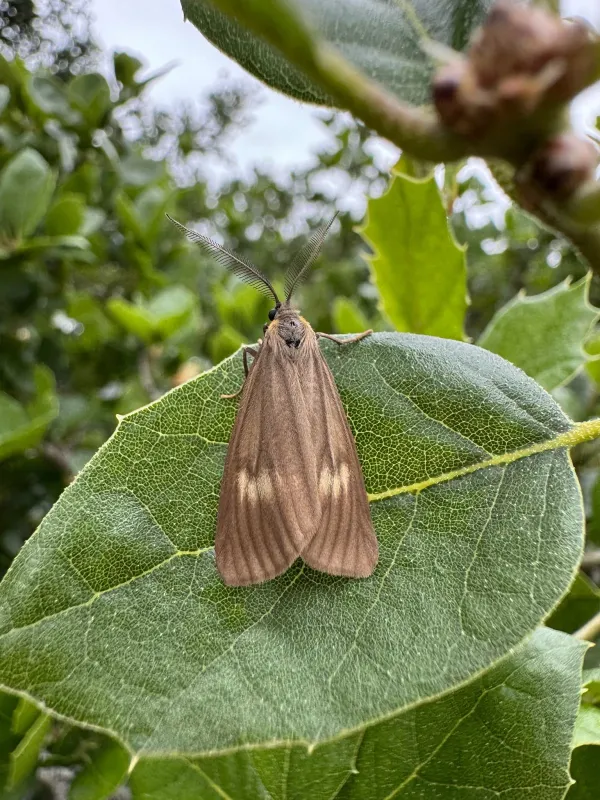
The California oakworm (Phryganidia californica) is a moth belonging to the family Dioptidae. It is native to the coastal regions of California and is famously known for its periodic, massive population outbreaks.
Adult moths have a wingspan of about 3.5 to 4 centimeters. Their wings are typically yellowish-brown with a distinct pattern of darker, thin veins running across them.
The larvae, or caterpillars, are easily recognizable by their vibrant coloration: they possess longitudinal stripes of yellow, white, and black along their bodies, complemented by a bright orange head.
Pupae of the California oakworm are unique, often found attached to the underside of leaves or twigs by fine silk, and they are usually yellowish or pale in color.
Unlike many other defoliators, this species is specialized and primarily targets oaks, making it a well-known pest in both urban landscapes and natural oak woodlands.
What it damages
The primary host plants for the California oakworm are various species of oak trees, including the Coast Live Oak (Quercus agrifolia) and other evergreen or deciduous oaks.
The caterpillars are foliage feeders that can cause severe defoliation, sometimes stripping an entire oak tree of its leaves during the peak of their feeding stage.
Young larvae initially graze on the leaf surface, creating a skeletonized appearance. As they mature, they consume the entire leaf blade, leaving only the tougher veins behind.
Significant defoliation reduces the tree's ability to photosynthesize, which stresses the plant and makes it more susceptible to secondary diseases or wood-boring insects.
In cases of consecutive years of heavy infestation, weakened trees may experience branch dieback or, in extreme instances, total tree mortality.
When it appears
The lifecycle of the California oakworm typically involves two generations per year, though temperature fluctuations can sometimes alter the timing of their emergence.
The species overwinters as young larvae. They remain active and continue to feed slowly throughout the milder winter months in coastal California.
Spring is the time when these overwintered larvae grow rapidly, eventually pupating and emerging as adult moths in the late spring or early summer months.
The summer generation of moths lays eggs on the leaves, leading to a second wave of caterpillars that feed throughout the late summer and early autumn.
Outbreaks of this pest are cyclic, often occurring in intervals of several years, followed by periods where natural predators significantly reduce their numbers.
Signs of infestation
One of the most noticeable signs of an infestation is the presence of dark, granular frass (excrement) raining down from the canopy onto sidewalks or driveways beneath the tree.
Early damage appears as thin, translucent patches on the leaves, where the soft tissue has been eaten away by the young, newly hatched caterpillars.
The presence of large groups of striped caterpillars in the canopy is an unmistakable sign of an active infestation that requires monitoring.
Infected trees often take on a brown or ragged appearance in the middle of summer as the leaves are consumed and eventually dry out or drop prematurely.
The discovery of silken pupal cases dangling from the foliage is a key indicator that the larvae have completed their feeding phase for the current generation.
Control measures
Biological control is the most recommended approach, specifically using Bacillus thuringiensis (Bt), which targets the caterpillars while sparing beneficial insects.
Encouraging natural predators such as parasitic wasps, tachinid flies, and birds is vital for maintaining long-term balance and preventing severe outbreaks.
In small, managed landscapes, manual removal of caterpillar clusters or egg masses can be effective if caught early in the development cycle.
Systemic insecticides should be used sparingly and only as a last resort, as they may have negative impacts on the broader ecosystem, including pollinators and natural enemies.
Proper tree care, including deep watering and soil maintenance, helps improve tree vigor, allowing oaks to better recover from the stress caused by defoliation.
Taxonomy
- Latin name
- Phryganidia
- Order
- Lepidoptera (butterflies)
- Family
- Notodontidae
- EPPO code
- PHRYSP
Discussion
No discussions yet — be the first.