
Satellite sphinx moth
Pholus satellitia
Description
How to identify
The Satellite sphinx moth (scientific name Eumorpha satellitia) belongs to the order Lepidoptera and the family Sphingidae. These moths are known for their large size, robust bodies, and strong flying capabilities.
Adult moths typically have a wingspan ranging from 90 to 110 mm. Their wing patterns are highly adaptive, often mimicking the texture and color of tree bark to provide camouflage against predators during the day.
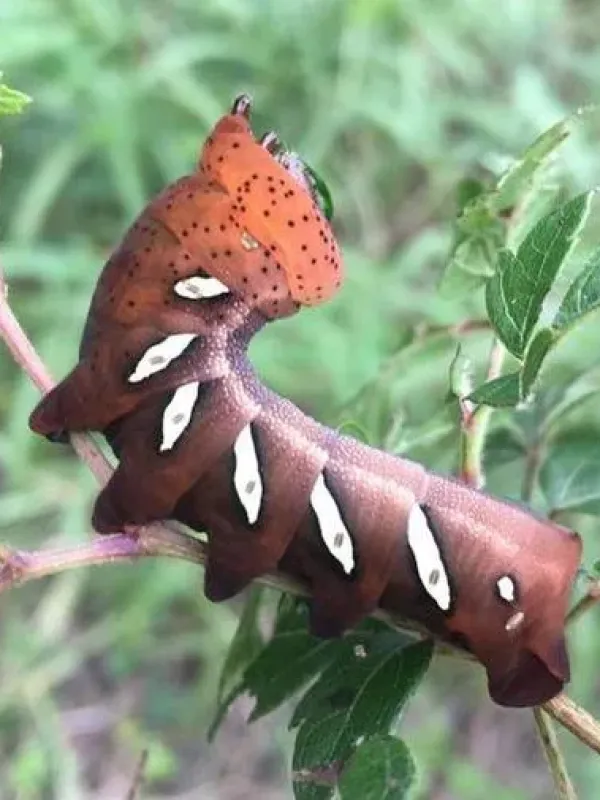
The larvae, known as caterpillars, are large and striking. In their later instars, they often exhibit eye-like spots on their posterior segments, which serve as a defensive mechanism to deter birds and other predators.
Their life cycle consists of complete metamorphosis: egg, larva, pupa, and adult. The pupal stage occurs in the soil, where the insects spend the winter in a state of diapause protected by the earth.
As nocturnal insects, they are most active during dusk and dawn. They possess the unique ability to hover over flowers while feeding on nectar, a behavior that makes them resemble small birds.
What it damages
The primary damage is caused by the caterpillars, which possess a ravenous appetite. They can rapidly strip a plant of its foliage, leading to significant loss of photosynthetic surface area.
They commonly target plants within the Vitaceae family (grapes) and various woody shrubs and trees. This feeding behavior can severely stress the host plant if the infestation is heavy.
Defoliation negatively impacts the plant's ability to store energy for the next growing season, which may lead to reduced vigor, poorer winter hardiness, and lower fruit yields.
In commercial vineyards, caterpillar feeding can lead to skeletonized leaves and damaged shoots, which interferes with the proper ripening of the grapes and overall vine health.
While mature plants can often withstand minor defoliation, young plants or seedlings can be severely stunted or even killed if the pest population remains unchecked during the peak feeding phase.
When it appears
The first generation of adult moths typically emerges in late spring or early summer, depending on the local climate and nighttime temperature conditions.
Caterpillars are generally present on host plants during the mid-to-late summer months, with peak feeding activity usually observed during July and August.
Pupation occurs in late summer or early autumn. The larvae burrow into the soil, where they transition into the pupal stage to overwinter until the following spring.
The number of generations per year varies by region; warmer climates may support two complete cycles, while cooler northern regions typically experience only one generation per year.
Environmental factors such as rainfall and soil temperature are critical, as they dictate the survival rate of the overwintering pupae and the timing of adult emergence.
Signs of infestation
One of the earliest signs of infestation is the rapid disappearance of foliage on specific branches, often leaving only the leaf veins behind in a skeleton-like state.
Large quantities of dark, cylindrical caterpillar droppings (frass) appearing on the ground beneath the plant canopy are a clear indication that large larvae are feeding above.
Direct visual inspection of the plant during the cooler hours of the evening often reveals the caterpillars, as they tend to feed actively and move about when the temperature drops.
Notches or irregular, jagged edges on leaves are common symptoms of early-stage feeding, which can progress to total defoliation as the caterpillars increase in size.
Stunted growth, yellowing foliage, and premature leaf drop are secondary signs that the plant is struggling to cope with the stress caused by the feeding larvae.
Control measures
Cultural control includes autumn soil cultivation, such as tilling or hoeing around the base of host plants, which helps to destroy the overwintering pupae hidden in the soil.
For small home gardens, manual collection of caterpillars in the morning or evening is an effective and environmentally friendly method for managing low population levels.
Biological control using Bacillus thuringiensis sprays is highly recommended, as it selectively targets the larvae without harming beneficial insects or the surrounding ecosystem.
Pheromone traps can be deployed to monitor adult moth activity. This data helps gardeners and farmers determine the optimal timing for interventions to prevent mass egg-laying.
Chemical insecticides should be used as a last resort, strictly following label instructions regarding application rates and pre-harvest intervals to ensure safety for consumers.
Taxonomy
- Latin name
- Pholus satellitia
- Order
- Lepidoptera (butterflies)
- Family
- Sphingidae
- EPPO code
- POLUSD
Discussion
No discussions yet — be the first.