
Shining rove beetle
Philonthus politus
Description
How to identify
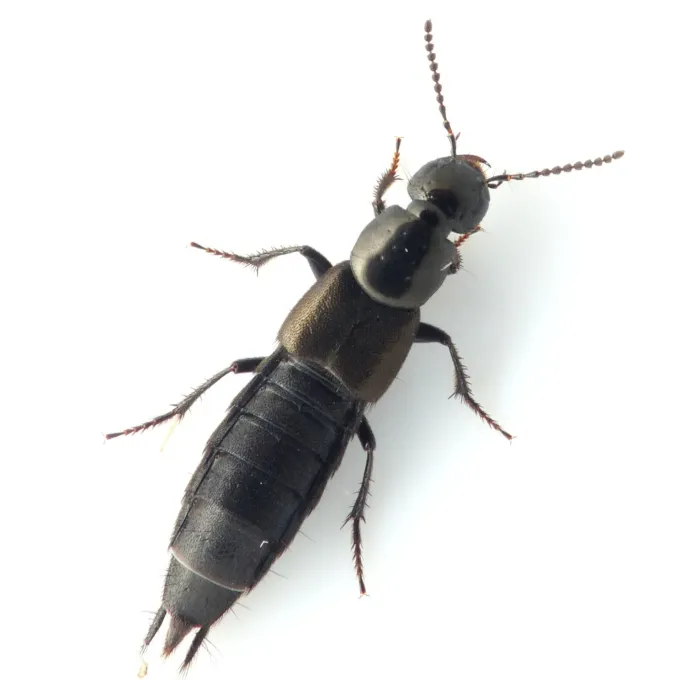
The shining rove beetle (Philonthus politus) belongs to the Staphylinidae family of the Coleoptera order. Adult beetles have an elongated body, typically measuring 10–14 mm, with a shiny black finish and a metallic reflection.
A key characteristic of this species is its shortened elytra, which leave most of the abdomen exposed. Despite this, the beetles possess well-developed hind wings and are capable of active flight to locate suitable habitats.
The larvae are campodeiform, featuring long legs and a mobile, slender body, which allows them to navigate efficiently through soil, leaf litter, and organic matter.
The head is equipped with powerful mandibles. While these are primarily used for predatory behavior against other small soil organisms, the beetles may also feed on decaying plant tissue.
The life cycle involves complete metamorphosis (egg, larva, pupa, adult). The species typically overwinters as an adult in soil cracks, under plant debris, or within manure piles.
What it damages
Although largely considered beneficial predators, Philonthus politus can become an agricultural nuisance when their natural food sources are scarce or when their population density is exceptionally high.
They are known to feed on the root systems of young vegetable seedlings, such as carrots, radishes, and lettuce, particularly in damp or over-fertilized environments.
Damage occurs when larvae or adults consume tender roots or root collars, causing the plant to wither and significantly reducing its vigor.
In addition to direct mechanical injury, the feeding sites often serve as entry points for fungal pathogens, leading to root rot and damping-off diseases.
- Lesions on the seedling root collar.
- Consumption of developing seeds in moist soil.
- Damage to the surface of growing root vegetables.
When it appears
The activity of the shining rove beetle begins in early spring, as soon as soil temperatures reach 5–8 degrees Celsius, when adults emerge from overwintering sites.
Peak populations are observed during May and June, which corresponds to the period of seedling emergence and active growth for many agricultural crops.
During the hot and dry summer months, adult activity decreases significantly as they migrate to cooler, deeper soil layers or areas with higher soil moisture.
While the first generation is the most prominent, a second generation may occur in late summer if climatic conditions remain favorable and soil moisture is high.
By autumn, the beetles gradually enter diapause, retreating into the soil to prepare for the cold winter months.
Signs of infestation
Visible signs of infestation often appear as sudden wilting of young plants, especially in patches within a field or greenhouse where organic matter is concentrated.
Close inspection of the root zone will reveal small, irregular feeding marks on the stems or roots, which may show signs of secondary rotting.
The presence of fast-moving, dark-colored beetles in the soil or under plant cover is a strong indicator of their activity near the crops.
Inconsistent seed germination and missing plants in nursery rows often point to larvae feeding on the seeds or the primary roots of emerging seedlings.
Accumulations of plant debris on moist soils often show higher concentrations of these beetles, indicating potential risk for adjacent young plantings.
Control measures
Effective control starts with proper field preparation, including deep plowing to disturb overwintering sites and reduce the pest population density.
Avoid using raw or uncomposted manure, as it serves as a primary attractant for adults seeking nesting sites for their larvae.
Managing soil moisture is critical; avoiding over-irrigation in seedling beds discourages the colonization of these beetles in the root zone of vulnerable plants.
Implementing crop rotation is a standard practice that helps prevent the buildup of soil pests and breaks the life cycle of the staphylinids.
If chemical intervention becomes necessary, use appropriate soil-applied insecticides approved for the specific crop, strictly following label instructions.
Taxonomy
- Latin name
- Philonthus politus
- Order
- Coleoptera (beetles)
- Family
- Staphylinidae
- EPPO code
- PHINPO
Discussion
No discussions yet — be the first.