
Philonthus rove beetle
Philonthus
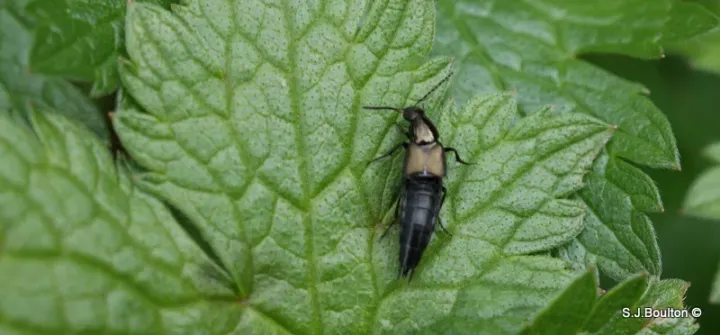
Description
How to identify
The genus Philonthus belongs to the family Staphylinidae, commonly known as rove beetles. They are characterized by their elongated bodies and shortened elytra that leave much of the abdomen exposed.
Adult beetles are typically dark-colored, ranging from brown to black, often exhibiting a slight metallic luster. They are known for their rapid, nervous movements and their ability to raise their abdomen like a scorpion when disturbed.
Larvae are campodeiform and highly mobile, featuring well-developed mandibles. They primarily reside in the soil or decaying organic matter, where they perform their developmental stages.
Distinguishing specific species within the Philonthus genus is notoriously difficult and usually requires expert examination of the male genitalia under a microscope.
Their presence in an agroecosystem is often linked to high organic content in the soil, which serves as both a breeding ground and a habitat for their prey.
What it damages
While most Philonthus species act as beneficial predators, some can turn into pests in agricultural settings, particularly when their natural prey is scarce.
The primary damage involves the gnawing of stems, roots, or seedlings of young vegetable crops, which can result in significant stunted growth or plant death.
Vegetable starts, such as tomatoes and peppers, are particularly susceptible during their initial establishment phase if the beetle population is high.
Mechanical injuries caused by the beetles' feeding can provide entry points for soil-borne pathogens, leading to fungal or bacterial decay of the stem base.
It is crucial to balance the concern for crop damage with their role as natural enemies that regulate other pest populations, such as dipteran larvae or small soil insects.
When it appears
The life cycle of the Philonthus genus is heavily influenced by soil temperature and moisture levels throughout the growing season.
Adults emerge from overwintering sites in the soil as soon as the ground begins to thaw and temperatures rise in early spring.
Peak activity periods usually occur in late spring and early summer, corresponding with mating cycles and the subsequent deposition of eggs into the soil.
During the peak of summer, if the soil becomes excessively dry, these beetles tend to retreat deeper into the soil profile to maintain hydration.
As autumn temperatures drop, adults enter a state of diapause, finding refuge under crop residues, mulch, or within cracks in the earth to survive the winter.
Signs of infestation
Early signs of infestation include tiny holes or superficial scars at the base of stems near the soil line, often observable during early morning inspections.
Plants may exhibit symptoms of wilting or loss of vigor without any immediate sign of foliar disease, suggesting damage at the root or stem collar level.
The presence of small, excavated channels in the soil directly around the seedling stems is a strong indicator of beetle activity.
Adult beetles are frequently found near the base of affected plants, rapidly retreating into the soil or under organic debris when approached.
Using pitfall traps buried flush with the soil surface is the most effective way to detect the presence and relative abundance of these beetles in a field.
Control measures
Integrated management is essential, focusing primarily on cultural practices such as removing crop debris to eliminate favorable habitats for the beetles.
Crop rotation helps minimize the concentration of soil-dwelling pests and breaks the reproductive cycle of the Philonthus population.
Applying biological control agents, such as entomopathogenic nematodes or fungi, can effectively reduce beetle numbers without harming beneficial non-target insects.
Chemical intervention should be considered a last resort and should only be applied based on documented threshold levels to prevent unnecessary ecological disruption.
- Improve soil drainage to reduce attractiveness to moisture-loving beetles.
- Maintain weed-free conditions to limit alternative food sources for larvae.
- Use protective collars for high-value seedling transplants.
Taxonomy
- Latin name
- Philonthus
- Order
- Coleoptera (beetles)
- Family
- Staphylinidae
- EPPO code
- PHINSP
Discussion
No discussions yet — be the first.