
Philanthus gibbosus
Philanthus gibbosus
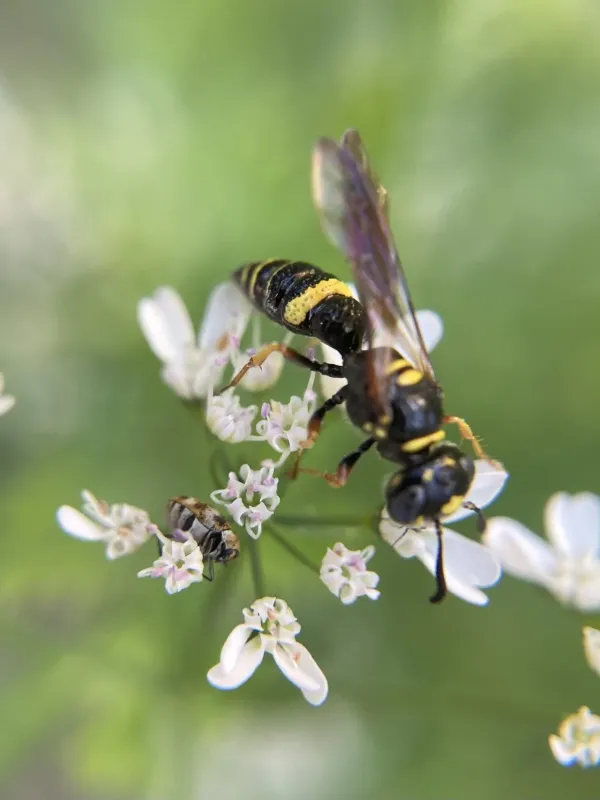
Description
How to identify
Philanthus gibbosus belongs to the family Crabronidae, order Hymenoptera. This small insect is characterized by a hump-backed thoracic structure and contrasting coloration, which aids in camouflage within its natural habitat.
Adults possess developed mouthparts adapted for feeding on floral nectar. Their bodies are covered in fine hairs, and the abdomen features a typical yellow-and-black striped pattern, making them visually similar to other digger wasps.
The life cycle involves complete metamorphosis: egg, larva, pupa, and imago. Unlike many other wasps, this species exhibits complex behavioral adaptations related to nesting in the soil.
Special attention should be paid to the head structure, where powerful mandibles are located. Females use these organs not only for nest construction but also for transporting prey to feed their future offspring.
While the species is a natural part of the entomofauna, its presence in agroecosystems can be undesirable due to the disruption of natural biological balances within the plot.
What it damages
Although adults act as pollinators, their predatory activity can cause indirect harm by killing beneficial insects. The primary agricultural damage occurs during the larval stage, which requires specific incubation conditions.
The insect prefers areas with loose sandy or loamy soils, making it easy to construct vertical burrows. This leads to mechanical disturbance of the root systems of young crops during mass nesting.
Damage manifests as injury to the rhizosphere, creating entry points for secondary infections, fungal diseases, and rots that penetrate the soil's micro-fissures.
Vegetable crops and ornamental plants grown in beds with light-textured soil are particularly susceptible to the activities of this pest.
The mass appearance of nests on agricultural land complicates field operations and can lead to localized stunted growth in seedlings due to root micro-trauma.
When it appears
The activity of Philanthus gibbosus peaks during the summer season when air and soil temperatures are consistently high. The first emergence of overwintered females occurs in late May or early June.
The most intensive phase of burrow construction and prey collection takes place in July and August, during which the highest concentration of individuals is observed in open areas.
Activity gradually declines by the end of August as larvae complete their development and transition to the pupal stage, preparing for overwintering within the soil.
The insect's daily rhythm is directly dependent on solar radiation; they are most active during hot midday hours when the soil is sufficiently warmed for rapid excavation.
Autumn frosts terminate the surface activity of adults, but the dormant stages successfully overwinter at depths of 15–20 centimeters within the maternal burrows.
Signs of infestation
The first visual indicator of this pest's presence is the characteristic pile of fine soil near the burrow entrance. These "spoil heaps" are funnel-shaped and measure up to 2–3 centimeters in diameter.
Upon inspecting the plot, one can observe the erratic movement of insects swiftly traveling over the soil surface, constantly returning to their nesting holes.
Stunted plant growth in specific patches of the garden, accompanied by yellowing of lower leaves, often indicates that the root system has been damaged during burrowing.
Finding fragments of other insect exoskeletons near burrow entrances confirms the predatory activity typical of this species during the larval rearing period.
The presence of numerous nests per square meter is a primary signal for the need to monitor the area and implement preventive soil stabilization measures.
Control measures
The most effective control method is regular soil cultivation during the intensive nesting period, which destroys nest structures and disrupts larval development.
Compacting the soil surface through irrigation and subsequent rolling makes the plot less attractive to wasps that prefer dry, loose ground.
Mulching beds with a thick layer of organic matter (straw, wood chips, bark) creates a physical barrier that prevents insects from moving and locating suitable nesting sites.
The use of environmentally friendly repellents, such as wormwood or garlic infusions, can temporarily deter adults, forcing them to abandon the chosen territory.
In cases of heavy infestation, the use of biological agents based on entomopathogenic fungi is recommended to inhibit larval development within the soil layer.
Taxonomy
- Latin name
- Philanthus gibbosus
- Order
- Hymenoptera
- Family
- Crabronidae
- EPPO code
- PHIHGI
Discussion
No discussions yet — be the first.