
Bee wolf
Philanthus
Description
How to identify
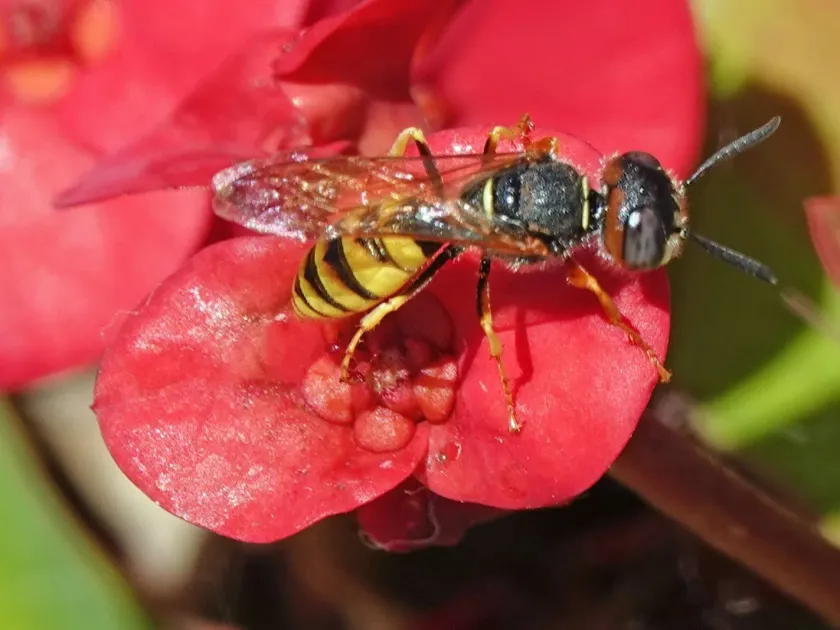
The bee wolf (Philanthus triangulum) is a solitary digger wasp belonging to the Crabronidae family. These wasps typically measure 15–17 mm in length and are easily identified by their bright yellow abdomen with black stripes and massive head.
They are robust insects that resemble common wasps but possess stronger mandibles, which they use to capture and carry their prey. The males are smaller and lack a stinger, while the females are highly specialized hunters.
Bee wolves favor habitats with sandy, well-drained soil that remains warm under sunlight. They construct complex underground burrows, where they create separate brood cells for their larvae.
Activity is highly dependent on temperature; these wasps are most active on sunny, warm days. During cold or rainy weather, they remain dormant within their underground shelters.
One can identify a bee wolf colony by the presence of numerous small tunnels in the soil, often surrounded by small piles of excavated sand, indicating active brood rearing.
What it damages
Philanthus triangulum acts as a specialized predator of honey bees. Female wasps intercept foraging bees in flight or on flowers, paralyze them with venom, and transport them to their underground nests.
Each brood cell can contain several paralyzed bees, which serve as a fresh food source for the developing wasp larvae. This predatory behavior leads to the direct depletion of the forager population in a hive.
The impact on beekeeping is significant, as the loss of foraging bees directly reduces the amount of nectar collected, hindering honey production and weakening the colony before winter.
Bee wolves essentially terminate the life cycle of the bees they hunt, which also negatively affects the pollination services the bees would have otherwise provided to the local flora.
In cases of heavy infestation, where hundreds of females operate within a small area, the cumulative loss of bees can be devastating for commercial and amateur apiaries located in close proximity to the colony.
When it appears
Adult bee wolves begin to emerge in early June when soil temperatures are high enough to support nesting activity. The peak activity occurs throughout July and August, coinciding with the prime nectar flow season.
During these months, the females are constantly hunting to provide provisions for their larvae. The nesting and hunting season typically concludes by the end of August or early September as temperatures begin to drop.
Overwintering occurs in the form of a pre-pupa protected inside a cocoon within the underground cells. This allows the species to survive harsh winter conditions and emerge as adults in the following spring.
Activity levels can fluctuate with the weather; however, once clear, warm conditions return, the wasps resume their hunting almost immediately, making continuous vigilance necessary.
The total lifespan of an adult is relatively short, but the overlapping emergence of different individuals keeps the pressure on local bee populations throughout the entire summer.
Control measures
The most effective management method involves mechanical disruption of the nesting sites. Deep tilling of the sandy soil during the nesting season can destroy the underground chambers and kill the wasp larvae.
Localized application of registered insecticides directly into the tunnel entrances can also be effective, although this requires careful and thorough targeting of every nest in the colony.
Beekeepers are advised to place their apiaries away from sandy slopes or bare, warm soil patches, which serve as prime nesting grounds for these predatory wasps.
Trapping adults using specific wasp baits or light traps can help reduce the local population of hunting females, thereby mitigating the risk to the hive's foraging force.
- Deep tillage of infested sandy areas.
- Targeted insecticide use in tunnel entrances.
- Apiary placement away from sandy terrain.
- Installation of effective wasp traps.
Taxonomy
- Latin name
- Philanthus
- Order
- Hymenoptera
- Family
- Crabronidae
- EPPO code
- PHIHSP
Discussion
No discussions yet — be the first.