
Bold jumper
Phidippus audax
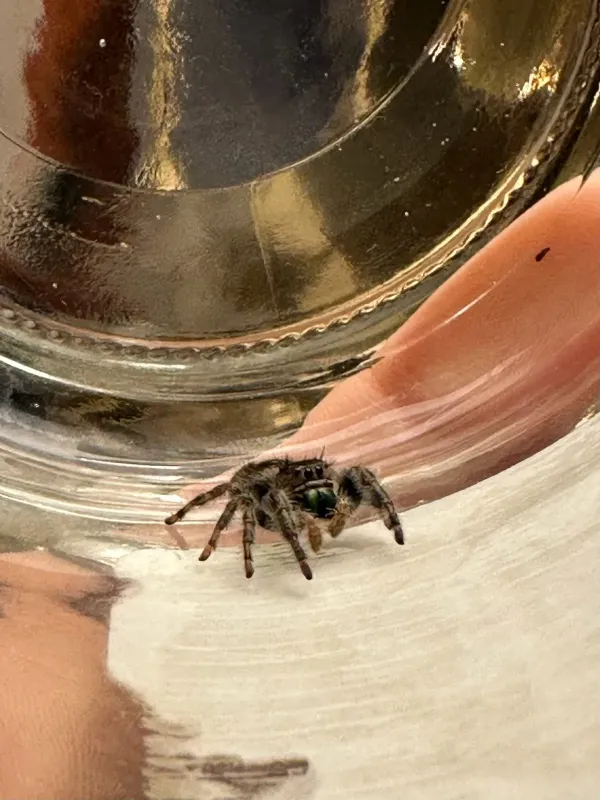
Description
How to identify
The bold jumper (Phidippus audax) is a member of the Salticidae family, known for its distinct jumping behavior. It features a dark body covered with hair and recognizable white spots on its abdomen.
This spider is famous for its exceptional vision, using its eight eyes to locate and stalk prey. It does not spin webs to catch insects but relies on stealth and quick movement.
Adult spiders are typically between 13 and 20 mm in size and possess vibrant, metallic-green or blue-green chelicerae, which make them easy to identify in the field.
They are highly active hunters that roam across leaves, stems, and surfaces, searching for small arthropods. Their movement is characterized by short, agile leaps.
Commonly found in sunny environments, they frequent agricultural fields, gardens, and urban landscapes, playing an active role as predatory arthropods within these habitats.
What it damages
Despite being occasionally mislabeled, Phidippus audax is not a plant pest. It is a strictly carnivorous predator that feeds on various insects and smaller arachnids.
It provides significant value to agriculture by consuming pests such as aphids, small caterpillars, thrips, and various flies that can compromise crop health and yields.
The bold jumper does not feed on plant tissue, sap, or roots. It poses no threat to the vitality of plants and does not transmit any bacterial or viral plant diseases.
In fact, their presence is often viewed as a biological indicator of a healthy ecosystem where natural pest suppression is taking place without excessive human intervention.
Treating these spiders as pests is a misconception; they are classified as beneficial entomophagous species that serve as natural allies to farmers and gardeners alike.
When it appears
The lifecycle begins in the spring when adults emerge from hibernation to feed and mate. This is when they start actively patrolling fields and garden beds for food.
During the summer months, the population is at its highest. Young spiders are particularly active at this time, playing an essential role in controlling pest outbreaks.
As autumn temperatures begin to drop, spiders search for suitable overwintering sites, such as hollow plant stems, bark crevices, or protected garden debris.
They remain dormant throughout the winter inside protective silk cocoons, which help them survive extreme conditions until the following growing season.
The complete generation cycle spans approximately one year. By maintaining a stable habitat, growers can ensure these predators are present to assist each new season.
Signs of infestation
The most common sign of a bold jumper is its unique movement pattern. They are frequently spotted pausing on a leaf, lifting their heads to scan the area before leaping.
There are no visible signs of damage left behind, such as chewed leaves or webs, as the spider does not rely on plants for sustenance or construction of traps.
Small, dense white silk retreats may be found in sheltered areas or bark crevices. These are used by the spiders for molting, resting, or nesting during reproduction.
Their activity does not impact the aesthetic or commercial quality of crops, as they focus entirely on hunting moving prey rather than interacting with the plant structure.
The absence of pests combined with the presence of these spiders is a clear sign that the integrated pest management strategy on the property is working correctly.
Control measures
Control measures against the bold jumper are unnecessary and counterproductive. Because they are beneficial predators, their presence should be encouraged and protected.
Farmers are advised to limit the use of broad-spectrum insecticides, as these chemicals are highly toxic to spiders and can lead to secondary pest outbreaks.
Preserving natural habitats, such as field margins and hedgerows, provides the necessary environment for these spiders to maintain stable populations near crops.
Integrated Pest Management (IPM) programs emphasize the value of native predators like Phidippus audax as a cost-effective way to reduce reliance on chemicals.
While the bold jumper can bite if handled roughly, it is generally docile and poses no threat to human health, making it a safe inhabitant of the agricultural workspace.
Taxonomy
- Latin name
- Phidippus audax
- Family
- Salticidae
- EPPO code
- PHIDAU
Discussion
No discussions yet — be the first.