
Galathea jumping spider
Pelegrina galathea
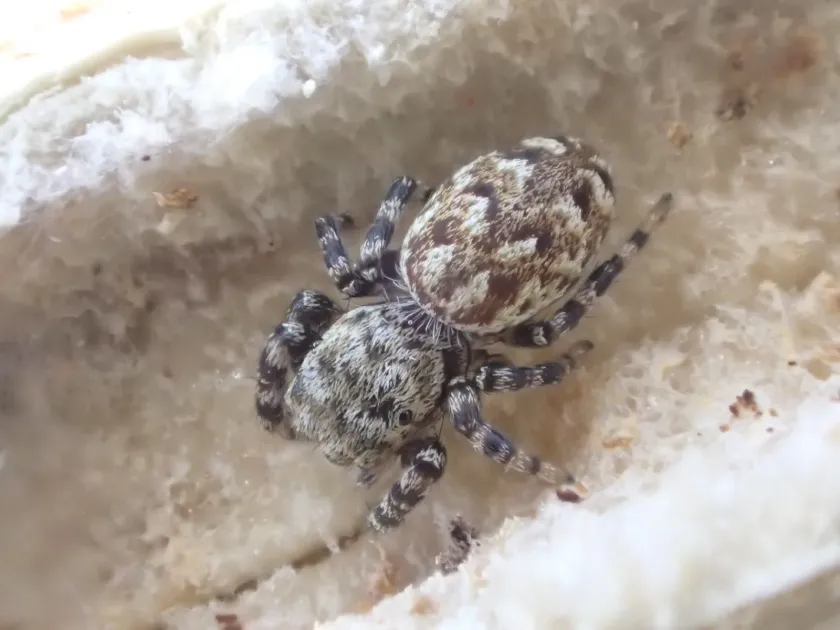
Description
How to identify
The Galathea jumping spider (lat. Pelegrina galathea) belongs to the Salticidae family, known for their unique hunting technique. Unlike web-building spiders, they rely on excellent vision and powerful jumps to capture prey.
The spider is easily recognizable by its distinct patterns and relatively small size. Identification is based on its characteristic jerky movement patterns and the arrangement of its eyes, which are typical for jumping spiders.
In agronomy, it is crucial to classify this species correctly. It is a predatory arthropod that occupies a niche in the field ecosystem as a consumer of smaller insects, which classifies it as a beneficial organism rather than a pest.
Biologically, Pelegrina galathea is well-adapted to agricultural landscapes. Its life cycle is synchronized with the availability of small insect prey, which often populate field crops during the growing season.
Morphologically, they do not possess mouthparts capable of damaging plant tissue. Their predatory nature is entirely focused on suppressing populations of other small invertebrates, making them valuable allies for farmers.
What it damages
The Galathea jumping spider does not damage agricultural crops. It does not feed on leaves, stems, roots, or fruit, and it does not create structures that could physically impair plant growth or development.
On the contrary, its presence in the field is a sign of a healthy ecosystem. By preying on aphids, mites, and various insect larvae, they perform biological pest control that helps maintain the balance of the agroecosystem.
There is no record of economic loss attributed to this species. Concerns about this spider as a potential pest are entirely unfounded and usually stem from a lack of information regarding the species' feeding habits.
Agro-ecologists consider Pelegrina galathea a neutral or beneficial organism. Their activity in the canopy of crops is limited to searching for prey, and they do not affect the physiological processes of the plants themselves.
Consequently, the economic significance of this spider is positive. It serves as a natural regulator of pest populations, contributing to the overall health and stability of the crop environment.
When it appears
The activity cycle of the Galathea jumping spider follows seasonal temperature patterns. They emerge in the spring as temperatures rise, signaling the beginning of the foraging season for most predatory invertebrates.
Peak activity occurs during the summer months when insect prey is most abundant. This period coincides with the most critical growth stages of many crops, during which the spiders provide constant natural protection.
As autumn approaches and temperatures drop, these spiders begin to seek sheltered locations for hibernation. They often utilize field debris, tree bark, or organic mulch to survive the winter in a state of diapause.
The survival rate of the population during winter depends on the presence of suitable overwintering sites. Minimizing extreme soil disturbance can help protect these beneficial populations from season to season.
Farmers should observe the seasonal dynamics to avoid unnecessary chemical treatments. Protecting the habitat during the spider's active and dormant phases ensures a consistent presence of biological controls.
Signs of infestation
There are no signs of infestation because the Galathea jumping spider is not an agricultural pest. You will not see necrosis, leaf deformation, or any other pathological symptoms on your crops caused by this species.
Visual identification is the only way to observe them. They can often be seen on the upper surfaces of leaves during sunny days, waiting for prey or moving quickly through the foliage to catch food.
It is important to distinguish between beneficial spiders and actual plant pests like spider mites. While mites cause visible yellowing and web formation on leaves, jumping spiders remain active hunters that do not leave such traces.
If you observe a jumping spider, you are witnessing an active participant in your field's biological control system. No remedial actions, alarms, or scouting for damage are required in relation to this species.
Maintaining awareness of the difference between predators and pests prevents accidental destruction of beneficial organisms. Use scouting reports to focus on legitimate pest threats while ignoring harmless predatory species.
Control measures
No control measures are needed for the Galathea jumping spider. As a beneficial predator, it should be protected and encouraged within the crop fields rather than suppressed or eradicated.
Integrated Pest Management (IPM) strategies emphasize the preservation of natural enemies. Farmers should minimize the use of broad-spectrum insecticides that are lethal to beneficial spiders and focus on targeted biological solutions.
Habitat management, such as maintaining non-crop vegetation around fields, helps support spider populations throughout the year. This ensures that a stable population of predators is available to manage pest outbreaks.
Chemical control programs should always be preceded by economic threshold evaluations for the pests themselves. If pest populations are below the threshold, natural predators like the Galathea jumping spider are sufficient.
Protecting Pelegrina galathea is a best practice in modern sustainable agriculture. By fostering an environment where these spiders can thrive, you reduce your reliance on synthetic chemicals for crop protection.
Taxonomy
- Latin name
- Pelegrina galathea
- Family
- Salticidae
- EPPO code
- METDGA
Discussion
No discussions yet — be the first.