
Evarcha jucunda
Evarcha jucunda
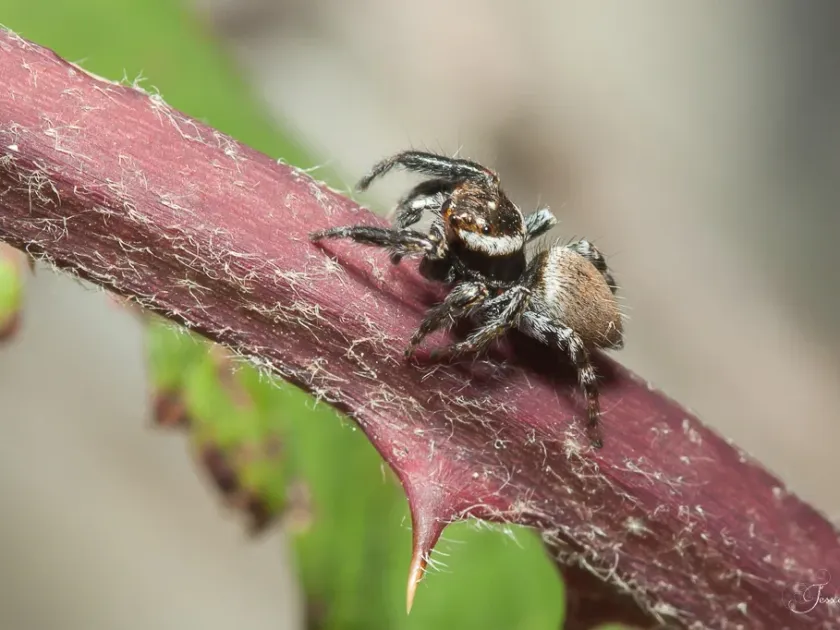
Description
How to identify
Evarcha jucunda is a species of jumping spider belonging to the Salticidae family. These spiders are renowned for their acute vision and unique ability to jump on prey rather than relying on silk webs for capture.
Morphologically, they exhibit sexual dimorphism. Males are often more colorful and display distinctive tufts of hair on their front legs, which are used during mating displays. Females are usually larger and blend into the environment with muted brown tones.
These spiders are characterized by their cephalothorax shape and eye arrangement, which allows them to track insects with precision. They move in short, quick bursts, frequently pausing to scan their surroundings.
They are primarily found in sun-drenched habitats, including grasslands, orchards, and gardens. Because they do not damage plant tissues, they are considered beneficial predators rather than pests.
Systematically, they are classified under the order Araneae. In agricultural settings, they are observed patrolling the leaves and stems of crops, actively hunting small dipterans and aphids.
When it appears
The activity cycle of Evarcha jucunda is strongly dependent on the temperature. They emerge from hibernation in late spring as soon as temperatures rise, typically remaining active until the autumn cooling.
They are diurnal hunters, meaning their activity peaks during the warmest, brightest parts of the day. This aligns with the activity of many agricultural insect pests they consume.
The life cycle involves an overwintering stage. During the cold months, individuals seek refuge in bark crevices, hollow stems, or leaf litter to survive until the following growing season.
Reproductive activities occur during the mid-summer months. Males engage in complex courtship rituals to attract females, after which the females lay their eggs in small, protected silken chambers.
As autumn progresses, the population density declines. The surviving individuals enter diapause, a physiological state that allows them to withstand low winter temperatures safely.
Control measures
It is important to emphasize that Evarcha jucunda is not a plant-damaging pest. In most agricultural and horticultural scenarios, these spiders act as biological control agents, reducing the population of harmful insect pests.
Over-reliance on broad-spectrum pesticides often leads to the decline of these beneficial spiders, which may cause secondary outbreaks of aphids or mites that the spiders were originally keeping in check.
If management is required to reduce their population, cultural practices are most effective. Clearing debris, managing weed growth, and pruning affected plant parts during the winter help eliminate their overwintering sites.
Integrated Pest Management (IPM) strategies encourage the conservation of such predatory species. By minimizing chemical inputs, growers can maintain a balanced population of spiders that support crop health.
Mechanical exclusion is only advised in strictly controlled environments like greenhouses where specific health standards are required. Otherwise, allowing these spiders to inhabit the ecosystem is highly recommended for natural pest suppression.
Taxonomy
- Latin name
- Evarcha jucunda
- Family
- Salticidae
- EPPO code
- EVARJU
Discussion
No discussions yet — be the first.