
Pelegrina
Pelegrina
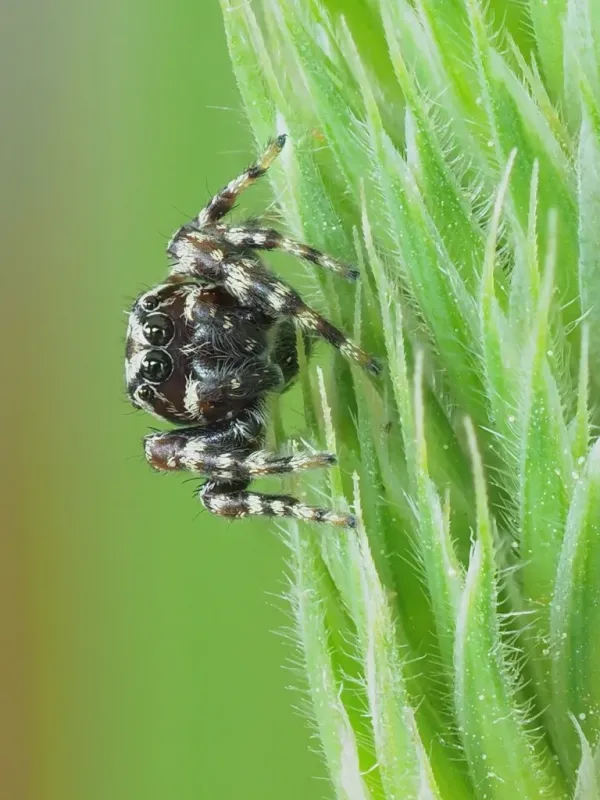
Description
How to identify
The genus Pelegrina belongs to the Salticidae family, commonly known as jumping spiders. These small predatory arachnids do not construct webs to trap prey but instead actively hunt using their exceptional visual acuity.
Adult specimens typically possess a compact body with a well-developed cephalothorax. Their coloration ranges from brown to gray with intricate white or dark markings, providing effective camouflage on tree bark and leaves.
A distinctive feature is the arrangement of four pairs of eyes in three rows. The front median eyes are particularly large, enabling them to calculate precise distances before launching a jump at their prey.
Males and females often exhibit sexual dimorphism, with differences in pedipalp structure and color intensity, which aids in mate selection during the breeding season.
While most species act as beneficial entomophages, high concentrations in specific agro-ecosystems may occasionally interfere with natural pest control programs.
What it damages
Pelegrina does not cause direct damage to cultivated plants by feeding on plant tissues. As obligate predators, they feed primarily on small insects residing in the tree canopy and on shrubs.
However, an overly dense population of jumping spiders in orchards may disrupt the biological balance by preying on beneficial pollinators or natural enemies of major agricultural pests.
In greenhouse operations, their presence may become problematic if they prey on beneficial insects introduced specifically to control aphids or spider mites.
Indiscriminate use of broad-spectrum insecticides often leads to the destruction of these helpful predators, subsequently triggering outbreaks of primary pests.
In general, Pelegrina is classified as a commensal or beneficial species in agronomy that requires consideration when implementing integrated pest management programs.
When it appears
The life cycle of Pelegrina is highly dependent on ambient temperature. Activity generally begins in early spring as soon as average daily temperatures consistently exceed 10 degrees Celsius.
Peak activity is observed during the flowering period of fruit crops, coinciding with the highest abundance of prey items — small insects active in the canopy.
Females deposit their eggs in small silk cocoons placed in protected microhabitats, such as under loose tree bark, inside wood crevices, or within rolled leaves.
Overwintering occurs in sheltered areas, with adult specimens and nymphs frequently seeking refuge in leaf litter or deep bark fissures of old trees.
The number of annual generations varies by climate zone, typically resulting in one or two generations per year in temperate regions.
Signs of infestation
The primary sign of Pelegrina presence is the observation of characteristic jumping spiders moving along foliage and branches during sunny daylight hours.
Unlike spider mites, they do not produce dense webs, although they may construct small silken retreats for molting or egg-laying purposes.
During visual inspection, one might notice quick, jerky movements across the leaf surface whenever a person or another organism approaches them.
The presence of empty egg cocoons under the bark of older trees can serve as an indicator of local population breeding sites within the orchard.
Sometimes, their presence is indirectly confirmed by a reduction in small insect populations in specific zones of the canopy where a spider has established its hunting territory.
Control measures
Specific control measures aimed solely at eliminating Pelegrina are rarely implemented in agronomy, as they are generally considered beneficial rather than harmful.
The primary management strategy involves maintaining ecological equilibrium and avoiding the excessive use of toxic synthetic pesticides.
In commercial orchards, it is recommended to use selective insecticides that target specific pests while sparing the predatory entomofauna.
- Removing old, loose bark from tree trunks to eliminate overwintering sites.
- Utilizing pheromone traps for precise monitoring of primary pests.
- Planting nectar-bearing border rows to attract and support beneficial insect populations.
The application of biological crop protection products, such as entomopathogenic fungi, is preferred, as these agents generally have a lower impact on predatory arachnids.
Taxonomy
- Latin name
- Pelegrina
- Family
- Salticidae
- EPPO code
- PLGRSP
Discussion
No discussions yet — be the first.