
Lesser Swallow Prominent
Pheosia tremula
Description
How to identify
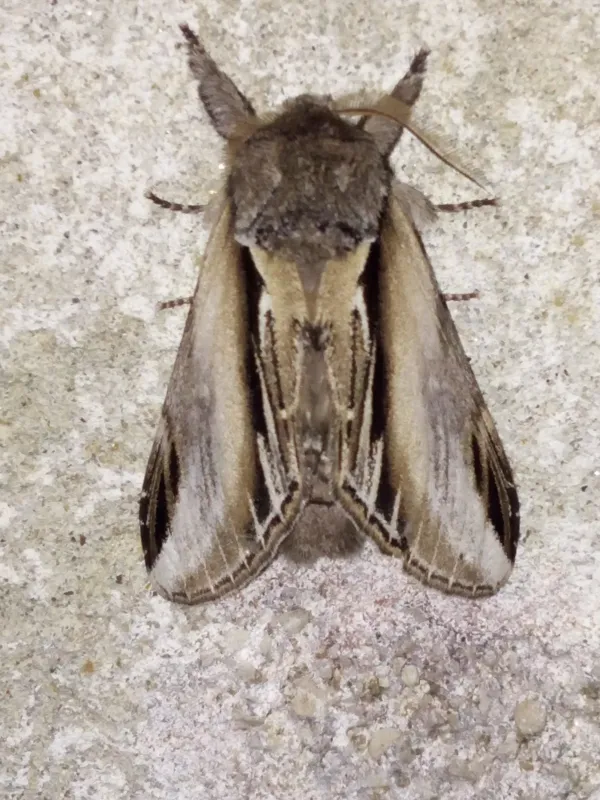
The Lesser Swallow Prominent (Pheosia tremula) is a moth belonging to the family Notodontidae and the order Lepidoptera. With a wingspan of 45–55 mm, it is characterized by its grayish-brown forewings featuring dark streaks and a distinct white patch near the trailing edge, which helps in its identification.
The larva (caterpillar) of this species can grow up to 60 mm in length. It is typically green with light lateral stripes, though brown color variants are not uncommon. A key diagnostic feature is the prominent conical tubercle on the final abdominal segment, which gives the species its distinctive appearance.
Adult moths are nocturnal and remain camouflaged during the day by resting on tree trunks and branches. Their appearance in the resting position closely mimics broken twigs or bark fragments, making them difficult to detect for birds and human observers alike.
Pupation occurs underground within a robust cocoon covered in soil particles. This biological adaptation ensures the moth's survival through environmental fluctuations and provides shelter against adverse winter weather conditions.
The species is widespread in forests and woodlands where its host plants, primarily from the willow family, are abundant. Its population dynamics are heavily influenced by environmental temperatures and the presence of natural predators.
What it damages
The primary hosts for the Lesser Swallow Prominent caterpillars are members of the Salicaceae family, specifically poplars (including aspen) and willows. These trees serve as the main food source for the larvae throughout their development.
The caterpillars are foliage feeders that consume leaves starting from the edges, often leaving only the midribs and petioles. In cases of severe infestations, they can cause complete defoliation of large branches or entire trees, which is highly detrimental.
Defoliation significantly reduces the tree's photosynthetic capacity. This loss of vitality makes the host tree susceptible to secondary pests and various fungal diseases that thrive on stressed, weakened woody tissue.
In nurseries and young plantations, larval feeding can be particularly devastating. Excessive loss of leaves causes the tree to struggle during the dormant season, potentially resulting in frost damage to terminal buds and reducing overall growth rates.
Repeated yearly attacks exhaust the tree's energy reserves, leading to stunted growth and potentially top-dieback. Maintaining healthy tree vigor is essential to mitigating the long-term impact of this pest in forest stands.
When it appears
The first generation of adults typically emerges in May, with active mating and egg-laying occurring throughout June. The larvae of this generation are highly active and feed during the early part of the summer.
A second generation of adults emerges in late summer, usually around August. Their offspring continue feeding until early autumn, at which point the final larval stage descends to the ground to pupate in the soil.
The period of peak damage coincides with the larval feeding stages in July and August. During these months, visible signs of infestation, such as bare branches, become most apparent to foresters and tree care professionals.
Developmental timing is heavily dependent on weather patterns. Warm and humid conditions generally accelerate the life cycle, leading to increased population density, while cooler seasons may delay the emergence of adults.
The pupal stage is the primary overwintering form, hidden securely in the soil or leaf litter. This dormancy allows the species to survive the harsh winter cold, readying the next generation for the following spring.
Control measures
Chemical control involving systemic or contact insecticides is a common approach in areas with heavy infestations. Applications should be timed to match the early larval stages to maximize efficacy and prevent significant foliage loss.
Biological control methods, such as utilizing Bacillus thuringiensis-based products, provide an environmentally friendly alternative for suppressing caterpillar populations. These treatments target the larvae specifically while sparing beneficial insects.
Silvicultural and cultural practices, such as removing leaf litter and lightly tilling the soil around tree bases in the fall, can help destroy overwintering pupae and reduce the pest population for the following year.
Encouraging natural predators, including insectivorous birds and predatory wasps, is a crucial part of long-term integrated pest management. Creating a balanced ecosystem helps naturally suppress the Lesser Swallow Prominent.
- Regular inspection of host tree foliage starting in June.
- Use of light traps to monitor and reduce adult population density.
- Strategic insecticide applications in nurseries where damage thresholds are exceeded.
Taxonomy
- Latin name
- Pheosia tremula
- Order
- Lepidoptera (butterflies)
- Family
- Notodontidae
- EPPO code
- PHEOTR
Discussion
No discussions yet — be the first.